كارثة عبّارة سيول
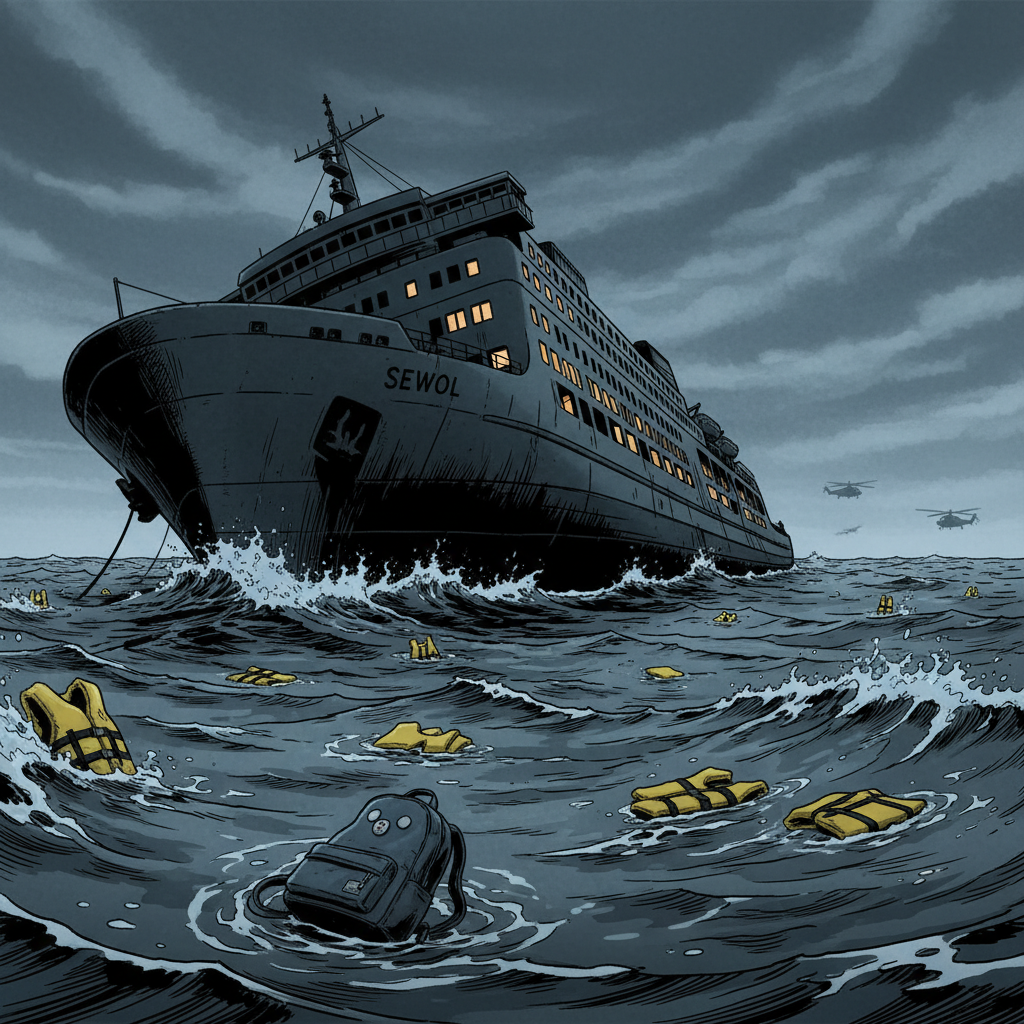
في 16 أبريل 2014، انقلبت وغرقت العبّارة الكورية الجنوبية إم في سيول أثناء رحلتها من إنتشون إلى جزيرة جيجو، مما أسفر عن مقتل 304 أشخاص من أصل 476 راكبًا. من بين القتلى 250 طالبًا من مدرسة دانون الثانوية في أنسان، تتراوح أعمارهم بين 16 و17 عامًا، في رحلة مدرسية. كشفت الكارثة عن إخفاقات منهجية في نظام السلامة البحرية في كوريا الجنوبية. وأصبح غياب الرئيسة بارك غون هيه لمدة سبع ساعات خلال الساعات الحرجة الأولى فضيحة سياسية كبرى ساهمت في عزلها عام 2017.
الملخص التنفيذي
تتقارب سبعة عدسات تحليلية نحو استنتاج مدمر واحد: لم تكن كارثة سيول حادثًا بل كانت النتيجة الحتمية لنظام اجتماعي أعطى الأولوية بشكل منهجي للسرعة والربح والطاعة الهرمية على سلامة الإنسان. تحدد جميع العدسات الفشل المنهجي وليس عدم الكفاءة الفردية كسبب جذري. تظهر أعمق رؤية من تقاطع التحليل الكونفوشيوسي والبافلوفي: الفضيلة التي يزرعها المجتمع الكوري أكثر في أطفاله — الطاعة للسلطة — أصبحت آلية موتهم عندما ثبت أن السلطة لا تستحق الثقة.
الحقائق الرئيسية
حقائق موثقة من بحث متعدد المصادر، مصنفة حسب مستوى الثقة
MV Sewol departed Incheon at approximately 9:00 PM on April 15, 2014, with 476 people: 443 passengers (325 Danwon High School students, 14 teachers) and 33 crew.
ثقة highDistress signal sent at 08:58 KST on April 16, 2014. The ship took approximately two and a half hours to sink.
ثقة highMV Sewol was originally the Japanese ferry Naminoue (built 1994). Chonghaejin Marine purchased it in 2012 and illegally modified it to add passenger cabins on upper decks, raising center of gravity.
ثقة highSewol carried 2,142.7 tons of cargo against a legal maximum of 987 tons, with only 761.2 tons of ballast water. Included 180 vehicles (recorded as 150) and 1,157+ tons of freight.
ثقة highCaptain Lee Joon-seok (age 69) and 14 crew evacuated while PA system told passengers to remain in cabins.
ثقة highOf 172 survivors, more than half were rescued by civilian fishing boats that arrived ~40 minutes before the Korea Coast Guard.
ثقة high304 people died, including ~250 Danwon High School students aged 16-17. About 82% of casualties were children.
ثقة highالفاعلون الرئيسيون
الفاعلون الرئيسيون المشاركون في هذا الحدث مع أفعالهم ومصالحهم المعلنة
القبطان لي جون سوك
individual- ›Failed to issue evacuation order
- ›Abandoned ship while passengers remained below
- ›Was among first crew rescued
شركة تشونغهيجين البحرية
corporation- ›Purchased and illegally modified MV Sewol
- ›Routinely overloaded beyond legal limits
- ›Falsified cargo manifests
الرئيسة بارك غون هيه
individual- ›Absent from crisis management for seven hours
- ›Blamed captain and crew publicly
- ›Ordered Coast Guard dissolution
خفر السواحل الكوري
organization- ›Arrived 40 min after civilian boats
- ›Failed to enter sinking vessel
- ›Rescued captain/crew first
عائلات مدرسة دانون الثانوية
group- ›Established Paengmok Harbor vigil
- ›Launched yellow ribbon movement
- ›Demanded independent investigation
البحث والمصادر
الجدول الزمني للحدث
2009-2017
التحليل السببي
رسم بياني تفاعلي يوضح كيف ترتبط السياسات والفاعلون والأحداث سببيًا — انقر على العقد لاستكشاف العلاقات
الشبكة السببية
14 عقدة · 16 اتصال
اختر عقدة
انقر على أي عقدة في الرسم البياني لاستكشاف اتصالاتها ومنظورات العدسات
الأسباب الجذرية
1المسار الحرج
8 خطواتتحليلات العدسات
تقدم كل عدسة إطارًا تحليليًا فريدًا — انقر للتوسيع والاطلاع على التحليل المعمّق
تحليل تأثير السكان المدنيين
civilian-impactThe Sewol disaster inverts the expected moral calculus of obedience: children who followed instructions died while those who defied authority survived. This produced not merely grief but a fundamental crisis of institutional trust in South Korean society, transforming a maritime accident into a civilization-level reckoning with the relationship between authority, obedience, and the duty of care.
الأخلاق الكونفوشيوسية
East AsianconfucianThe Sewol disaster reveals the lethal paradox at the heart of Confucian obedience culture: the very virtue of respectful compliance that Korean society cultivates in its children became the mechanism of their deaths when the authority figures they trusted violated every Confucian duty of care. The disaster demands a reckoning not with Confucianism itself but with its distortion — obedience without the reciprocal obligation of benevolent authority that makes Confucian hierarchy ethically coherent.
نظرية الألعاب
Western Moderngame-theoryThe Sewol disaster is a textbook case of catastrophic equilibrium: every actor behaved rationally given the incentive structure they faced, and 304 people died. The regulatory capture equilibrium was individually rational for both regulators and industry, the captain's abandonment was individually rational given the payoff structure, and the students' obedience was rational given their information state. The tragedy is that the system produced collectively catastrophic outcomes from individually rational choices at every level.
تحليل التكييف السلوكي
Western ModernpavlovThe Sewol disaster demonstrates that behavioral conditioning is not merely a laboratory phenomenon but a lethal social force. The Korean education system's systematic conditioning of obedience produced students who followed fatal instructions as automatically as Pavlov's dogs responded to bells. The tragedy is not that the conditioning 'failed' — it worked perfectly. The students did exactly what they had been trained to do. The failure was in the system that conditioned obedience without ensuring the authorities being obeyed were worthy of that conditioned trust.
السياسة الواقعية الماكيافيلية
Greco-Roman & ClassicalmachiavelliThe Sewol disaster is a Machiavellian masterclass in how appearance devours substance. Park Geun-hye may or may not have been monitoring the crisis during the seven missing hours — but it does not matter. Machiavelli teaches that for a prince, appearing to act is as important as acting. By disappearing during the crisis, Park violated the cardinal Machiavellian principle: never let your people see you as either incompetent or indifferent, for they will forgive cruelty before they forgive contempt.
تحليل مصالح الشركات
Western ModerncorporateThe Sewol disaster demonstrates that regulatory capture is not a market 'imperfection' but a predictable equilibrium outcome when the regulated industry has concentrated interests and the public has diffuse ones. Chonghaejin Marine did not 'break' the system — it operated exactly as the system was designed to allow. The 304 deaths are the externalized cost of a regulatory regime that systematically valued corporate profitability over public safety.
التحليل الغرامشي (الهيمنة الثقافية)
Western ModerngramsciThe Sewol disaster reveals that ppalli-ppalli is not a neutral cultural trait but a hegemonic formation — a way of organizing society that serves particular class interests while appearing as universal common sense. When 250 children died because speed and profit were prioritized over safety and care, the hegemonic spell was broken. The yellow ribbon movement and the candlelight protests represent one of the most successful counter-hegemonic mobilizations in recent East Asian history: a war of position that toppled a president and, for a time, made a new common sense — that the state's first duty is to protect life, not to facilitate profit.
التقاربات
حيث تصل عدسات متعددة إلى استنتاجات متشابهة — مما يشير إلى المتانة
Systemic institutional failure, not individual incompetence
All four lenses independently identify the disaster as the product of systemic failures — regulatory capture, corporate impunity, deregulation ideology — rather than merely individual bad actors. Captain Lee's abandonment and Park's absence are symptoms, not causes.
Obedience to authority as lethal mechanism
The Confucian, Pavlovian, and civilian impact lenses all identify the students' conditioned obedience as the proximate cause of the extreme casualty concentration. The cultural conditioning that produced compliance (Confucian/Pavlov) directly produced the casualties (civilian impact).
Appearance vs. reality in governance
Machiavelli identifies the failure of political appearance management; Gramsci identifies the hegemonic construction of 'common sense' that masked danger; corporate analysis identifies the regulatory capture that created the appearance of oversight without substance.
Post-1997 deregulation as causal root
Corporate, Gramscian, and game theory analyses all trace the causal chain back to the post-Asian Financial Crisis deregulation regime that created the institutional conditions for the disaster.
التوترات المثمرة
حيث تختلف العدسات — كاشفةً عن تعقيد يستحق الفحص
مستقبلات محتملة
سيناريوهات مستمدة من تحليلات العدسات — ما قد يتكشف بناءً على أطر مختلفة
Durable reform: Sewol becomes Korea's 'never again' moment
Medium — possible if reforms are institutionalized before political attention fades
Gradual erosion: Reforms decay as memories fade
Medium-high — historical pattern suggests regulatory reforms erode within 15-20 years without sustained political pressure
Cultural transformation: Korean society fundamentally rebalances obedience norms
Low — deep cultural conditioning is resistant to event-driven change
الأسئلة الرئيسية
أسئلة تظل مفتوحة بعد التحليل — للبحث المستمر
- ?What was Park Geun-hye doing during the seven missing hours?
- ?How many previous overloading incidents occurred on Sewol routes before the disaster?
- ?What was the exact relationship between maritime regulators and Chonghaejin Marine personnel?
تفاصيل تدقيق الحقائق
نتائج تدقيق الحقائق
verifiedملاحظات فوقية
All seven lenses focus on what went wrong and why, but none adequately accounts for the acts of extraordinary courage that also occurred: the crew member Park Ji-young (age 22) who helped students put on life vests and pushed them toward exits before she herself drowned, or the students who defied instructions to help classmates. The disaster produced both the worst and the best of human behavior, and an exclusive focus on failure risks dishonoring those who chose courage.
The Sewol disaster sits at the intersection of culture (Confucian hierarchy), economics (neoliberal deregulation), politics (regulatory capture and presidential accountability), psychology (conditioned obedience), and technology (maritime engineering). No single lens can capture this intersection; the seven together approach but do not exhaust the event's meaning.
This analysis was conducted from outside Korean culture, primarily using English-language sources. Korean-language scholarship, survivor testimony, and the Sewol families' own articulation of what the disaster means should be weighted more heavily than any external analytical framework. The most important voices in this analysis are those of the 304 who cannot speak and the families who speak for them.
اعثر على منظورك
تتوافق أطر مختلفة مع قراء مختلفين — اعثر على نقطة دخولك
Readers who think in terms of incentives, systems, and institutional design. You see the disaster as a predictable outcome of misaligned incentives and regulatory failure.
The disaster was rational at every level — the system produced catastrophic outcomes from individually rational choices. Reform requires changing incentive structures, not just punishing individuals.
Readers who focus on cultural context, human behavior, and the relationship between individuals and the social systems that shape them. You see the disaster as a failure of the social contract between authority and trust.
The obedience that killed the students was a product of the very social system that Korean society values most. Reform requires rethinking the relationship between authority and compliance, not just fixing regulations.
Readers who focus on leadership, governance, and the responsibilities of those in power. You see the disaster as a failure of leadership at every level.
Leaders' failure to fulfill their duty of care — captain, company, president — produced both the disaster and the political consequences. The appearance of caring is inseparable from the substance of governance.
Readers who question dominant narratives and look for whose interests are served by 'common sense.' You see the disaster as the product of a hegemonic system that normalized danger.
Ppalli-ppalli culture and deregulation ideology were not neutral — they served particular class interests while appearing as universal Korean values. The reforms may be transformismo: surface changes that preserve underlying power structures.
Start with the convergences — all seven lenses agree on systemic failure. Then explore the tensions: the debate between individual agency (Machiavelli) and structural determinism (Gramsci) reveals the most productive analytical ground. The Confucian-Pavlovian intersection on obedience is the most distinctive insight this analysis produces.
تحليلات ذات صلة
أحداث أخرى حُللت من خلال عدسات أو فئات مشابهة
في 26 أبريل 1986، الساعة 01:23 صباحاً، انفجر المفاعل رقم 4 في محطة تشيرنوبيل للطاقة النووية في جمهورية أوكرانيا السوفيتية أثناء اختبار السلامة، مطلقاً مواد مشعة تفوق 400 مرة ما أطلقته قنبلة هيروشيما. أخفت السلطات السوفيتية الكارثة في البداية، مجبرةً 49,000 من سكان بريبيات على مواصلة حياتهم الطبيعية لمدة 36 ساعة قبل الإخلاء. تم نشر نحو 600,000 من 'المصفّين' لاحتواء الكارثة. تتراوح تقديرات الوفيات من 4,000 (منظمة الصحة العالمية) إلى 93,000 (غرينبيس). حطمت الكارثة أسطورة التفوق التكنولوجي السوفيتي وأجبرت غورباتشوف على الغلاسنوست.
كان الربيع العربي موجة ثورية من الاحتجاجات والانتفاضات والتمردات المسلحة التي اجتاحت العالم العربي ابتداءً من ديسمبر 2010. أشعلها إحراق البائع المتجول التونسي محمد البوعزيزي لنفسه في 17 ديسمبر 2010 — في فعل يأس ضد عقود من الفساد الاستبدادي والإذلال وبطالة الشباب — وانتشرت الحركة بسرعة مذهلة عبر شمال أفريقيا والشرق الأوسط. تردد الهتاف المعرِّف "الشعب يريد إسقاط النظام" من تونس إلى القاهرة إلى بنغازي إلى دمشق. فرّ بن علي في تونس بعد 23 عاماً (14 يناير 2011)؛ وسقط مبارك في مصر بعد 30 عاماً في 18 يوماً فقط (11 فبراير 2011)؛ وأُطيح بالقذافي في ليبيا وقُتل بعد تدخل حلف الناتو (أكتوبر 2011)؛ واختار الأسد في سوريا القمع الوحشي مشعلاً حرباً أهلية قتلت أكثر من 500,000 وشردت 13 مليوناً. أثبت اختيار الجيش — الانحياز للمتظاهرين أو البقاء موالياً للنظام — أنه المتغير الحاسم في كل بلد. ضخّمت بثوث الجزيرة الفضائية ووسائل التواصل الاجتماعي العدوى، لكن الأسباب الكامنة كانت بنيوية: عقود من الركود والفساد والإذلال لجيل كامل بلا آفاق اقتصادية. وصفت وسائل الإعلام الغربية هذا بأنه صحوة ديمقراطية؛ وصاغته الممالك الخليجية كزعزعة استقرار مدعومة من الخارج؛ ووصفته الأنظمة الاستبدادية بتسلل إرهابي؛ أما المشاركون فسموه ثورة الكرامة. بعد عقد، لم تحقق سوى تونس انتقالاً ديمقراطياً. عادت مصر إلى الحكم العسكري. انهارت ليبيا كدولة فاشلة. وأصبحت سوريا أسوأ كارثة إنسانية في القرن، فولّدت داعش وأطلقت أزمة اللاجئين الأوروبية. يظل الربيع العربي أكثر الأحداث الجيوسياسية تأثيراً في عقد 2010 — قصة شجاعة استثنائية ونتائج مأساوية والسؤال الدائم: هل تستطيع الثورة تحقيق الكرامة التي تَعِد بها؟
بين 6 أبريل ب18 يوليو 1994، قُتل ما يقرب من 800,000 من التوتسي والهوتو المعتدلين بشكل ممنهج في رواندا خلال 100 يوم — أكثر عمليات القتل الجماعي كفاءة في التاريخ الحديث. لم تكن الإبادة الجماعية انفجاراً لـ«عداوات قبلية قديمة» بل كانت ذروة مشروع استعماري: صنع الإداريون البلجيكيون فئات عرقية جامدة من هويات اجتماعية مرنة من خلال تعداد 1933 وبطاقات الهوية العرقية الإلزامية. اختار نظام هابياريمانا ودائرته الداخلية akazu الإبادة الجماعية كاستراتيجية للبقاء السياسي. قامت إذاعة RTLM — «راديو الماشيتي» — بتكييف السكان بشكل ممنهج من خلال سنوات من الدعاية المهينة، واصفة التوتسي بـ«inyenzi» (الصراصير). تم اغتصاب ما بين 250,000 و500,000 امرأة كسلاح متعمد للإبادة الجماعية. فشل المجتمع الدولي لم يكن سلبياً بل إيجابياً: أرسل دالير تحذيره قبل ثلاثة أشهر، وطلب 5,000 جندي، ورُفض. خفض مجلس الأمن UNAMIR من 2,500 إلى 270 جندياً أثناء الإبادة. أنهى انتصار الجبهة الوطنية الرواندية الإبادة في يوليو 1994، لكن التداعيات امتدت إلى حرب الكونغو الأولى (1996-97) و«حرب أفريقيا العالمية» التي قتلت أكثر من 5 ملايين شخص.
كيف تم تحليل هذا
شفافية كاملة حول عملية التحليل والأدوات والقيود
Crosslight Engine
v0.4.0 "Global Lens Expansion"- ⚠Non-Western philosophical lenses rely on translated primary texts — nuance may be lost in translation
- ⚠Some traditions (e.g., Maat, Ubuntu) have limited surviving primary texts; analysis draws on scholarly reconstruction
- ⚠Cross-cultural lens application is inherently interpretive — a Confucian reading of a Western event is an analytical exercise, not a claim of cultural authority
إحصائيات التحليل
المنهجية
أُنتج هذا التحليل بواسطة خط أنابيب Crosslight متعدد الوكلاء: وكيل بحث جمع وتحقق من الحقائق من مصادر متعددة، ووكلاء عدسات متخصصون طبّقوا أطرًا تحليلية متميزة، ووكيل تركيب دمج الرؤى وحدد الأنماط، ووكيل تدقيق حقائق تحقق من الادعاءات. كل منظور عدسة هو تفسير الذكاء الاصطناعي — وليس تأييدًا مؤسسيًا.اعرف المزيد →