
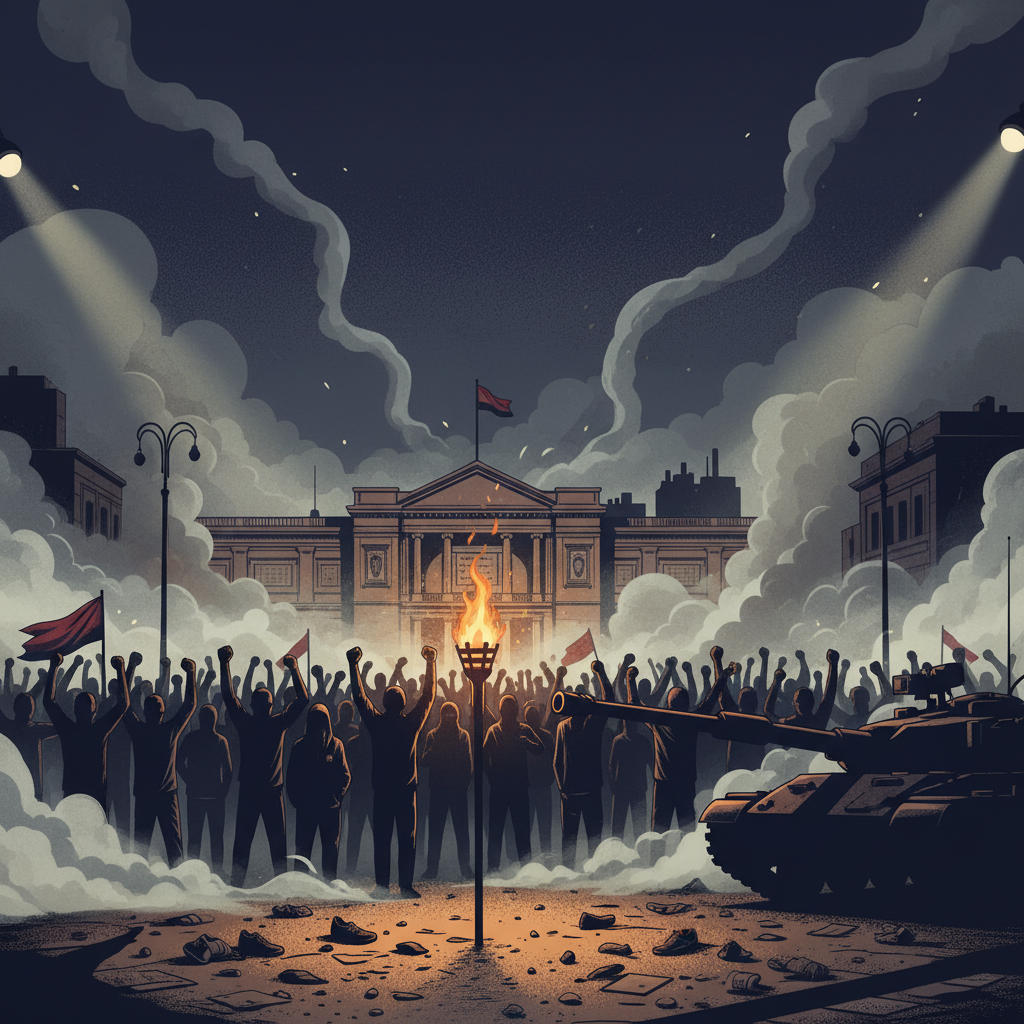
Arabischer Frühling 2011
Der Arabische Frühling war eine revolutionäre Welle von Protesten, Aufständen und bewaffneten Rebellionen, die ab Dezember 2010 über die arabische Welt hinwegfegte. Ausgelöst durch die Selbstverbrennung des tunesischen Straßenverkäufers Mohamed Bouazizi am 17. Dezember 2010 — ein Akt der Verzweiflung gegen Jahrzehnte autoritärer Korruption, Demütigung und Jugendarbeitslosigkeit — breitete sich die Bewegung mit atemberaubender Geschwindigkeit über Nordafrika und den Nahen Osten aus. Der prägende Sprechchor „الشعب يريد إسقاط النظام“ (Das Volk will den Sturz des Regimes) hallte von Tunis bis Kairo, von Bengasi bis Damaskus. Tunesiens Ben Ali floh nach 23 Jahren (14. Januar 2011); Ägyptens Mubarak fiel nach 30 Jahren in nur 18 Tagen (11. Februar 2011); Libyens Gaddafi wurde nach einer NATO-Intervention gestürzt und getötet (Oktober 2011); Syriens Assad wählte brutale Unterdrückung und entfachte einen Bürgerkrieg, der über 500.000 Menschen tötete und 13 Millionen vertrieb. Die Entscheidung des Militärs — sich auf die Seite der Demonstranten zu stellen oder dem Regime treu zu bleiben — erwies sich in jedem Land als entscheidende Variable.
Zusammenfassung
Sieben analytische Perspektiven konvergieren bei einer zentralen Erkenntnis: Der Arabische Frühling war der unvermeidliche Ausbruch jahrzehntelang unterdrückter menschlicher Bestrebungen, aber seine Ergebnisse wurden nicht durch die Bestrebungen von Millionen, sondern durch die institutionellen Berechnungen militärischer Eliten und die strategischen Interventionen externer Mächte bestimmt. Die Entscheidung des Militärs — vom Regime abzufallen oder ihm treu zu bleiben — war die entscheidende Variable in jedem Land.
Wichtige Fakten
Verifizierte Fakten aus Mehrquellen-Recherche, bewertet nach Konfidenzgrad
Mohamed Bouazizi, a 26-year-old street vendor in Sidi Bouzid, Tunisia, set himself on fire on December 17, 2010, after his produce cart was confiscated and he was humiliated by a municipal official. He died of his injuries on January 4, 2011.
high KonfidenzTunisian President Zine El Abidine Ben Ali fled to Saudi Arabia on January 14, 2011, ending his 23-year rule. Tunisia's military refused to fire on protesters.
high KonfidenzMass protests began in Egypt on January 25, 2011 (the 'Day of Rage'), centering on Tahrir Square in Cairo. President Hosni Mubarak resigned on February 11, 2011, after 30 years in power.
high KonfidenzEgypt's Supreme Council of the Armed Forces (SCAF) sided with protesters and forced Mubarak's resignation, protecting the military's extensive economic and institutional interests.
high KonfidenzMohamed Morsi of the Muslim Brotherhood won Egypt's first free presidential election in June 2012. He was removed by a military coup led by General Abdel Fattah al-Sisi on July 3, 2013.
high KonfidenzProtests against Muammar Gaddafi began in Benghazi, Libya on February 15, 2011. UN Security Council Resolution 1973 authorized a no-fly zone. NATO intervened militarily beginning March 19, 2011. Gaddafi was captured and killed on October 20, 2011.
high KonfidenzAnti-government protests began in Daraa, Syria in mid-March 2011 after schoolchildren were detained for anti-regime graffiti. The Assad regime responded with military force, escalating into civil war.
high KonfidenzWichtige Akteure
Hauptakteure dieses Ereignisses mit ihren Handlungen und erklärten Interessen
Mohamed Bouazizi
individual- ›Set himself on fire on December 17, 2010 in Sidi Bouzid, Tunisia
Hosni Mubarak
individual- ›Imposed curfew and deployed military to streets
- ›Shut down internet and mobile communications
- ›Resigned on February 11, 2011
Muammar Gaddafi
individual- ›Ordered military to suppress protests violently
- ›Threatened to 'cleanse Libya house by house'
- ›Fought NATO intervention until captured and killed
Bashar al-Assad
individual- ›Deployed military against civilian protesters
- ›Used barrel bombs and chemical weapons against civilian areas
- ›Relied on Iranian and Russian military support
Al Jazeera
organization- ›Provided 24/7 satellite coverage of Arab Spring protests across the region
- ›Amplified protest movements through pan-Arab broadcasts reaching millions
- ›Created a shared narrative space across Arab-speaking populations
Recherche & Quellen
Ereigniszeitlinie
2010-12-17 to 2015-09-01
Kausalanalyse
Interaktiver Graph, der zeigt, wie Richtlinien, Akteure und Ereignisse kausal zusammenhängen — klicken Sie auf Knoten, um Beziehungen zu erkunden
KAUSALES NETZWERK
21 Knoten · 18 Verbindungen
Knoten auswählen
Klicken Sie auf einen beliebigen Knoten im Graphen, um seine Verbindungen und Linsenperspektiven zu erkunden
Grundursachen
3Kritischer Pfad
9 SchritteLinsenanalysen
Jede Linse bietet einen einzigartigen analytischen Rahmen — klicken Sie zum Aufklappen für eine tiefgehende Analyse
Spieltheorie
Western Moderngame-theoryThe Arab Spring was a massive multi-player sequential game where each country's outcome changed the information set for all other players. Tunisia's success solved the collective action problem by demonstrating that revolution was possible — but the game-theoretic insight is that the same initial shock (popular uprising) produced radically different outcomes depending on one variable: whether the military's institutional interests were better served by defecting from or remaining loyal to the regime. This is the 'military kingmaker' dynamic — not a bug in the revolutionary wave but the fundamental strategic variable that determined winners and losers.
Machiavelli
Greco-Roman & ClassicalmachiavelliThe Arab Spring is a masterclass in Machiavellian power dynamics: it demonstrated that power built solely on fear collapses catastrophically when the fear barrier breaks. The military — not the people, not social media, not Western intervention — was the prince-maker in every country. Where the military calculated that its institutional interests were better served by sacrificing the ruler (Tunisia, Egypt), transitions were relatively peaceful. Where the military's survival was bound to the regime (Syria's Alawite officers, Bahrain's Sunni security forces), the result was either civil war or brutal suppression. The tragedy of the Arab Spring, in Machiavellian terms, is that destroying the old order proved far easier than building a new one. As Machiavelli warned: 'There is nothing more difficult to take in hand, more perilous to conduct, or more uncertain in its success, than to take the lead in the introduction of a new order of things.'
CIA-Geheimdienstbewertung
Western InstitutionalciaThe Arab Spring exposed the central paradox of US intelligence engagement in the Middle East: the very authoritarian relationships that provided counter-terrorism intelligence created the conditions for the revolutionary explosions that destroyed those relationships. The CIA's partnerships with Mubarak's GIS, Ben Ali's secret police, and Gaddafi's reformed intelligence services gave the US excellent visibility into specific terrorist networks but no understanding of the structural rage building across Arab societies. The intelligence failure was not in the collection but in the analytical framework — the inability to see that 'stable authoritarian allies' was a contradiction in terms, and that the suppressed frustrations of millions of young Arabs constituted a strategic threat greater than any specific terrorist organization.
Pawlowsche Konditionierungsanalyse
Western ModernpavlovThe Arab Spring demonstrates that authoritarian control based on conditioned fear is inherently fragile: it works perfectly until it doesn't, and when it fails, it fails catastrophically. Decades of conditioning created a population that appeared compliant but was actually a pressure cooker of suppressed frustration. Bouazizi's act served as the extinction trial that demonstrated the old contingency no longer held. Al Jazeera's broadcasts generalized this extinction across the Arab world. But conditioning theory also explains the tragedy: it is far easier to extinguish a fear response (stop obeying) than to condition new constructive behaviors (build democratic institutions). The Arab Spring succeeded as mass behavioral de-conditioning — the fear was broken — but failed as re-conditioning toward democratic habits, which require years of consistent reinforcement that the post-revolutionary environment could not provide.
Nietzscheanische Analyse
Western ModernnietzscheThe Arab Spring was a revolt of dignity — ثورة الكرامة — and Nietzsche's philosophy provides the deepest reading of what dignity means in this context. It was not merely a demand for political rights but an existential assertion: the refusal to accept humiliation as the human condition. Bouazizi's act was the purest expression of will against a system that had crushed all will. The tragedy is Nietzsche's own warning: destruction of the old order is the easy part. The hard part — the creation of new values, the emergence of what Nietzsche would call higher types of human organizing — requires precisely the kind of patient, creative work that revolutionary energy cannot sustain. The Arab Spring proved that the will to power can topple any regime, but it cannot, by itself, build what comes next.
Taoistische Analyse
East AsiantaoismThe Arab Spring is the Tao's most powerful modern demonstration of the principle of reversal (反, fan): whatever reaches an extreme produces its opposite. Decades of authoritarian rigidity (extreme yang) produced explosive revolutionary energy (extreme yin). Regimes that gripped tighter fell faster — Gaddafi's 42 years of iron control shattered into state collapse; Assad's brutal suppression produced the century's worst humanitarian disaster. Regimes that bent survived — Morocco's limited reforms, Jordan's modest concessions. The Tao's deepest insight about the Arab Spring is this: the revolutionary wave moved not through strategic coordination but through the natural resonance of shared grievances, flowing like water through every crack in authoritarian structures. It could not be stopped because it was not being directed — it was the Tao itself, the natural flow of suppressed human aspiration finding expression. But the Tao also teaches that water, unconstrained, floods and destroys. The Arab Spring's devastation in Libya and Syria is water without banks — natural force without the channels needed to direct it constructively.
Bewertung der Auswirkungen auf die Zivilbevölkerung
civilian-impactThe Arab Spring's civilian impact reveals the terrible disproportion between revolutionary aspiration and human cost. Millions of people demanded nothing more than dignity, economic opportunity, and an end to corruption — the most basic human aspirations. In Tunisia, these aspirations were achieved at relatively low cost. In Syria, the same aspirations produced the worst humanitarian catastrophe of the 21st century. The difference was not in what civilians wanted or how they protested, but in the structural variables they could not control: military loyalty, sectarian composition, external intervention, and the willingness of rulers to destroy their own countries rather than relinquish power. The most devastating finding of this analysis is that the people who suffered most — Syrian civilians — had the least agency in determining their fate. They were caught between a regime willing to use chemical weapons, an opposition that fragmented into rival militias, external powers pursuing strategic interests, and a jihadist movement (ISIS) that exploited the chaos. The Arab Spring's human cost is not a story of failed revolution — it is a story of civilians trapped in conflicts they did not choose, determined by forces they could not influence.
Konvergenzen
Wo mehrere Linsen zu ähnlichen Schlussfolgerungen gelangen — was auf Robustheit hindeutet
Militärische Loyalität als entscheidende Variable
Alle vier Perspektiven identifizieren unabhängig die institutionelle Entscheidung des Militärs als den Faktor, der bestimmte, ob Revolutionen friedlich gelangen, in Bürgerkriege abglitten oder niedergeschlagen wurden.
Autoritäre Stabilität ist inhärent fragil
Spieltheorie zeigt, dass angstbasierte Gleichgewichte zusammenbrechen. Pawlow zeigt, dass konditionierte Angst erlischt. Taoismus zeigt, dass starre Systeme ihre eigene Umkehr erzeugen.
Zerstörung alter Ordnungen ist einfacher als der Aufbau neuer
Machiavelli warnte, dass die Errichtung neuer Ordnungen das schwierigste politische Unterfangen ist. Nietzsche identifiziert das Übermensch-Problem. Taoismus sieht ungebundenes Wasser als zerstörerisch.
Produktive Spannungen
Wo Linsen nicht übereinstimmen — und Komplexität offenbaren, die es zu untersuchen lohnt
Mögliche Zukünfte
Szenarien, die aus Linsenanalysen abgeleitet wurden — was sich auf Basis verschiedener Rahmen entfalten könnte
Second wave of Arab uprisings driven by unresolved structural grievances
Medium — the structural conditions remain, but the memory of Syria's catastrophe acts as a powerful deterrent
Authoritarian adaptation and tech-enabled control prevent future uprisings
Medium-high — authoritarian regimes have invested heavily in learning from the Arab Spring's failures
Tunisia's democratic path consolidates and gradually influences the region
Low — Tunisia's own democracy has faced setbacks since 2021 (Kais Saied's power concentration)
Schlüsselfragen
Fragen, die nach der Analyse offen bleiben — für weitere Untersuchungen
- ?What was the precise role of Gulf intelligence services in funding and directing various factions?
- ?To what extent did Al Jazeera's editorial decisions shape the direction of the Arab Spring?
- ?What were the internal deliberations within military high commands that determined their choices?
Details der Faktenprüfung
Ergebnisse der Faktenprüfung
verifiedMeta-Beobachtungen
All seven lenses are fundamentally retrospective — they analyze what happened and why, but none fully captures the lived experience of revolutionary hope before it turned to despair. The Arab Spring was, for millions of people, the most exhilarating experience of their lives — a moment of collective agency and shared purpose that cannot be reduced to strategic calculation, conditioning, or power dynamics. That hope, even though it was largely betrayed by outcomes, was real and transformative for those who experienced it.
The Arab Spring involves simultaneous causation at multiple scales — individual psychology (Bouazizi), institutional dynamics (military choices), regional contagion (media amplification), and global geopolitics (external intervention) — that cannot be adequately captured by any single analytical framework. The seven lenses together approach a more complete picture, but the full complexity of a revolutionary wave affecting 300+ million people across 20 countries over five years exceeds any analytical capacity.
The Arab Spring humbled every analytical framework that tried to predict or explain it in real time. Intelligence agencies did not predict it. Academic experts did not anticipate its trajectory. No single theory — rational choice, structuralism, constructivism, or any other — captured the full dynamic. This analysis, with its seven lenses, is an attempt to triangulate toward truth, but the reader should hold all conclusions with appropriate humility.
Ihre Perspektive finden
Verschiedene Rahmen sprechen unterschiedliche Leser an — finden Sie Ihren Einstiegspunkt
Readers who see the Arab Spring primarily through strategic dynamics, institutional calculations, and power politics — who ask 'what were the incentives?' and 'who benefited?'
The military kingmaker dynamic and the failure of intelligence frameworks to predict popular uprisings
Readers who see the Arab Spring as an expression of deep human aspirations — dignity, freedom, natural flow against artificial constraint — and who feel the movement's moral power
The revolt of dignity and the paradox of control — regimes that gripped tighter fell faster
Readers focused on power structures, institutional dynamics, and the concrete consequences of political action — who ask 'what happened to real people?' and 'who holds power?'
The gap between revolutionary aspiration and institutional capacity to build new orders, and the devastating human cost of that gap
Readers skeptical of grand narratives who focus on mechanisms, costs, and unintended consequences — who ask 'how did it actually spread?' and 'what was the real price?'
The conditioning dynamics that made the wave possible and the cruel arithmetic of human suffering across the spectrum
Start with the lens that resonates most, then deliberately read the lens that challenges your assumptions. If you see strategic rationality (game-theory), read the existential dimension (nietzsche). If you feel the moral power of the movement (nietzsche), confront the human cost (civilian-impact). The Arab Spring's full truth lives in the tension between these perspectives, not in any single lens.
Verwandte Analysen
Andere Ereignisse, die durch ähnliche Linsen oder Kategorien analysiert wurden
Am 26. April 1986 um 01:23 Uhr explodierte Reaktor Nr. 4 des Kernkraftwerks Tschernobyl in der Ukrainischen SSR während eines Sicherheitstests und setzte 400-mal mehr radioaktives Material frei als die Hiroshima-Bombe. Die sowjetischen Behörden verheimlichten die Katastrophe zunächst und zwangen die 49.000 Einwohner von Prypjat, 36 Stunden lang ihr normales Leben fortzusetzen. Etwa 600.000 Liquidatoren wurden zum Einsatz gebracht. Die geschätzte Todeszahl reicht von 4.000 (WHO) bis 93.000 (Greenpeace). Die Katastrophe zerstörte den Mythos der sowjetischen technologischen Überlegenheit und trieb Gorbatschow zur Glasnost — und war nach seiner eigenen Einschätzung «vielleicht die wahre Ursache für den Zusammenbruch der Sowjetunion».
Zwischen dem 6. April und dem 18. Juli 1994 wurden in Ruanda innerhalb von 100 Tagen systematisch etwa 800.000 Tutsi und gemäßigte Hutu ermordet — das effizienteste Massentöten der modernen Geschichte mit einer höheren täglichen Todesrate als der Holocaust. Der Völkermord war nicht der Ausbruch „alter Stammeskonflikte“, sondern der Höhepunkt eines Kolonialprojekts: Belgische Verwalter hatten durch die Volkszählung von 1933 und obligatorische ethnische Ausweise starre Rassenkategorien aus fließenden sozialen Identitäten geschaffen und die Hutu-Tutsi-Spaltung erzeugt, die politische Eliten später als Waffe einsetzten. Das Habyarimana-Regime und sein innerer Kreis der akazu (kleines Haus) wählten angesichts des militärischen Drucks der Ruandischen Patriotischen Front und der Machtteilungsforderungen der Arusha-Abkommen den Völkermord als politische Überlebensstrategie. RTLM-Radio — „Radio Machete“ — konditionierte die Bevölkerung systematisch durch jahrelange entmenschlichende Propaganda, nannte Tutsi „inyenzi“ (Kakerlaken) und sendete während des Völkermordes explizite Tötungsbefehle und Standorte der Opfer. Zwischen 250.000 und 500.000 Frauen wurden als vorsätzliche Waffe des Völkermordes vergewaltigt. Das Versagen der internationalen Gemeinschaft war nicht passiv, sondern aktiv: UNAMIR-Kommandeur Dallaire sandte seinen „Völkermord-Fax“ drei Monate vor Beginn der Morde, forderte 5.000 Soldaten und wurde abgewiesen. Der UN-Sicherheitsrat reduzierte UNAMIR von 2.500 auf 270 Soldaten während des Völkermordes. Der militärische Sieg der RPF beendete den Völkermord im Juli 1994, doch die Folgen kaskadieren in den Ersten Kongokrieg (1996-97) und „Afrikas Weltkrieg“ mit über 5 Millionen Toten.
Am 22. November 1963 wurde Präsident John F. Kennedy auf dem Dealey Plaza in Dallas, Texas, ermordet. Lee Harvey Oswald wurde verhaftet, aber noch vor seinem Prozess von Jack Ruby getötet. Die Warren-Kommission kam zu dem Schluss, dass Oswald allein gehandelt habe, während das HSCA später eine wahrscheinliche Verschwörung feststellte. Freigegebene Dokumente bis 2025 enthüllen institutionelle Vertuschungen durch die CIA und das FBI und machen den Fall zum folgenreichsten ungelösten Fall der amerikanischen Geschichte.
Wie dies analysiert wurde
Vollständige Transparenz über den Analyseprozess, die verwendeten Werkzeuge und die Einschränkungen
Crosslight Engine
v0.4.0 "Global Lens Expansion"- ⚠Non-Western philosophical lenses rely on translated primary texts — nuance may be lost in translation
- ⚠Some traditions (e.g., Maat, Ubuntu) have limited surviving primary texts; analysis draws on scholarly reconstruction
- ⚠Cross-cultural lens application is inherently interpretive — a Confucian reading of a Western event is an analytical exercise, not a claim of cultural authority
Analysestatistiken
Methodik
Diese Analyse wurde von der Crosslight-Multi-Agenten-Pipeline erstellt: Ein Rechercheagent sammelte und verifizierte Fakten aus mehreren Quellen, spezialisierte Linsenagenten wendeten verschiedene analytische Rahmen an, ein Syntheseagent integrierte Erkenntnisse und identifizierte Muster, und ein Faktenprüfungsagent überprüfte Behauptungen. Jede Linsenperspektive ist die KI-Interpretation — keine institutionelle Empfehlung.Mehr erfahren →