
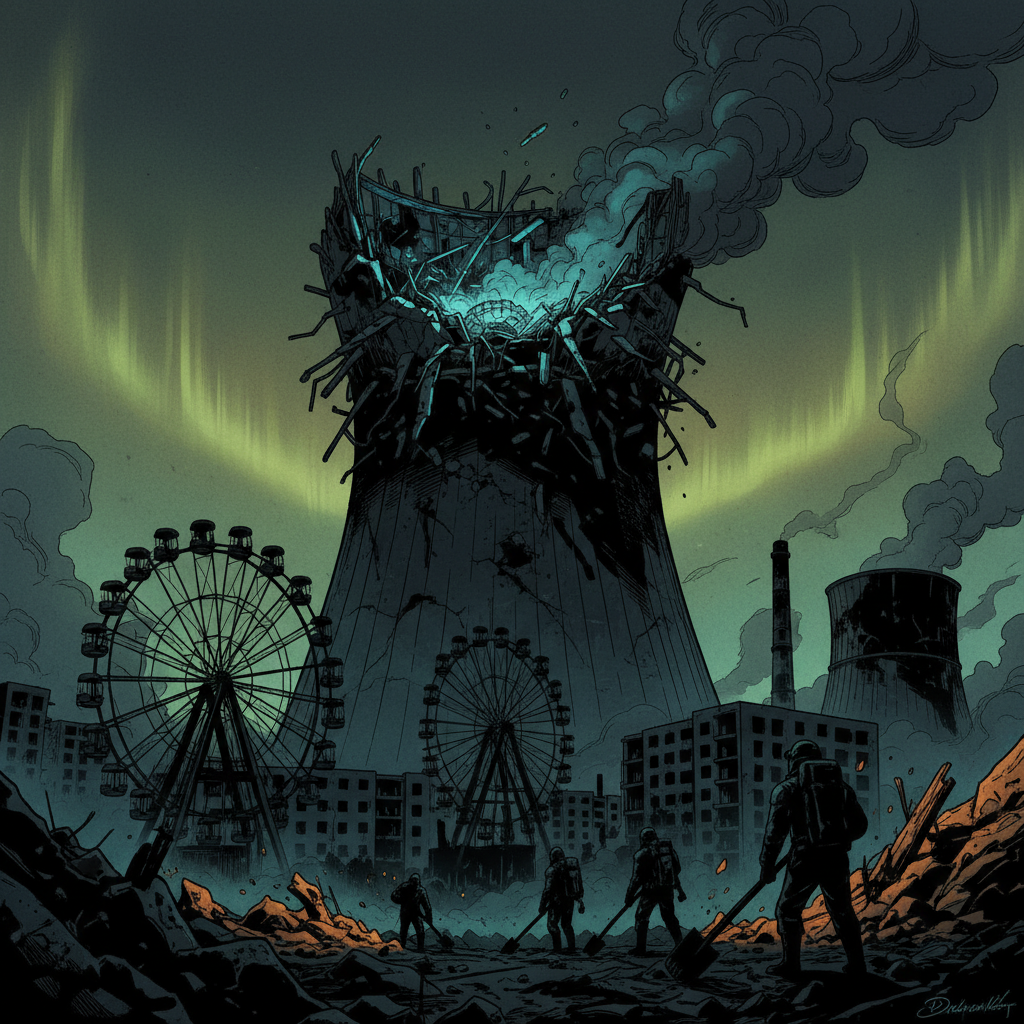
El desastre de Chernóbil
El 26 de abril de 1986, a la 01:23, el reactor n.º 4 de la central nuclear de Chernóbil en la RSS de Ucrania explotó durante una prueba de seguridad, liberando 400 veces más material radiactivo que la bomba de Hiroshima. Las autoridades soviéticas ocultaron inicialmente el desastre, obligando a los 49.000 residentes de Prípiat a continuar su vida normal durante 36 horas. Unos 600.000 'liquidadores' fueron desplegados. Las estimaciones de muertes van de 4.000 (OMS) a 93.000 (Greenpeace). El desastre destruyó el mito de la supremacía tecnológica soviética y forzó la glásnost de Gorbachov.
Resumen Ejecutivo
Siete perspectivas analíticas convergen en un hallazgo central: el desastre de Chernóbil fue una catástrofe doble — un fallo técnico arraigado en compromisos de diseño del reactor, amplificado por un fallo institucional en el que cada nivel del sistema soviético priorizó la autopreservación sobre la seguridad humana. Las siete perspectivas coinciden: el fallo institucional fue tan catastrófico como el técnico, y posiblemente más prevenible.
Hechos Clave
Hechos verificados de investigacion multifuente, puntuados por nivel de confianza
At 01:23 AM on April 26, 1986, Reactor No. 4 at the Chernobyl Nuclear Power Plant exploded during a turbine rundown safety test.
Confianza highThe RBMK-1000 reactor design had a known positive void coefficient of reactivity, meaning loss of coolant water increased reactivity. This was accepted as a trade-off for dual-use capability and cost savings.
Confianza highDeputy chief engineer Anatoly Dyatlov pressured operators to continue the test despite dangerously low power levels (~200 MW vs. planned 700-1000 MW). Operators disabled the ECCS and overrode automatic shutdown signals.
Confianza highPripyat (population 49,000), 3 km from the reactor, was not evacuated until 36 hours after the explosion. Children played outdoors, weddings were held, and residents observed the fire from the 'Bridge of Death.'
Confianza highSwedish radiation monitoring stations at Forsmark detected elevated levels on April 28, forcing Soviet acknowledgment. The Soviets initially blamed a 'minor accident.'
Confianza highApproximately 600,000 liquidators were deployed between 1986 and 1990. 'Bio-robots' on the roof worked in 90-second shifts, each receiving a near-lifetime dose.
Confianza highOf 134 plant workers and firefighters diagnosed with acute radiation syndrome, 28 died within months. Their deaths were documented in clinical detail.
Confianza highActores Clave
Actores principales involucrados en este evento con sus acciones e intereses declarados
Anatoly Dyatlov
individual- ›Supervised the safety test
- ›Pressured operators to continue at low power
- ›Ordered disabled safety systems
Mikhail Gorbachev
individual- ›Delayed public acknowledgment 18 days
- ›Blamed Western media
- ›Used Chernobyl to accelerate glasnost
Valery Legasov
individual- ›Led scientific investigation
- ›Presented Soviet narrative to IAEA
- ›Recorded truth-telling tapes
Liquidators
group- ›Built sarcophagus
- ›Cleared radioactive graphite from roof
- ›Decontaminated surrounding areas
Investigacion y Fuentes
Linea de Tiempo del Evento
1954-06-27 to 1991-12-26
Analisis Causal
Grafo interactivo que muestra como politicas, actores y eventos se conectan causalmente — haz clic en los nodos para explorar relaciones
RED CAUSAL
18 nodos · 19 conexiones
Selecciona un nodo
Haz clic en cualquier nodo del grafo para explorar sus conexiones y perspectivas de lentes
Causas Raiz
3Ruta Critica
8 pasosAnalisis por Lente
Cada lente proporciona un marco analitico unico — haz clic para expandir el analisis profundo
Teoría de juegos
Western Moderngame-theoryChernobyl was not a failure of rationality but a masterclass in how rational individual decisions within a pathological institutional structure produce collectively catastrophic outcomes. The system's information architecture was the root cause: by classifying safety data, punishing dissent, and rewarding concealment, the system guaranteed that each actor's rational choice would aggregate into civilizational disaster. The 'peaceful atom' ideology functioned as a corrupted focal point coordinating the entire system toward catastrophe. A system that makes honesty irrational will produce dishonesty at scale, and a nuclear power program built on institutional dishonesty will eventually produce Chernobyl.
Maquiavelo
Greco-Roman & ClassicalmachiavelliChernobyl is a perfect Machiavellian case study in institutional self-preservation becoming self-destruction. The Soviet system followed the classic playbook: conceal weakness, project strength, control information, blame subordinates. This works for political competition between elites. It fails catastrophically for governing complex technical systems where accurate information is a safety prerequisite. Nuclear reactors do not respond to political narratives — they respond to physics. When the Soviet system treated safety information as a political resource rather than a physical reality, it created conditions for an accident that physics, not politics, would determine. Gorbachev's subsequent use of Chernobyl to accelerate glasnost was genuinely Machiavellian: converting catastrophic weakness into reform leverage. But glasnost could not be confined to nuclear safety.
CIA
Western InstitutionalciaChernobyl's intelligence significance lies not in the reactor failure but in what it revealed about Soviet decision-making under crisis. The disaster stress-tested the Soviet information architecture and it failed comprehensively: upward reporting filtered bad news, lateral communication was impeded by classification, downward communication prioritized messaging over safety, international communication was dishonest until forced. The pattern — institutional mendacity as structural feature — became a key lens for assessing authoritarian fragility. The insight that information-controlled systems are brittle rather than resilient remains one of the most durable Cold War intelligence lessons.
Pávlov
Western ModernpavlovChernobyl demonstrates that institutional conditioning is a safety-critical infrastructure vulnerability. Decades of conditioning — obedience, news suppression, trust in official narratives, punishment of dissent — created patterns individually adaptive (kept people employed) but collectively catastrophic (prevented detection of and response to existential threats). The disaster was caused not by a few bad decisions on April 26 but by forty years of conditioning that made those decisions inevitable. When you condition operators to obey authority over instruments, managers to filter reality, officials to prioritize narrative over facts, and citizens to trust silence as safety — you create an anti-safety culture where every reflex moves toward catastrophe.
Impacto civil
civilian-impactChernobyl's civilian impact reveals a disaster on geological timescales: centuries of contamination, generational health consequences, and psychological wounds transmitted through families. The contested death toll is ongoing harm: when official count is 31 and the range extends to 93,000, communities exist in unresolved grief. The most important lesson: the institutional failure caused as much damage as the explosion. Without the 36-hour delay, the thyroid cancer epidemic would have been significantly reduced. Without the May Day parade, Kyiv's children would not have marched through fallout. The civilian toll is a consequence not merely of the explosion but of every subsequent institutional decision that prioritized image over human life.
Taoísmo
East AsiantaoismChernobyl is the Tao's answer to the 'peaceful atom.' The Taoist reading reveals a disaster driven by fundamental violation of the principle that nature cannot be conquered, only cooperated with. The Soviet system forced the atom, forced secrecy, forced obedience, forced ignorance, forced fiction. At every point, forcing produced its opposite. The Exclusion Zone — where nature flourishes in humanity's absence — is the most eloquent Taoist commentary. The wolves of Chernobyl embody the Tao Te Ching: 'the Tao nourishes all things.' The deepest lesson: systems that deny uncertainty will be destroyed by it.
Nietzsche
Western ModernnietzscheChernobyl is the story of a will to power that confused institutional dominance with genuine mastery. The Soviet system had power to classify, conceal, command, and coerce — but not to control nuclear fission when the reactor exceeded institutional narrative. The liquidators embody Nietzsche's central question: what distinguishes authentic heroism from coerced sacrifice? The Soviet system, by making genuine choice impossible, destroyed the conditions that make heroism meaningful — then claimed the sacrifice as institutional virtue. Legasov's arc is the most purely Nietzschean story: beginning in slave morality, recognizing institutional values as lies, destroying himself in self-overcoming that affirmed individual truth. The Soviet response — blaming individuals, concealing flaws, claiming liquidator sacrifice as institutional virtue — was slave morality: inverting truth and power, making institutional survival the highest value. Chernobyl shattered that inversion at a cost measured in human lives.
Convergencias
Donde multiples lentes llegan a conclusiones similares — sugiriendo robustez
Institutional mendacity as root cause
All four identify Soviet information architecture — classification, punishment of dissent, rewarding optimism — as the fundamental cause transforming technical failure into civilizational catastrophe.
The coverup caused more harm than the explosion
36-hour evacuation delay, Kyiv May Day, continued milk distribution all caused measurable additional harm. The thyroid cancer epidemic was largely preventable with timely response.
Hubris and limits of institutional control
All four converge on the insight that Soviet confidence in its own control was the precondition for losing control catastrophically.
Tensiones Productivas
Donde los lentes discrepan — revelando complejidad que merece examinarse
Futuros Posibles
Escenarios derivados de los analisis de lentes — lo que podria desarrollarse segun diferentes marcos
Nuclear renaissance with institutional learning
Moderate. Institutional learning genuine but incomplete. Climate pressures make expansion likely.
Another major nuclear accident exposing institutional failure
Low but non-negligible per decade.
Preguntas Clave
Preguntas que permanecen abiertas despues del analisis — para investigacion continua
- ?What is the true death toll? Will advances in epidemiology resolve the 4,000-93,000 range?
- ?How many liquidators developed radiation-related conditions and were denied recognition?
- ?What was the full chain of command in the first 72 hours?
Detalles de Verificacion
Resultados de Verificacion
verifiedMeta Observaciones
All seven share a bias toward explanation. What all miss is the irreducibly incomprehensible dimension: ARS as documented by Alexievich, the three-day lie's cruelty, children's thyroid cancers. Some dimensions of Chernobyl resist comprehension and should resist it.
The relationship between technical and institutional failure is irreducibly complex: they are co-produced effects of the same Soviet institutional culture. Separating them is analytically useful but ultimately misrepresents a disaster in which technology and institutions were inseparable.
The contested death toll — 31 to 93,000 — is a permanent reminder of irreducible uncertainty. Any analysis claiming certainty is less honest than one acknowledging the range.
Encuentra Tu Perspectiva
Diferentes marcos resuenan con diferentes lectores — encuentra tu punto de entrada
Readers drawn to structural explanations and institutional design. You see Chernobyl as fixable through better incentive structures.
The Soviet information architecture was the root cause. Information-controlled systems are brittle, not strong.
Readers drawn to questions about hubris, nature's limits, and moral weight of choices. Chernobyl as parable about humanity's relationship with uncontrollable forces.
The 'peaceful atom' embodied a fundamental misunderstanding: institutional will cannot master natural forces through political commitment.
Readers focused on how organizations function and how institutional cultures shape behavior. Chernobyl as case study in institutional pathology.
Behavioral conditioning and power dynamics made every actor behave rationally within their context while producing collective catastrophe.
Readers prioritizing human experience over analytical frameworks. Skeptical that any lens captures the horror of radiation sickness or the injustice of the contested death toll.
All frameworks risk abstracting away individual suffering. The thyroid cancer in a child's throat exceeds what any theory contains.
If in the analytical cluster, read civilian-impact to ground structural understanding in human experience. If intuitive, game-theory shows how 'hubris' operated through fixable mechanisms. If institutional, Nietzsche reminds that individual choices cannot be fully explained by conditioning. All readers: engage with the liquidator heroism/victimization tension without resolving it prematurely.
Analisis Relacionados
Otros eventos analizados con lentes o categorias similares
La Primavera Árabe fue una ola revolucionaria de protestas, levantamientos y rebeliones armadas que barrió el mundo árabe a partir de diciembre de 2010. Desencadenada por la autoinmolación del vendedor ambulante tunecino Mohamed Bouazizi el 17 de diciembre de 2010 — un acto de desesperación contra décadas de corrupción autoritaria, humillación y desempleo juvenil — el movimiento se extendió con velocidad vertiginosa por el norte de África y Oriente Medio. El cántico definitorio "الشعب يريد إسقاط النظام" (El pueblo quiere la caída del régimen) resonó de Túnez a El Cairo, de Bengasi a Damasco. La elección del ejército — ponerse del lado de los manifestantes o permanecer leal al régimen — resultó ser la variable decisiva en cada país.
Entre el 6 de abril y el 18 de julio de 1994, aproximadamente 800.000 tutsis y hutus moderados fueron asesinados sistemáticamente en Ruanda en el transcurso de 100 días — la matanza masiva más eficiente de la historia moderna, con una tasa de mortalidad diaria superior a la del Holocausto. El genocidio no fue la erupción de «odios tribales ancestrales» sino la culminación de un proyecto colonial: los administradores belgas habían fabricado categorías raciales rígidas a partir de identidades sociales fluidas mediante el censo de 1933 y las tarjetas de identidad étnica obligatorias. El régimen de Habyarimana y su círculo íntimo akazu (la casita) eligieron el genocidio como estrategia de supervivencia política frente a la presión militar del Frente Patriótico Ruandés y las exigencias de los Acuerdos de Arusha. La radio RTLM — «Radio Machete» — condicionó sistemáticamente a la población mediante años de propaganda deshumanizante, llamando a los tutsis «inyenzi» (cucarachas). Entre 250.000 y 500.000 mujeres fueron violadas como arma deliberada de genocidio. El fracaso de la comunidad internacional fue activo: Dallaire envió su «fax del genocidio» tres meses antes, solicitó 5.000 soldados y fue rechazado. El Consejo de Seguridad de la ONU redujo la UNAMIR de 2.500 a 270 soldados durante el genocidio. La victoria militar del FPR puso fin al genocidio en julio de 1994, pero las consecuencias se extendieron a la Primera Guerra del Congo (1996-97) y la «Guerra Mundial Africana» que mató a más de 5 millones de personas.
El 22 de noviembre de 1963, el Presidente John F. Kennedy fue asesinado en Dealey Plaza, Dallas, Texas. Lee Harvey Oswald fue arrestado, pero Jack Ruby lo mató antes de que pudiera ser juzgado. La Warren Commission concluyó que Oswald actuó solo, mientras que la HSCA determinó posteriormente que existió una probable conspiración. Los documentos desclasificados hasta 2025 revelan encubrimientos institucionales por parte de la CIA y el FBI, convirtiéndolo en el caso sin resolver más trascendental de la historia estadounidense.
Como Se Analizo Esto
Transparencia total sobre el proceso de analisis, herramientas y limitaciones
Crosslight Engine
v0.4.0 "Global Lens Expansion"- ⚠Non-Western philosophical lenses rely on translated primary texts — nuance may be lost in translation
- ⚠Some traditions (e.g., Maat, Ubuntu) have limited surviving primary texts; analysis draws on scholarly reconstruction
- ⚠Cross-cultural lens application is inherently interpretive — a Confucian reading of a Western event is an analytical exercise, not a claim of cultural authority
Estadisticas del Analisis
Metodologia
Este analisis fue producido por el pipeline multi-agente de Crosslight: un Agente de Investigacion recopilo y verifico hechos de multiples fuentes, Agentes de Lentes especializados aplicaron marcos analiticos distintos, un Agente de Sintesis integro hallazgos e identifico patrones, y un Agente de Verificacion valido las afirmaciones. Cada perspectiva de lente es la interpretacion de la IA — no un respaldo institucional.Saber mas →