
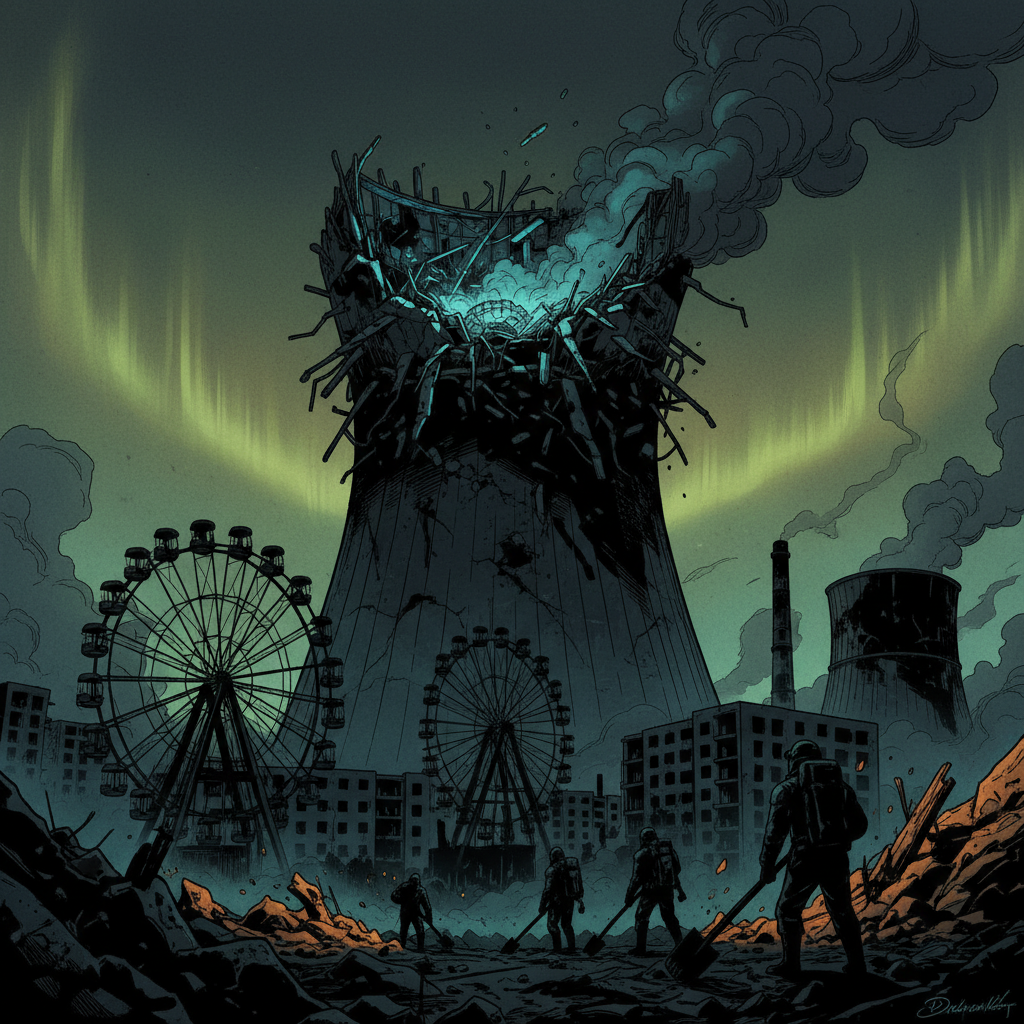
La catastrophe de Tchernobyl
Le 26 avril 1986 à 01h23, le réacteur n°4 de la centrale nucléaire de Tchernobyl en RSS d'Ukraine a explosé lors d'un test de sécurité, libérant 400 fois plus de matières radioactives que la bombe d'Hiroshima. Les autorités soviétiques ont d'abord dissimulé la catastrophe, forçant les 49 000 habitants de Pripiat à poursuivre leur vie normale pendant 36 heures. Environ 600 000 « liquidateurs » ont été déployés. Les estimations de décès vont de 4 000 (OMS) à 93 000 (Greenpeace). La catastrophe a brisé le mythe de la suprématie technologique soviétique et a forcé Gorbatchev vers la glasnost.
Resume Executif
Sept perspectives analytiques convergent vers une conclusion centrale : la catastrophe de Tchernobyl fut une double catastrophe — une défaillance technique enracinée dans les compromis de conception du réacteur, amplifiée par une défaillance institutionnelle où chaque niveau du système soviétique a privilégié l'auto-préservation à la sécurité humaine. Les sept perspectives s'accordent : la défaillance institutionnelle fut aussi catastrophique que la technique, et probablement plus évitable.
Faits Cles
Faits verifies issus de recherches multi-sources, notes par niveau de confiance
At 01:23 AM on April 26, 1986, Reactor No. 4 at the Chernobyl Nuclear Power Plant exploded during a turbine rundown safety test.
Confiance highThe RBMK-1000 reactor design had a known positive void coefficient of reactivity, meaning loss of coolant water increased reactivity. This was accepted as a trade-off for dual-use capability and cost savings.
Confiance highDeputy chief engineer Anatoly Dyatlov pressured operators to continue the test despite dangerously low power levels (~200 MW vs. planned 700-1000 MW). Operators disabled the ECCS and overrode automatic shutdown signals.
Confiance highPripyat (population 49,000), 3 km from the reactor, was not evacuated until 36 hours after the explosion. Children played outdoors, weddings were held, and residents observed the fire from the 'Bridge of Death.'
Confiance highSwedish radiation monitoring stations at Forsmark detected elevated levels on April 28, forcing Soviet acknowledgment. The Soviets initially blamed a 'minor accident.'
Confiance highApproximately 600,000 liquidators were deployed between 1986 and 1990. 'Bio-robots' on the roof worked in 90-second shifts, each receiving a near-lifetime dose.
Confiance highOf 134 plant workers and firefighters diagnosed with acute radiation syndrome, 28 died within months. Their deaths were documented in clinical detail.
Confiance highActeurs Cles
Acteurs majeurs impliques dans cet evenement avec leurs actions et interets declares
Anatoly Dyatlov
individual- ›Supervised the safety test
- ›Pressured operators to continue at low power
- ›Ordered disabled safety systems
Mikhail Gorbachev
individual- ›Delayed public acknowledgment 18 days
- ›Blamed Western media
- ›Used Chernobyl to accelerate glasnost
Valery Legasov
individual- ›Led scientific investigation
- ›Presented Soviet narrative to IAEA
- ›Recorded truth-telling tapes
Liquidators
group- ›Built sarcophagus
- ›Cleared radioactive graphite from roof
- ›Decontaminated surrounding areas
Recherche et Sources
Chronologie de l'Evenement
1954-06-27 to 1991-12-26
Analyse Causale
Graphe interactif montrant comment les politiques, acteurs et evenements sont relies causalement — cliquez sur les noeuds pour explorer les relations
RESEAU CAUSAL
18 noeuds · 19 connexions
Selectionnez un noeud
Cliquez sur n'importe quel noeud du graphe pour explorer ses connexions et les perspectives des prismes
Causes Profondes
3Chemin Critique
8 etapesAnalyses par Prisme
Chaque prisme fournit un cadre analytique unique — cliquez pour developper l'analyse approfondie
Théorie des jeux
Western Moderngame-theoryChernobyl was not a failure of rationality but a masterclass in how rational individual decisions within a pathological institutional structure produce collectively catastrophic outcomes. The system's information architecture was the root cause: by classifying safety data, punishing dissent, and rewarding concealment, the system guaranteed that each actor's rational choice would aggregate into civilizational disaster. The 'peaceful atom' ideology functioned as a corrupted focal point coordinating the entire system toward catastrophe. A system that makes honesty irrational will produce dishonesty at scale, and a nuclear power program built on institutional dishonesty will eventually produce Chernobyl.
Machiavel
Greco-Roman & ClassicalmachiavelliChernobyl is a perfect Machiavellian case study in institutional self-preservation becoming self-destruction. The Soviet system followed the classic playbook: conceal weakness, project strength, control information, blame subordinates. This works for political competition between elites. It fails catastrophically for governing complex technical systems where accurate information is a safety prerequisite. Nuclear reactors do not respond to political narratives — they respond to physics. When the Soviet system treated safety information as a political resource rather than a physical reality, it created conditions for an accident that physics, not politics, would determine. Gorbachev's subsequent use of Chernobyl to accelerate glasnost was genuinely Machiavellian: converting catastrophic weakness into reform leverage. But glasnost could not be confined to nuclear safety.
CIA
Western InstitutionalciaChernobyl's intelligence significance lies not in the reactor failure but in what it revealed about Soviet decision-making under crisis. The disaster stress-tested the Soviet information architecture and it failed comprehensively: upward reporting filtered bad news, lateral communication was impeded by classification, downward communication prioritized messaging over safety, international communication was dishonest until forced. The pattern — institutional mendacity as structural feature — became a key lens for assessing authoritarian fragility. The insight that information-controlled systems are brittle rather than resilient remains one of the most durable Cold War intelligence lessons.
Pavlov
Western ModernpavlovChernobyl demonstrates that institutional conditioning is a safety-critical infrastructure vulnerability. Decades of conditioning — obedience, news suppression, trust in official narratives, punishment of dissent — created patterns individually adaptive (kept people employed) but collectively catastrophic (prevented detection of and response to existential threats). The disaster was caused not by a few bad decisions on April 26 but by forty years of conditioning that made those decisions inevitable. When you condition operators to obey authority over instruments, managers to filter reality, officials to prioritize narrative over facts, and citizens to trust silence as safety — you create an anti-safety culture where every reflex moves toward catastrophe.
Impact civil
civilian-impactChernobyl's civilian impact reveals a disaster on geological timescales: centuries of contamination, generational health consequences, and psychological wounds transmitted through families. The contested death toll is ongoing harm: when official count is 31 and the range extends to 93,000, communities exist in unresolved grief. The most important lesson: the institutional failure caused as much damage as the explosion. Without the 36-hour delay, the thyroid cancer epidemic would have been significantly reduced. Without the May Day parade, Kyiv's children would not have marched through fallout. The civilian toll is a consequence not merely of the explosion but of every subsequent institutional decision that prioritized image over human life.
Taoïsme
East AsiantaoismChernobyl is the Tao's answer to the 'peaceful atom.' The Taoist reading reveals a disaster driven by fundamental violation of the principle that nature cannot be conquered, only cooperated with. The Soviet system forced the atom, forced secrecy, forced obedience, forced ignorance, forced fiction. At every point, forcing produced its opposite. The Exclusion Zone — where nature flourishes in humanity's absence — is the most eloquent Taoist commentary. The wolves of Chernobyl embody the Tao Te Ching: 'the Tao nourishes all things.' The deepest lesson: systems that deny uncertainty will be destroyed by it.
Nietzsche
Western ModernnietzscheChernobyl is the story of a will to power that confused institutional dominance with genuine mastery. The Soviet system had power to classify, conceal, command, and coerce — but not to control nuclear fission when the reactor exceeded institutional narrative. The liquidators embody Nietzsche's central question: what distinguishes authentic heroism from coerced sacrifice? The Soviet system, by making genuine choice impossible, destroyed the conditions that make heroism meaningful — then claimed the sacrifice as institutional virtue. Legasov's arc is the most purely Nietzschean story: beginning in slave morality, recognizing institutional values as lies, destroying himself in self-overcoming that affirmed individual truth. The Soviet response — blaming individuals, concealing flaws, claiming liquidator sacrifice as institutional virtue — was slave morality: inverting truth and power, making institutional survival the highest value. Chernobyl shattered that inversion at a cost measured in human lives.
Convergences
La ou plusieurs prismes arrivent a des conclusions similaires — suggerant une robustesse
Institutional mendacity as root cause
All four identify Soviet information architecture — classification, punishment of dissent, rewarding optimism — as the fundamental cause transforming technical failure into civilizational catastrophe.
The coverup caused more harm than the explosion
36-hour evacuation delay, Kyiv May Day, continued milk distribution all caused measurable additional harm. The thyroid cancer epidemic was largely preventable with timely response.
Hubris and limits of institutional control
All four converge on the insight that Soviet confidence in its own control was the precondition for losing control catastrophically.
Tensions Productives
La ou les prismes divergent — revelant une complexite qui merite examen
Futurs Possibles
Scenarios derives des analyses par prisme — ce qui pourrait se derouler selon differents cadres
Nuclear renaissance with institutional learning
Moderate. Institutional learning genuine but incomplete. Climate pressures make expansion likely.
Another major nuclear accident exposing institutional failure
Low but non-negligible per decade.
Questions Cles
Questions qui restent ouvertes apres l'analyse — pour une investigation continue
- ?What is the true death toll? Will advances in epidemiology resolve the 4,000-93,000 range?
- ?How many liquidators developed radiation-related conditions and were denied recognition?
- ?What was the full chain of command in the first 72 hours?
Details de la Verification
Resultats de la Verification
verifiedMeta Observations
All seven share a bias toward explanation. What all miss is the irreducibly incomprehensible dimension: ARS as documented by Alexievich, the three-day lie's cruelty, children's thyroid cancers. Some dimensions of Chernobyl resist comprehension and should resist it.
The relationship between technical and institutional failure is irreducibly complex: they are co-produced effects of the same Soviet institutional culture. Separating them is analytically useful but ultimately misrepresents a disaster in which technology and institutions were inseparable.
The contested death toll — 31 to 93,000 — is a permanent reminder of irreducible uncertainty. Any analysis claiming certainty is less honest than one acknowledging the range.
Trouvez Votre Perspective
Differents cadres resonnent avec differents lecteurs — trouvez votre point d'entree
Readers drawn to structural explanations and institutional design. You see Chernobyl as fixable through better incentive structures.
The Soviet information architecture was the root cause. Information-controlled systems are brittle, not strong.
Readers drawn to questions about hubris, nature's limits, and moral weight of choices. Chernobyl as parable about humanity's relationship with uncontrollable forces.
The 'peaceful atom' embodied a fundamental misunderstanding: institutional will cannot master natural forces through political commitment.
Readers focused on how organizations function and how institutional cultures shape behavior. Chernobyl as case study in institutional pathology.
Behavioral conditioning and power dynamics made every actor behave rationally within their context while producing collective catastrophe.
Readers prioritizing human experience over analytical frameworks. Skeptical that any lens captures the horror of radiation sickness or the injustice of the contested death toll.
All frameworks risk abstracting away individual suffering. The thyroid cancer in a child's throat exceeds what any theory contains.
If in the analytical cluster, read civilian-impact to ground structural understanding in human experience. If intuitive, game-theory shows how 'hubris' operated through fixable mechanisms. If institutional, Nietzsche reminds that individual choices cannot be fully explained by conditioning. All readers: engage with the liquidator heroism/victimization tension without resolving it prematurely.
Analyses Connexes
Autres evenements analyses a travers des prismes ou categories similaires
Le Printemps arabe fut une vague révolutionnaire de manifestations, de soulèvements et de rébellions armées qui déferla sur le monde arabe à partir de décembre 2010. Déclenché par l'auto-immolation du vendeur ambulant tunisien Mohamed Bouazizi le 17 décembre 2010 — un acte de désespoir contre des décennies de corruption autoritaire, d'humiliation et de chômage des jeunes — le mouvement se propagea avec une rapidité fulgurante à travers l'Afrique du Nord et le Moyen-Orient. Le slogan définitoire «الشعب يريد إسقاط النظام» (Le peuple veut la chute du régime) résonna de Tunis au Caire, de Benghazi à Damas. Le choix de l'armée — se ranger du côté des manifestants ou rester fidèle au régime — s'avéra la variable décisive dans chaque pays.
Entre le 6 avril et le 18 juillet 1994, environ 800 000 Tutsis et Hutus moderes ont ete systematiquement assassines au Rwanda en l'espace de 100 jours — le massacre le plus efficace de l'histoire moderne, avec un taux de mortalite quotidien superieur a celui de l'Holocauste. Le genocide n'etait pas l'eruption de « haines tribales ancestrales » mais l'aboutissement d'un projet colonial : les administrateurs belges avaient fabrique des categories raciales rigides a partir d'identites sociales fluides par le biais du recensement de 1933 et des cartes d'identite ethniques obligatoires, creant la division Hutu-Tutsi que les elites politiques ont ensuite instrumentalisee. Le regime de Habyarimana et son cercle restreint de l'akazu (la maisonnee), confrontes a la pression militaire du Front patriotique rwandais et aux exigences de partage du pouvoir des Accords d'Arusha, ont choisi le genocide comme strategie de survie politique. La radio RTLM — « Radio Machette » — a systematiquement conditionne la population par des annees de propagande deshumanisante, qualifiant les Tutsis d'« inyenzi » (cafards) avant de diffuser des instructions explicites de mise a mort et les localisations des victimes pendant le genocide lui-meme. Entre 250 000 et 500 000 femmes ont ete violees comme arme deliberee de genocide, le jugement historique du TPIR dans l'affaire Akayesu reconnaissant le viol comme acte de genocide pour la premiere fois en droit international. L'echec de la communaute internationale n'etait pas passif mais actif : le commandant de la MINUAR Romeo Dallaire a envoye son « fax sur le genocide » trois mois avant le debut des massacres, a demande 5 000 soldats, et a ete refuse. Le Conseil de securite des Nations Unies a reduit la MINUAR de 2 500 a 270 soldats pendant le genocide. Les Etats-Unis ont deliberement evite d'utiliser le mot « genocide » pour contourner les obligations legales d'intervenir. La Commission Duclert (2021) a conclu que la France portait des « responsabilites lourdes et accablantes » incluant « une faillite politique, institutionnelle, intellectuelle, morale et cognitive ». L'Operation Turquoise, officiellement humanitaire, a permis aux genocidaires de fuir au Zaire. La victoire militaire du FPR a mis fin au genocide en juillet 1994, mais les consequences se sont propagees jusqu'a la Premiere Guerre du Congo (1996-97) et la « Guerre mondiale africaine » qui a tue plus de 5 millions de personnes.
Le 22 novembre 1963, le président John F. Kennedy fut assassiné à Dealey Plaza, Dallas, Texas. Lee Harvey Oswald fut arrêté mais tué par Jack Ruby avant son procès. La Warren Commission conclut qu'Oswald avait agi seul, tandis que la HSCA constata ultérieurement une probable conspiration. Les documents déclassifiés jusqu'en 2025 révèlent des dissimulations institutionnelles de la CIA et du FBI, faisant de cet événement l'affaire criminelle non résolue la plus lourde de conséquences de l'histoire américaine.
Comment Cela a Ete Analyse
Transparence totale sur le processus d'analyse, les outils et les limitations
Crosslight Engine
v0.4.0 "Global Lens Expansion"- ⚠Non-Western philosophical lenses rely on translated primary texts — nuance may be lost in translation
- ⚠Some traditions (e.g., Maat, Ubuntu) have limited surviving primary texts; analysis draws on scholarly reconstruction
- ⚠Cross-cultural lens application is inherently interpretive — a Confucian reading of a Western event is an analytical exercise, not a claim of cultural authority
Statistiques d'Analyse
Methodologie
Cette analyse a ete produite par le pipeline multi-agents de Crosslight : un Agent de Recherche a rassemble et verifie les faits de sources multiples, des Agents de Prismes specialises ont applique des cadres analytiques distincts, un Agent de Synthese a integre les perspectives et identifie les tendances, et un Agent de Verification a valide les affirmations. Chaque perspective de prisme est l'interpretation de l'IA — pas une approbation institutionnelle.En savoir plus →