
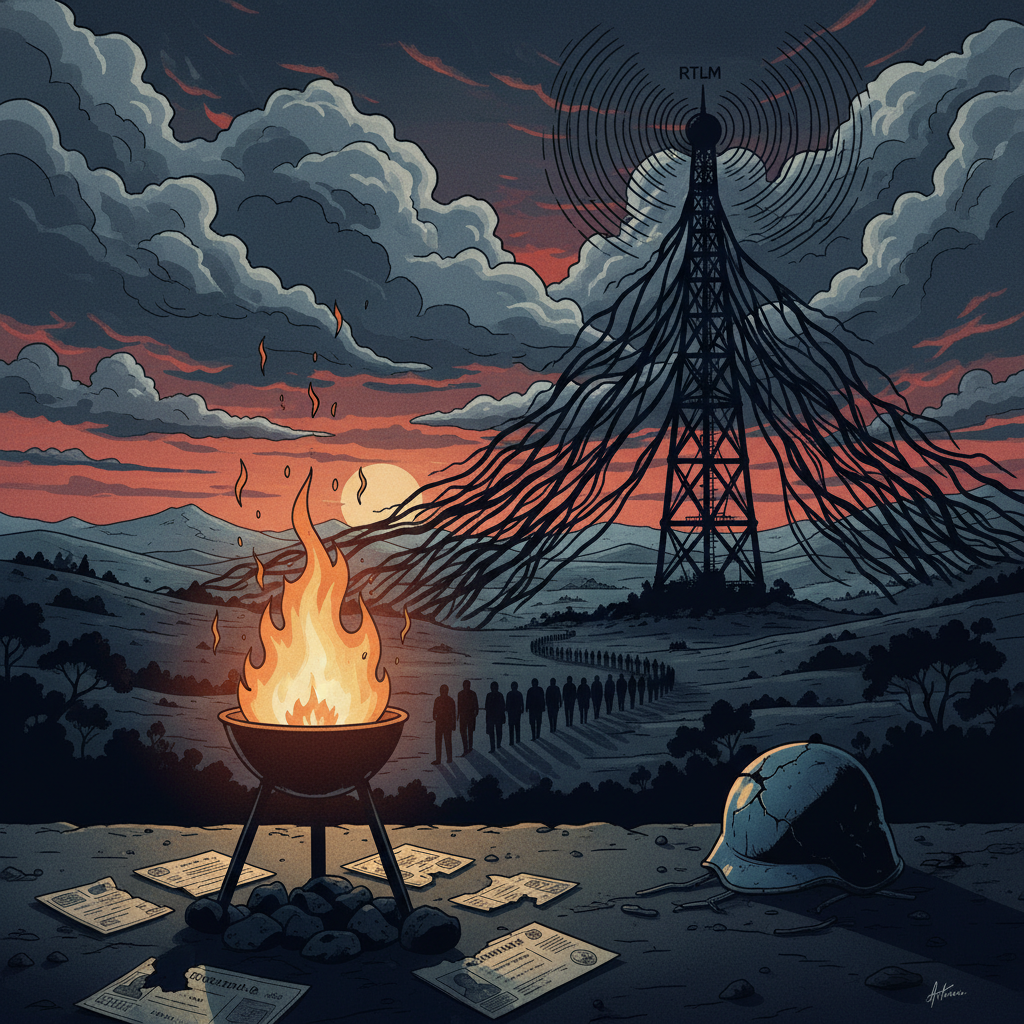
רצח העם ברואנדה
בין 6 באפריל ל-18 ביולי 1994, כ-800,000 טוטסים והוטו מתונים נרצחו בשיטתית ברואנדה במהלך 100 ימים — רצח ההמונים היעיל ביותר בהיסטוריה המודרנית. רצח העם לא היה פריצת של «שנאות שבטיות עתיקות» אלא שיאו של מפעל קולוניאלי: המנהלים הבלגיים יצרו קטגוריות גזעיות נוקשות מזהויות חברתיות גמישות במפקד 1933 ותעודות זהות אתנית חובה. משטר האביארימנה והמעגל הפנימי akazu בחרו ברצח עם כאסטרטגיה להישרדות פוליטית. רדיו RTLM — «רדיו מאצ'טה» — התנה את האוכלוסיה בשיטתית בשנים של תעמולה משפילה. כישלון הקהילה הבינלאומי היה פעיל: דלייר שלח את האזהרה שלו שלושה חודשים לפני תחילת הרצח, ביקש 5,000 חיילים וסורב. מועצת הביטחון של האו"ם צמצמה את UNAMIR מ-2,500 ל-270 חיילים במהלך רצח העם. ניצחון RPF הצבאי סיים את רצח העם ביולי 1994, אך התוצאות התפשטו למלחמת קונגו הראשונה (1996-97) ו«מלחמת העולם של אפריקה» שהרגה למעלה מ-5 מיליון אנשים.
סיכום מנהלים
Seven lenses converge on a central insight: the Rwandan genocide was not the eruption of ancient tribal hatreds but the catastrophic endpoint of a colonial project weaponized by political elites and enabled by international indifference. Belgian colonial racial engineering created the categories (colonial-legacy); decades of political manipulation hardened them into existential identities (machiavelli); RTLM radio conditioned the population to act on them (pavlov); the international community's strategic calculations ensured no external check existed (game-theory, cia); and the resulting human cost — 800,000 dead, 500,000 raped, millions displaced — cascaded into Africa's deadliest conflict (civilian-impact). The moral inversion at the heart of the genocide — framing extermination as liberation — reveals the deepest danger of manufactured victimhood narratives (nietzsche). The lenses agree that every major failure was a choice: Belgium chose to create racial categories; Habyarimana chose to maintain them; Hutu Power chose to weaponize them; the international community chose not to intervene. The genocide was not inevitable — it was chosen.
עובדות מרכזיות
עובדות מאומתות ממחקר רב-מקורי, מדורגות לפי רמת ביטחון
Between April 6 and July 18, 1994, approximately 800,000 Tutsi and moderate Hutu were killed in Rwanda over approximately 100 days.
ביטחון highBelgian colonial authorities introduced mandatory ethnic identity cards after the 1933 census, classifying every Rwandan as Hutu, Tutsi, or Twa based on cattle ownership (10+ cattle = Tutsi) and pseudoscientific racial measurements (nose width, skull shape, height).
ביטחון highOn January 11, 1994, UNAMIR force commander Roméo Dallaire sent the 'genocide fax' to UN headquarters warning that a high-level informant had revealed plans to register all Tutsi in Kigali for extermination and to distribute weapons to Interahamwe militias.
ביטחון highKofi Annan, then head of UN Peacekeeping Operations, ordered Dallaire not to raid arms caches and to strictly adhere to his mandate. Dallaire's request for 5,000 reinforcement troops was denied.
ביטחון highOn April 21, 1994, the UN Security Council passed Resolution 912 reducing UNAMIR from 2,500 to 270 troops — during the active genocide.
ביטחון highRTLM (Radio Télévision Libre des Mille Collines) was established in July 1993, funded by Hutu extremists. It systematically dehumanized Tutsis as 'inyenzi' (cockroaches) and during the genocide broadcast names and locations of people to be killed.
ביטחון highBetween 250,000 and 500,000 women were raped during the genocide. UN Special Rapporteur René Degni-Ségui stated: 'Rape was the rule, and its absence the exception.' An estimated two-thirds of genocide widows tested positive for HIV.
ביטחון highגורמים מרכזיים
גורמים מרכזיים המעורבים באירוע זה עם פעולותיהם ואינטרסים מוצהרים
Juvénal Habyarimana
individual- ›Seized power in 1973 military coup
- ›Maintained single-party Hutu-dominated state for 21 years
- ›Permitted akazu inner circle to consolidate power
Paul Kagame
individual- ›Led RPF military campaign from Uganda into Rwanda (1990)
- ›Commanded RPF forces that ended the genocide through military victory (July 1994)
- ›Became Vice President and Minister of Defence (1994-2000), then President (2000-present)
Roméo Dallaire
individual- ›Commanded UNAMIR peacekeeping force (October 1993 - August 1994)
- ›Sent genocide fax warning three months before the killing began
- ›Requested 5,000 reinforcement troops — denied by UN
Théoneste Bagosora
individual- ›Chaired crisis committee that coordinated genocide in hours after Habyarimana's assassination
- ›Ordered the murder of Prime Minister Agathe Uwilingiyimana
- ›Ordered the murder of ten Belgian UNAMIR peacekeepers at Camp Kigali
מחקר ומקורות
ציר זמן של האירוע
1933-01-01 to 1997-05-17
ניתוח סיבתי
גרף אינטראקטיבי המציג כיצד מדיניות, גורמים ואירועים מתחברים סיבתית — לחץ על צמתים לחקור קשרים
רשת סיבתית
16 צמתים · 19 חיבורים
בחר צומת
לחץ על כל צומת בגרף לחקור את חיבוריו ופרספקטיבות העדשות
סיבות שורש
1נתיב קריטי
9 שלביםניתוחי עדשות
כל עדשה מספקת מסגרת אנליטית ייחודית — לחץ להרחבה לניתוח מעמיק
תורת המשחקים
Western Moderngame-theoryThe Rwandan genocide was not a failure of information but a failure of incentive structures. Every relevant actor had sufficient information to predict and prevent the genocide — Dallaire's fax, intelligence reports, RTLM's open broadcasting of genocidal intent. The failure occurred because the incentive structure rewarded inaction: no UNSC member faced costs for non-intervention, while each faced potential costs for intervention. Hutu Power solved its coordination problem brilliantly through RTLM and institutional infrastructure; the international community failed to solve the much simpler coordination problem of deploying 5,000 troops. The game-theoretic lesson is stark: 'never again' without enforcement mechanisms is just words.
מקיאוולי
Greco-Roman & ClassicalmachiavelliThe Rwandan genocide was not a descent into chaos but an exercise in ruthless political calculation. Bagosora and the akazu chose genocide as a political strategy when they concluded that Arusha's power-sharing would end their dominance. They transformed the state itself into a killing machine: the colonial bureaucratic infrastructure (identity cards, local administration) became the instrument of extermination. The international community's failure was equally calculated — the US chose linguistic evasion, the UN chose mandate compliance over civilian protection, and France chose client-state loyalty over moral obligation. Machiavelli would recognize every actor's logic, even as he would note that Hutu Power committed the cardinal Machiavellian sin: they pursued a strategy whose success depended on eliminating an entire people, a goal that is always ultimately self-defeating.
מורשת קולוניאלית
colonial-legacyThe Rwandan genocide is the most devastating consequence of colonial racial engineering in modern history. Belgian administrators, applying European pseudoscientific racism and the Hamitic hypothesis, converted fluid social categories into fixed racial identities through the 1933 census and mandatory identity cards. These colonial instruments became the bureaucratic infrastructure of genocide — the identity cards checked at every roadblock in 1994 were the same cards introduced 61 years earlier by Belgian colonizers. The genocide was not the eruption of 'ancient tribal hatreds' — it was the catastrophic endpoint of a colonial project that manufactured ethnicity, froze it in bureaucratic systems, and then abandoned the consequences when Belgian administrators left. The colonial-legacy lens does not diminish Rwandan perpetrators' agency; it reveals the deeper structural conditions that made genocide possible and, critically, rejects the racist 'tribal conflict' narrative that implies Africans were simply predisposed to killing each other.
CIA
Western InstitutionalciaThe Rwandan genocide exposed the fundamental limitation of intelligence in the absence of political will. Western intelligence agencies — particularly the CIA, DIA, and French services — had sufficient information to assess and potentially prevent the genocide. Dallaire's genocide fax was explicit. RTLM's broadcasts were monitored. Weapons distribution was tracked. Satellite imagery documented mass graves in real time. The failure was not informational but political: the Clinton administration's post-Somalia risk aversion, Rwanda's lack of strategic value, and the deliberate legal strategy of avoiding the word 'genocide' to circumvent Convention obligations. The intelligence lesson is stark: the best intelligence in the world is worthless when policymakers have decided that the lives at stake do not warrant action. The geopolitical lesson is equally stark: the international system's response to mass atrocity is not determined by the severity of the atrocity but by the strategic interests of the intervening powers.
השפעה אזרחית
civilian-impactThe Rwandan genocide was the most intimate mass killing in modern history — 800,000 people murdered in 100 days, primarily by their neighbors, with machetes, in the communities where they had lived together. The civilian impact extends far beyond the death toll: 250,000-500,000 women raped as a systematic weapon with deliberate HIV transmission, 400,000 orphans, 2 million refugees, the complete destruction of social trust in a society where perpetrators and survivors must now live side by side. The refugee crisis that followed triggered the Congo Wars (5+ million dead), making the genocide the catalyst for the deadliest conflict since World War II. The civilian-impact lens reveals not only the horror of the genocide itself but the cascading humanitarian consequences that continue across generations and across borders.
פבלוב
Western ModernpavlovRTLM radio was the most successful mass behavioral conditioning program for violence in recorded history. Through a systematic five-phase escalation — from entertainment to political framing to dehumanization to urgency to direct coordination — it transformed ordinary Rwandans into genocide participants. The conditioning operated at both the mass media level (RTLM's daily broadcasts) and the social reinforcement level (neighbor pressure making participation the expected behavior and refusal the deviant behavior punished by death). The identity card system served as the conditioned stimulus that triggered the kill-or-release response at every roadblock. The Pavlov lens reveals that the Rwandan genocide was not a spontaneous eruption of hatred but the product of a deliberate, systematic conditioning program that exploited the power of media repetition, dehumanizing language, and social conformity pressure to override the human inhibition against killing.
ניטשה
Western ModernnietzscheThe Rwandan genocide is the most extreme expression of ressentiment in modern history: a narrative of victimhood ('the Tutsis oppressed us') transformed into a moral justification for the extermination of 800,000 people. Hutu Power performed a complete moral inversion, reframing genocide as 'self-defense' and 'completing the 1959 revolution,' making mass murder feel not just permissible but righteous. The will to power operated at every level — from elite political calculation to the roadblock operator's absolute power over life and death. Kagame's post-genocide Rwanda represents the counter-project: the will to create new values from the ruins, to refuse victimhood, to build a new society — but at the cost of authoritarian control that suppresses the very ethnic identification that the colonial project created. The deepest Nietzschean question remains unanswered: how do survivors create meaning after the total collapse of moral order?
התכנסויות
היכן שעדשות מרובות מגיעות למסקנות דומות — מה שמצביע על עמידות
Manufactured ethnicity as foundational cause
All four lenses point to the colonial construction of rigid Hutu-Tutsi ethnic categories as the necessary precondition for genocide. Colonial-legacy traces the 1933 census and identity cards. Pavlov shows how RTLM weaponized the manufactured categories through conditioning. Nietzsche reveals how the colonial framework was transformed into a ressentiment narrative. Machiavelli demonstrates how political elites instrumentalized the categories for power.
International failure as active choice, not passive neglect
All four lenses demonstrate that the international community's failure to prevent the genocide was a deliberate choice, not an intelligence failure or bureaucratic accident. Game-theory reveals the incentive structure that rewarded inaction. CIA documents the available intelligence. Machiavelli traces the strategic calculations. Civilian-impact shows the consequences of those choices in human terms.
Genocide as political strategy, not ethnic explosion
The genocide was chosen as a political survival strategy by the akazu when they faced existential threats from the RPF and Arusha. Machiavelli traces the cold calculus. Game-theory models the coordination problem and its solution. Colonial-legacy provides the ethnic infrastructure that made the strategy executable. All three reject the 'spontaneous tribal violence' narrative.
Media as weapon of mass conditioning
RTLM's role as both conditioning tool and coordination mechanism is confirmed by all three lenses. Pavlov traces the graduated escalation from entertainment to kill instructions. Game-theory shows how RTLM solved the coordination problem for mass participation. Civilian-impact documents the human consequences of that conditioning.
מתחים פוריים
היכן שעדשות חולקות — מגלה מורכבות הראויה לבחינה
עתידות אפשריים
תרחישים הנגזרים מניתוחי עדשות — מה עשוי להתפתח על פי מסגרות שונות
Post-Kagame democratic transition
Uncertain but significant. Rwanda's remarkable stability is strongly associated with Kagame's personal authority. A democratic transition could either release suppressed tensions or channel them productively depending on institutional strength.
Rwanda as model for post-conflict reconstruction
Partially already realized — Rwanda is frequently cited as a development success story. The question is whether the model is replicable without the specific conditions (national trauma, strong leader, external guilt-driven aid) that shaped it.
Renewed Great Lakes regional instability
Ongoing risk. Eastern DRC remains unstable, with Rwanda-backed armed groups active. The genocide's regional consequences continue to generate conflict.
שאלות מרכזיות
שאלות שנותרות פתוחות לאחר הניתוח — לחקירה מתמשכת
- ?Who definitively ordered the shooting down of Habyarimana's plane?
- ?What was the exact scale of RPF atrocities during the 1994 campaign and in the subsequent Congo Wars?
- ?How many of the estimated 200,000 genocide participants were acting under genuine coercion versus willing participation?
פרטי בדיקת עובדות
תוצאות בדיקת עובדות
verifiedתצפיות מטא
No lens fully captures the experience of the individual Tutsi person at the roadblock — the moment when a colonial-era identity card determined their death. The lenses analyze structures, strategies, conditioning, and moral frameworks, but the irreducible horror is personal: a human being murdered by their neighbor because of what is written on a piece of paper. All analysis is, at some level, an abstraction from this reality.
The genocide was simultaneously a colonial legacy, a political strategy, a conditioning achievement, a game-theoretic outcome, a moral catastrophe, an intelligence failure, and a human tragedy. No single framework can contain all of these dimensions. The most honest analysis holds multiple frameworks simultaneously and acknowledges the tensions between them.
Analyzing the Rwandan genocide from the safety of distance — temporal, geographic, and existential — carries inherent limitations. Those who were not there cannot fully understand. Those who survived carry knowledge that no lens can capture. The purpose of multi-lens analysis is not to 'explain' the genocide but to ensure it is not explained away — not reduced to 'tribal conflict,' 'ancient hatreds,' or 'African chaos.' The analysis must serve the memory of the dead by insisting on the truth of how and why they were killed.
מצא את הפרספקטיבה שלך
מסגרות שונות מהדהדות עם קוראים שונים — מצא את נקודת הכניסה שלך
Readers who think in terms of systems, incentives, and strategic calculation. Those who want to understand the mechanisms that enabled genocide and the structural reasons for international failure.
The genocide was not irrational — it operated within a perverse but coherent incentive structure. International failure was not accidental — it reflected the revealed preference that Rwandan lives did not justify intervention costs.
Readers who feel the horror first and seek to understand how moral order can collapse so completely. Those who center the human experience of both victims and perpetrators.
The genocide was the most intimate mass killing in history — 800,000 people murdered by their neighbors. The moral inversion that made this possible reveals the fragility of moral order and the power of manufactured narratives of victimhood.
Readers who focus on structures, institutions, and power. Those who want to trace how colonial decisions created the conditions for genocide and how political actors exploited those conditions.
The genocide was structurally prepared by colonial racial engineering and strategically executed by political actors who chose extermination as a survival strategy. Both the colonial structure and the political choices were necessary conditions.
Readers who question official narratives and want to understand how populations are manipulated. Those who are suspicious of simplistic explanations like 'tribal conflict.'
The 'ancient tribal hatreds' narrative is itself a form of colonial thinking. The ethnic categories were manufactured. The population was conditioned. The genocide was produced, not spontaneous.
All readers should engage with the colonial-legacy lens, which provides the foundational context that all other lenses depend on. The tension between game-theory's rational analysis and nietzsche's moral analysis is particularly productive: neither alone captures the genocide's full character, but together they illuminate how moral collapse can be rationally produced.
ניתוחים קשורים
אירועים אחרים שנותחו דרך עדשות או קטגוריות דומות
האביב הערבי היה גל מחאה מהפכני של מחאות, התקוממויות ומרדים מזוינים שפקדו את העולם הערבי החל מדצמבר 2010. הוצת על ידי הצתת האש של הרוכל הטוניסאי מוחמד בועזיזי ב-17 בדצמבר 2010 — מעשה ייאוש נגד עשרות שנים של שחיתות סמכותנית, השפלה ואבטלה בקרב צעירים. קריאת הלחימה המזהה "الشعب يريد إسقاط النظام" (העם רוצה בנפילת המשטר) הדהדה מתוניס עד קהיר, מבנגזי עד דמשק. בחירת הצבא — לעמוד לצד המפגינים או להישאר נאמן למשטר — התבררה כמשתנה המכריע בכל מדינה.
ב-26 באפריל 1986, בשעה 01:23 בלילה, התפוצץ כור מספר 4 בתחנת הכוח הגרעינית של צ'רנוביל בסוכנות האוקראינית הסובייטית במהלך ניסוי בטיחות, ושחרר חומר רדיואקטיבי פי 400 מפצצת הירושימה. הרשויות הסובייטיות הסתירו תחילה את האסון, והכריחו את 49,000 תושבי פריפיאט להמשיך בחיים רגילים במשך 36 שעות. כ-600,000 'מחסלים' גויסו. הערכות מספר ההרוגים נעות בין 4,000 (WHO) ל-93,000 (גרינפיס). האסון שבר את המיתוס של העליונות הטכנולוגית הסובייטית.
The Partition of British India in August 1947 divided the subcontinent into the independent dominions of India and Pakistan (later splitting into Pakistan and Bangladesh in 1971). Accompanied by one of the largest mass migrations in human history — an estimated 14 to 20 million people displaced — and catastrophic communal violence that killed between 200,000 and 2 million people, the Partition reshaped the political, demographic, and cultural landscape of South Asia. Driven by the interplay of British colonial withdrawal strategy, Hindu-Muslim communal tensions inflamed over decades, and the political maneuvering of leaders including Mountbatten, Nehru, Jinnah, Gandhi, and Patel, the Partition remains one of the most consequential and contested events of the twentieth century. Its reverberations continue in the India-Pakistan rivalry, the Kashmir conflict, communal politics across the subcontinent, and the lived trauma of millions of partition survivors and their descendants.
כיצד נותח זה
שקיפות מלאה לגבי תהליך הניתוח, הכלים והמגבלות
מנוע Crosslight
v0.4.0 "Global Lens Expansion"- ⚠Non-Western philosophical lenses rely on translated primary texts — nuance may be lost in translation
- ⚠Some traditions (e.g., Maat, Ubuntu) have limited surviving primary texts; analysis draws on scholarly reconstruction
- ⚠Cross-cultural lens application is inherently interpretive — a Confucian reading of a Western event is an analytical exercise, not a claim of cultural authority
סטטיסטיקות ניתוח
מתודולוגיה
ניתוח זה הופק על ידי צינור הסוכנים המרובים של Crosslight: סוכן מחקר אסף ואימת עובדות ממקורות מרובים, סוכני עדשות מתמחים החילו מסגרות אנליטיות ייחודיות, סוכן סינתזה שילב תובנות וזיהה דפוסים, וסוכן בדיקת עובדות אימת טענות. כל פרספקטיבת עדשה היא פרשנות הבינה המלאכותית — לא אישור מוסדי.למד עוד →