
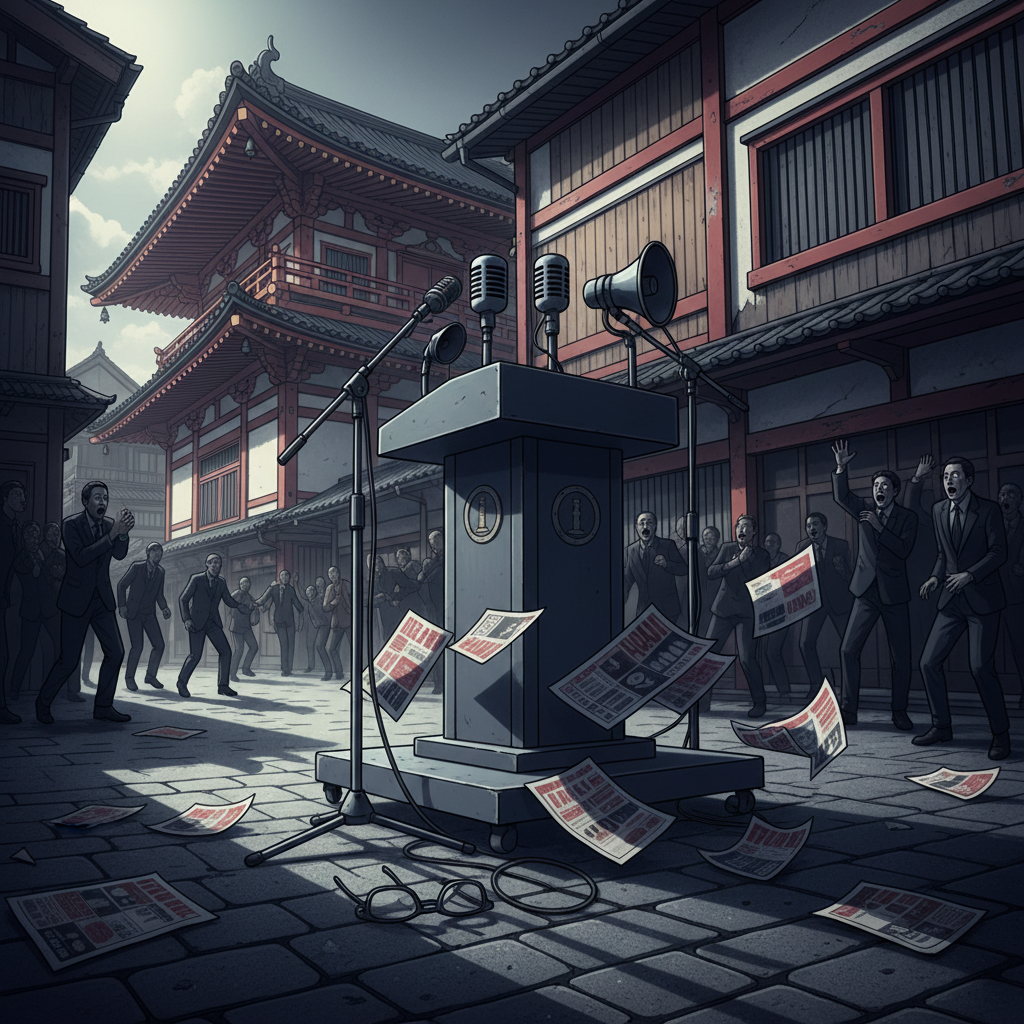
安倍晋三暗殺事件
2022年7月8日、安倍晋三元首相が奈良市内での選挙応援演説中に銃撃され死亡した。犯人の山上徹也は、母親が世界平和統一家庭連合(旧統一教会)に約1億円を献金して家族が破産したことへの恨みから、教団と最も深い関わりを持つ政治家として安倍氏を標的にした。この事件は、安倍氏の祖父である岸信介元首相が1960年代に築いた自民党と旧統一教会の関係を白日のもとにさらし、自民党国会議員の約半数が教団と何らかの接点を持っていたことが判明。2023年10月には教団の解散命令請求に至る、戦後日本最大の政治スキャンダルとなった。
エグゼクティブサマリー
6つの分析レンズは中心的な発見で一致している:安倍晋三の暗殺は、60年以上にわたり隠されてきた制度的取り決めの暴力的な露呈であった。自民党と旧統一教会の関係は、相互利益(ゲーム理論)、権力集中(マキャヴェリ)、集団的否認(ユング)、行動条件付け(パヴロフ)、継承された権力意志(ニーチェ)、そして啓示を求める隠蔽(道教)によって維持されていた。レンズは山上の行為主体性について生産的に分岐する。事前の均衡は持続不可能であり、教団解散命令を含む事後の制度的清算は、日本の政治と宗教の関係における真の構造的変革を表している。
重要な事実
複数のソースからの検証済み事実、確信度レベルで評価
Abe was shot and killed July 8, 2022, at approximately 11:30 AM during a campaign speech outside Yamato-Saidaiji Station in Nara. He was 67.
highの確信度Yamagami (41) used a homemade firearm. First shot missed; second struck Abe in neck and left upper arm, fatally damaging an artery near the heart.
highの確信度Yamagami's mother joined the Church in August 1991 and donated approximately 100 million yen (~$720,000) over seven years, including 50 million yen from husband's life insurance within months of joining. Family declared bankruptcy.
highの確信度Yamagami's father died by suicide. His brother lost sight in one eye. In 2005, Yamagami himself attempted suicide while in the Maritime Self-Defense Force.
highの確信度Abe sent a video message to a September 12, 2021 UPF rally praising the organization's focus on family values. This was a key trigger for Yamagami's targeting decision.
highの確信度Abe's grandfather Kishi Nobusuke (PM 1957-1960) established close ties with Moon Sun-myung in the 1960s. The Church HQ was at one point housed adjacent to Kishi's Tokyo residence.
highの確信度The Church co-founded the IFVC with Sasakawa Ryoichi. This anti-communist network spread Church influence throughout the LDP.
highの確信度主要アクター
このイベントに関与する主要アクターとその行動および表明された利益
Shinzo Abe
individual- ›Longest-serving PM
- ›Maintained Church-LDP relationship
- ›Sent 2021 UPF video
Tetsuya Yamagami
individual- ›Built homemade firearm
- ›Researched Abe schedule
- ›Assassinated Abe July 8 2022
Unification Church
organization- ›Cultivated LDP since 1960s
- ›Provided electoral support
- ›Extracted donations
Kishida Fumio
individual- ›Ordered LDP Church investigation
- ›Held state funeral
- ›Sought Church dissolution
リサーチとソース
イベントタイムライン
1960s-2023
因果分析
政策、アクター、イベントが因果的にどのように結びついているかを示すインタラクティブグラフ。ノードをクリックして関係を探索できます。
因果ネットワーク
14ノード · 14接続
ノードを選択
グラフ内の任意のノードをクリックして、接続とレンズの視点を探索してください
根本原因
3クリティカルパス
6ステップレンズ分析
各レンズは独自の分析フレームワークを提供します。クリックして深い分析を展開してください。
ゲーム理論分析
Western Moderngame-theoryThe assassination of Shinzo Abe represents the violent collapse of a six-decade Nash equilibrium between the LDP and the Unification Church. Yamagami's targeting calculus was strategically rational: by attacking the highest-profile Church ally rather than the Church itself, he ensured the investigation would expose the political nexus rather than being dismissed as anti-religious violence. The pre-assassination equilibrium was Pareto efficient for the LDP and Church but exploitative of Church members and the uninformed public. The new post-assassination equilibrium, enforced by the dissolution order, is more socially efficient but came at the cost of a political assassination and life imprisonment for the agent of change.
マキャヴェリ的権力分析
Greco-Roman & ClassicalmachiavelliThe Abe assassination reveals a classic Machiavellian tragedy: a political dynasty that maintained power through a morally compromised alliance ultimately had that alliance destroy its most prominent member. Abe mastered the Machiavellian arts of power consolidation, faction management, and institutional alliance-building. But he and the LDP committed the fundamental Machiavellian error of confusing concealment with resolution. The Church relationship was a known vulnerability that was managed through secrecy rather than addressed through severance. When the concealment failed, the accumulated weight of 60 years of hidden alliance crashed down at once. Kishida's post-assassination response was textbook Machiavellian crisis management: sacrifice the expendable (Church ties) to preserve the essential (LDP power), use the crisis to weaken internal rivals (Abe faction), and signal reform without surrendering structural advantage.
ユング深層心理分析
Western ModernjungThe assassination represents the violent eruption of three generations of inherited shadow. Yamagami, personally wounded by the Church's shadow practices, became the agent through whom Japan's collective shadow -- the known-but-unacknowledged Church-LDP nexus -- was forced into consciousness. The public's shift from condemnation to partial sympathy marks the beginning of collective individuation: the painful but necessary process of integrating shadow material that the persona had long concealed. The deepest Jungian insight is that the assassination was not an anomaly but an inevitability: shadow material that is repressed for 60 years does not dissolve but accumulates pressure until it erupts through whatever fault line the psyche presents.
行動条件付け分析
Western ModernpavlovThe Abe assassination illuminates behavioral conditioning operating at three levels simultaneously: the Church's operant conditioning of individual members (exploiting grief to establish donation behavior), the LDP's institutional conditioning through decades of mutual reinforcement with the Church, and Japanese society's conditioned deference to institutional authority that allowed the nexus to persist unchallenged. Yamagami's radicalization follows a classic extinction burst pattern: when all conditioned avoidance responses were extinguished, the behavioral repertoire collapsed to a single extreme response. The public's rapid counter-conditioning from condemnation to sympathy reveals that the old conditioned trust in institutional integrity was already weakened, awaiting only a sufficiently powerful unconditioned stimulus to complete the shift.
ニーチェ的権力哲学
Western ModernnietzscheThe Abe assassination presents the collision between two forms of will to power: Abe's institutional will to power (the patient, generational accumulation of political dominance through the LDP-Church alliance) and Yamagami's individual will to power (the explosive assertion of agency by a person whose entire life had been shaped by institutional domination). Nietzsche would recognize the tragic inevitability: inherited power that refuses to examine its own foundations creates the conditions for its own destruction. The double transvaluation of values -- Yamagami from terrorist to sympathetic figure, Abe from great statesman to Church collaborator -- represents a genuine Nietzschean transformation of the moral framework through which Japanese society evaluates political power and institutional corruption.
道教的分析
East AsiantaoismThe assassination of Shinzo Abe is a profound illustration of the Taoist principle that extreme yin generates extreme yang: six decades of concealment (yin) produced an explosive revelation (yang) through the most unlikely catalyst -- a single act of violence by a traumatized individual. The deepest Taoist insight is the paradox of Yamagami's action: his intention was to destroy Abe, but the consequence was to expose the institutional corruption that Abe had concealed. The assassin became the unwitting agent of truth, and the assassination became the mechanism through which a hidden relationship was brought into the light. This is wu wei in its most paradoxical form: the truth emerged not through intentional truth-seeking (which had failed for decades) but through an act of violence whose consequences flowed naturally beyond the actor's control. The Tao moved through the event, using the assassin's personal grievance as the channel through which collective truth could emerge.
収束点
複数のレンズが類似した結論に達する箇所。堅牢性を示唆しています。
Hidden institutional corruption generates pressure toward exposure
All four lenses identify the concealment of the Church-LDP nexus as inherently unstable. Game-theory identifies information asymmetry as the equilibrium's vulnerability. Jung identifies collective shadow accumulation. Taoism identifies extreme yin generating yang reversal. Pavlov identifies weakening conditioned trust.
The assassination was more consequential than the assassin intended
Yamagami intended to punish Abe for Church ties. The actual consequence was the exposure and dissolution of the entire Church-LDP institutional arrangement. Game-theory notes the equilibrium collapse. Machiavelli notes the cascade of alliance shifts. Taoism identifies wu wei (truth emerging beyond the actor's control). Nietzsche identifies the transvaluation of values.
Institutional conditioning enabled exploitation at every level
The Church conditioned individual members (pavlov), the LDP was institutionally conditioned to accept Church support (pavlov/game-theory), the public was conditioned to trust institutional arrangements (pavlov/jung), and the entire system operated through habitual power arrangements resistant to change (machiavelli).
The public sympathy shift represents genuine institutional learning
Jung sees collective individuation, Pavlov sees counter-conditioning, Nietzsche sees transvaluation of values, Taoism sees yin-yang reversal. All interpret the shift from condemnation to sympathy as substantive rather than superficial.
生産的な緊張
レンズが意見を異にする箇所。検討に値する複雑さを明らかにしています。
起こりうる未来
レンズ分析から導出されたシナリオ。異なるフレームワークに基づいて何が展開するかもしれないか。
Complete institutional reform: Church dissolved, LDP reforms transparency, Japan establishes robust political-religious separation framework
Moderate -- most likely outcome in the medium term, but depth of reform is uncertain.
Partial reform: Church dissolved but LDP finds new non-transparent organizational partners; surface reforms without structural change
Moderate-high -- Machiavellian power-seeking and conditioned patterns suggest adaptation rather than transformation.
Minimal lasting change: Church dissolution proceeds but broader political-religious relationships remain unexamined; the case treated as isolated exception
Lower -- the scale of the revelations makes this less likely, but institutional memory is short.
主要な問い
分析後も残る未解決の問い。継続的な探求のために。
- ?What was the full extent of Church influence on specific LDP policy decisions?
- ?How many Japanese families were financially destroyed by Church donation extraction?
- ?What did Abe personally know about Church coercive practices when recording the 2021 UPF video?
ファクトチェック詳細
ファクトチェック結果
verifiedメタ観察
All six lenses analyze the assassination through the Church-LDP nexus, which is where the analytical weight belongs. But they collectively underweight Abe's diplomatic legacy -- his role in strengthening the Japan-US alliance, the Quad framework, and Japan's international standing. A complete assessment of Abe requires holding both the domestic corruption nexus and the international diplomatic achievement in view simultaneously. The assassination's aftermath also has implications for Japan-South Korea relations (the Church's Korean origins) that none of the selected lenses fully address.
The Abe assassination resists single-lens explanation precisely because it operates simultaneously at personal (Yamagami's family destruction), institutional (Church-LDP alliance), cultural (Japanese norms of deference), and philosophical (questions of justice and violence) levels. Each lens illuminates one dimension clearly but necessarily distorts the others. The event is irreducibly complex because the personal and institutional, the rational and psychological, the inevitable and contingent are all simultaneously true.
This analysis was produced two years after the assassination, while the trial has concluded but the Church dissolution is still proceeding through courts. Future revelations may significantly alter our understanding of the Church-LDP relationship, Yamagami's psychology, or the institutional consequences. The reader should hold these interpretations provisionally, recognizing that events this complex continue to reveal new dimensions over time.
あなたの視点を見つける
異なるフレームワークは異なる読者に響きます。あなたの入口を見つけてください。
Readers who think in terms of incentives, power structures, and strategic calculation. You likely focus on what actors wanted, what they got, and how the institutional rules shaped their behavior.
The Church-LDP alliance was a rational arrangement sustained by mutual benefit. It collapsed when information asymmetry was destroyed. Post-assassination reforms represent a new equilibrium, not a moral awakening.
Readers who sense deeper patterns beneath surface events. You may feel that the assassination revealed something that was always true but collectively denied, and that the truth emerged with a strange inevitability.
The assassination was the eruption of collective shadow material accumulated over three generations. The truth was already seeking emergence; Yamagami was the catalyst, not the cause.
Readers who focus on how institutions shape individual behavior. You likely see the Church-LDP nexus as a product of systematic conditioning and power arrangements rather than individual moral failure.
Every actor in this event -- from Church members to LDP politicians to the Japanese public -- was shaped by conditioning processes that made the arrangement self-perpetuating until external shock disrupted it.
Readers who question dominant narratives and accepted moral frameworks. You may find yourself sympathizing with Yamagami not despite but because of the moral complexity, and questioning whether the institutional system deserved the disruption it received.
The transvaluation of values -- from condemning Yamagami to partially sympathizing with him -- reveals that the pre-assassination moral consensus was itself a product of institutional concealment rather than genuine moral reasoning.
Start with game-theory for the clearest structural analysis of what happened and why. Move to jung for the psychological depth that strategic analysis misses. Then read nietzsche for the philosophical stakes of the legacy question. Finish with taoism for the paradoxical insight that unifies the other perspectives: the assassination destroyed one man but revealed a truth that sixty years of peaceful advocacy could not.
関連分析
類似のレンズやカテゴリーを通して分析された他のイベント
1963年11月22日、ジョン・F・ケネディ大統領はテキサス州ダラスのディーリー・プラザで暗殺された。リー・ハーヴェイ・オズワルドは逮捕されたが、裁判前にジャック・ルビーに殺害された。ウォーレン委員会はオズワルドの単独犯行と結論付けたが、後のHSCAは陰謀の可能性が高いと判断した。2025年までに機密解除された文書により、CIAとFBIによる組織的な隠蔽工作が明らかとなり、アメリカ史上最も重大な未解決事件となっている。
ラップスーパースターのニッキー・ミナージュとカーディ・Bの複数年にわたる確執。2017年のチャート支配をめぐる緊張から、2018年NYFWでのハーパーズ・バザー靴投げ事件、ゴーストライティング疑惑、アトランティック・レコードのレーベル政治、そしてカーディの『Am I the Drama?』アルバムリリースに続く2025年の爆発的な再燃まで。この確執は、女性ラップにおけるゲートキーピング、「女王は一人だけ」という語り、音楽業界の女性アーティストへの扱いをめぐるより深い緊張を反映している。
1986年2月28日夜23時21分、スウェーデン首相オロフ・パルメは妻リスベスと映画館から帰宅途中、ストックホルム中心部のスヴェアヴァーゲンで射殺された。
この分析の方法
分析プロセス、ツール、および限界についての完全な透明性
Crosslightエンジン
v0.4.0 "Global Lens Expansion"- ⚠Non-Western philosophical lenses rely on translated primary texts — nuance may be lost in translation
- ⚠Some traditions (e.g., Maat, Ubuntu) have limited surviving primary texts; analysis draws on scholarly reconstruction
- ⚠Cross-cultural lens application is inherently interpretive — a Confucian reading of a Western event is an analytical exercise, not a claim of cultural authority
分析統計
方法論
この分析はCrosslightマルチエージェントパイプラインによって生成されました。リサーチエージェントが複数のソースから事実を収集・検証し、専門化されたレンズエージェントが個別の分析フレームワークを適用し、統合エージェントが洞察を統合してパターンを特定し、ファクトチェックエージェントが主張を検証しました。各レンズの視点はAIによる解釈であり、機関としての推薦ではありません。詳しく見る →