
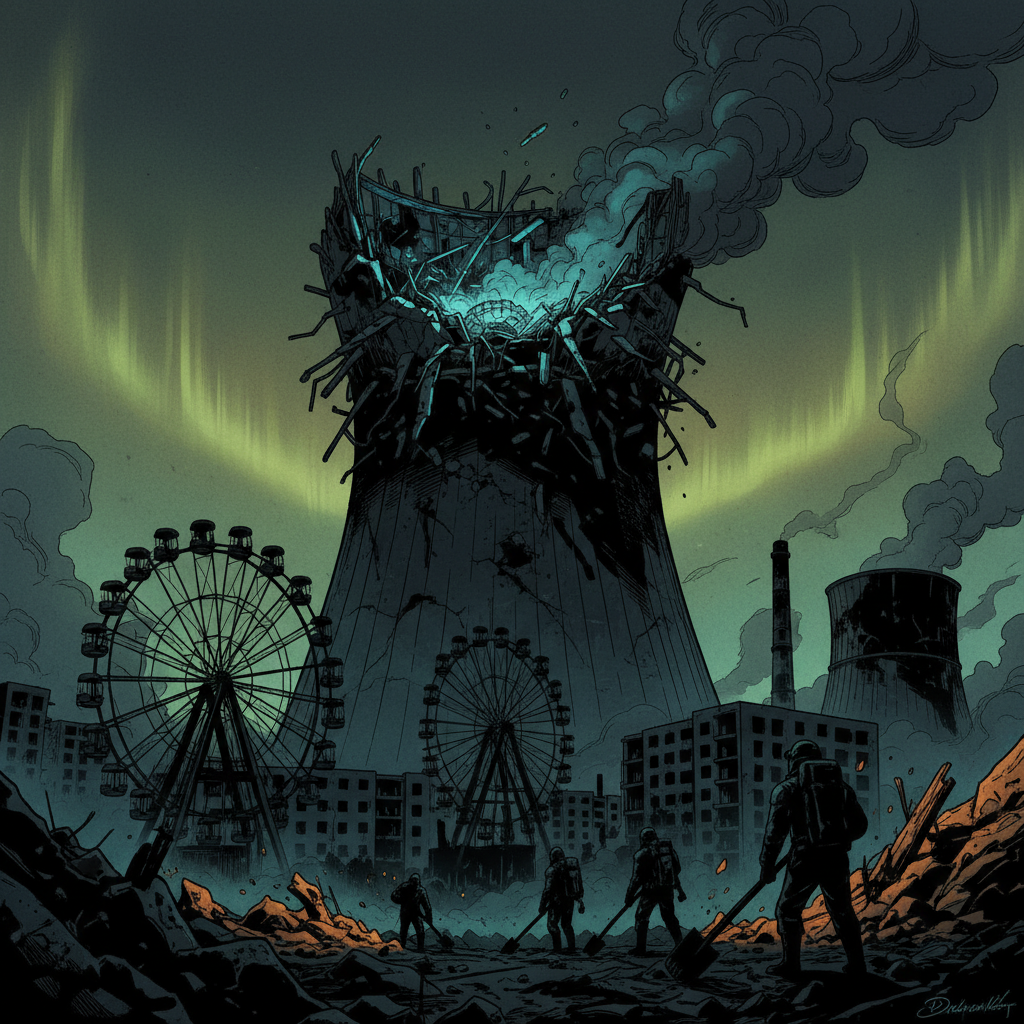
チェルノブイリ原発事故
1986年4月26日午前1時23分、ウクライナ・ソビエト社会主義共和国のチェルノブイリ原子力発電所4号炉が安全試験中に爆発し、広島原爆の400倍の放射性物質を放出した。ソ連当局は当初この大惨事を隠蔽し、プリピャチの住民49,000人に36時間にわたり通常の生活を続けさせた。約60万人の「リクビダートル(除染作業員)」が動員された。死亡者数の推定はWHOの4,000人からグリーンピースの93,000人まで幅がある。この惨事はソ連の技術的優位という神話を打ち砕き、ゴルバチョフにグラスノスチを余儀なくさせた。
エグゼクティブサマリー
7つの分析的視点が中心的な結論に収束する:チェルノブイリの惨事は二重の大災害であった——原子炉設計の妥協に根ざした技術的失敗が、ソ連体制のあらゆるレベルが人間の安全より自己保存を優先する制度的失敗によって増幅された。7つの視点すべてが一致する:制度的失敗は技術的失敗と同様に壊滅的であり、おそらくより予防可能であった。
重要な事実
複数のソースからの検証済み事実、確信度レベルで評価
At 01:23 AM on April 26, 1986, Reactor No. 4 at the Chernobyl Nuclear Power Plant exploded during a turbine rundown safety test.
highの確信度The RBMK-1000 reactor design had a known positive void coefficient of reactivity, meaning loss of coolant water increased reactivity. This was accepted as a trade-off for dual-use capability and cost savings.
highの確信度Deputy chief engineer Anatoly Dyatlov pressured operators to continue the test despite dangerously low power levels (~200 MW vs. planned 700-1000 MW). Operators disabled the ECCS and overrode automatic shutdown signals.
highの確信度Pripyat (population 49,000), 3 km from the reactor, was not evacuated until 36 hours after the explosion. Children played outdoors, weddings were held, and residents observed the fire from the 'Bridge of Death.'
highの確信度Swedish radiation monitoring stations at Forsmark detected elevated levels on April 28, forcing Soviet acknowledgment. The Soviets initially blamed a 'minor accident.'
highの確信度Approximately 600,000 liquidators were deployed between 1986 and 1990. 'Bio-robots' on the roof worked in 90-second shifts, each receiving a near-lifetime dose.
highの確信度Of 134 plant workers and firefighters diagnosed with acute radiation syndrome, 28 died within months. Their deaths were documented in clinical detail.
highの確信度主要アクター
このイベントに関与する主要アクターとその行動および表明された利益
Anatoly Dyatlov
individual- ›Supervised the safety test
- ›Pressured operators to continue at low power
- ›Ordered disabled safety systems
Mikhail Gorbachev
individual- ›Delayed public acknowledgment 18 days
- ›Blamed Western media
- ›Used Chernobyl to accelerate glasnost
Valery Legasov
individual- ›Led scientific investigation
- ›Presented Soviet narrative to IAEA
- ›Recorded truth-telling tapes
Liquidators
group- ›Built sarcophagus
- ›Cleared radioactive graphite from roof
- ›Decontaminated surrounding areas
リサーチとソース
イベントタイムライン
1954-06-27 to 1991-12-26
因果分析
政策、アクター、イベントが因果的にどのように結びついているかを示すインタラクティブグラフ。ノードをクリックして関係を探索できます。
因果ネットワーク
18ノード · 19接続
ノードを選択
グラフ内の任意のノードをクリックして、接続とレンズの視点を探索してください
根本原因
3クリティカルパス
8ステップレンズ分析
各レンズは独自の分析フレームワークを提供します。クリックして深い分析を展開してください。
ゲーム理論
Western Moderngame-theoryChernobyl was not a failure of rationality but a masterclass in how rational individual decisions within a pathological institutional structure produce collectively catastrophic outcomes. The system's information architecture was the root cause: by classifying safety data, punishing dissent, and rewarding concealment, the system guaranteed that each actor's rational choice would aggregate into civilizational disaster. The 'peaceful atom' ideology functioned as a corrupted focal point coordinating the entire system toward catastrophe. A system that makes honesty irrational will produce dishonesty at scale, and a nuclear power program built on institutional dishonesty will eventually produce Chernobyl.
マキャヴェッリ
Greco-Roman & ClassicalmachiavelliChernobyl is a perfect Machiavellian case study in institutional self-preservation becoming self-destruction. The Soviet system followed the classic playbook: conceal weakness, project strength, control information, blame subordinates. This works for political competition between elites. It fails catastrophically for governing complex technical systems where accurate information is a safety prerequisite. Nuclear reactors do not respond to political narratives — they respond to physics. When the Soviet system treated safety information as a political resource rather than a physical reality, it created conditions for an accident that physics, not politics, would determine. Gorbachev's subsequent use of Chernobyl to accelerate glasnost was genuinely Machiavellian: converting catastrophic weakness into reform leverage. But glasnost could not be confined to nuclear safety.
CIA
Western InstitutionalciaChernobyl's intelligence significance lies not in the reactor failure but in what it revealed about Soviet decision-making under crisis. The disaster stress-tested the Soviet information architecture and it failed comprehensively: upward reporting filtered bad news, lateral communication was impeded by classification, downward communication prioritized messaging over safety, international communication was dishonest until forced. The pattern — institutional mendacity as structural feature — became a key lens for assessing authoritarian fragility. The insight that information-controlled systems are brittle rather than resilient remains one of the most durable Cold War intelligence lessons.
パブロフ
Western ModernpavlovChernobyl demonstrates that institutional conditioning is a safety-critical infrastructure vulnerability. Decades of conditioning — obedience, news suppression, trust in official narratives, punishment of dissent — created patterns individually adaptive (kept people employed) but collectively catastrophic (prevented detection of and response to existential threats). The disaster was caused not by a few bad decisions on April 26 but by forty years of conditioning that made those decisions inevitable. When you condition operators to obey authority over instruments, managers to filter reality, officials to prioritize narrative over facts, and citizens to trust silence as safety — you create an anti-safety culture where every reflex moves toward catastrophe.
市民への影響
civilian-impactChernobyl's civilian impact reveals a disaster on geological timescales: centuries of contamination, generational health consequences, and psychological wounds transmitted through families. The contested death toll is ongoing harm: when official count is 31 and the range extends to 93,000, communities exist in unresolved grief. The most important lesson: the institutional failure caused as much damage as the explosion. Without the 36-hour delay, the thyroid cancer epidemic would have been significantly reduced. Without the May Day parade, Kyiv's children would not have marched through fallout. The civilian toll is a consequence not merely of the explosion but of every subsequent institutional decision that prioritized image over human life.
道教
East AsiantaoismChernobyl is the Tao's answer to the 'peaceful atom.' The Taoist reading reveals a disaster driven by fundamental violation of the principle that nature cannot be conquered, only cooperated with. The Soviet system forced the atom, forced secrecy, forced obedience, forced ignorance, forced fiction. At every point, forcing produced its opposite. The Exclusion Zone — where nature flourishes in humanity's absence — is the most eloquent Taoist commentary. The wolves of Chernobyl embody the Tao Te Ching: 'the Tao nourishes all things.' The deepest lesson: systems that deny uncertainty will be destroyed by it.
ニーチェ
Western ModernnietzscheChernobyl is the story of a will to power that confused institutional dominance with genuine mastery. The Soviet system had power to classify, conceal, command, and coerce — but not to control nuclear fission when the reactor exceeded institutional narrative. The liquidators embody Nietzsche's central question: what distinguishes authentic heroism from coerced sacrifice? The Soviet system, by making genuine choice impossible, destroyed the conditions that make heroism meaningful — then claimed the sacrifice as institutional virtue. Legasov's arc is the most purely Nietzschean story: beginning in slave morality, recognizing institutional values as lies, destroying himself in self-overcoming that affirmed individual truth. The Soviet response — blaming individuals, concealing flaws, claiming liquidator sacrifice as institutional virtue — was slave morality: inverting truth and power, making institutional survival the highest value. Chernobyl shattered that inversion at a cost measured in human lives.
収束点
複数のレンズが類似した結論に達する箇所。堅牢性を示唆しています。
Institutional mendacity as root cause
All four identify Soviet information architecture — classification, punishment of dissent, rewarding optimism — as the fundamental cause transforming technical failure into civilizational catastrophe.
The coverup caused more harm than the explosion
36-hour evacuation delay, Kyiv May Day, continued milk distribution all caused measurable additional harm. The thyroid cancer epidemic was largely preventable with timely response.
Hubris and limits of institutional control
All four converge on the insight that Soviet confidence in its own control was the precondition for losing control catastrophically.
生産的な緊張
レンズが意見を異にする箇所。検討に値する複雑さを明らかにしています。
起こりうる未来
レンズ分析から導出されたシナリオ。異なるフレームワークに基づいて何が展開するかもしれないか。
Nuclear renaissance with institutional learning
Moderate. Institutional learning genuine but incomplete. Climate pressures make expansion likely.
Another major nuclear accident exposing institutional failure
Low but non-negligible per decade.
主要な問い
分析後も残る未解決の問い。継続的な探求のために。
- ?What is the true death toll? Will advances in epidemiology resolve the 4,000-93,000 range?
- ?How many liquidators developed radiation-related conditions and were denied recognition?
- ?What was the full chain of command in the first 72 hours?
ファクトチェック詳細
ファクトチェック結果
verifiedメタ観察
All seven share a bias toward explanation. What all miss is the irreducibly incomprehensible dimension: ARS as documented by Alexievich, the three-day lie's cruelty, children's thyroid cancers. Some dimensions of Chernobyl resist comprehension and should resist it.
The relationship between technical and institutional failure is irreducibly complex: they are co-produced effects of the same Soviet institutional culture. Separating them is analytically useful but ultimately misrepresents a disaster in which technology and institutions were inseparable.
The contested death toll — 31 to 93,000 — is a permanent reminder of irreducible uncertainty. Any analysis claiming certainty is less honest than one acknowledging the range.
あなたの視点を見つける
異なるフレームワークは異なる読者に響きます。あなたの入口を見つけてください。
Readers drawn to structural explanations and institutional design. You see Chernobyl as fixable through better incentive structures.
The Soviet information architecture was the root cause. Information-controlled systems are brittle, not strong.
Readers drawn to questions about hubris, nature's limits, and moral weight of choices. Chernobyl as parable about humanity's relationship with uncontrollable forces.
The 'peaceful atom' embodied a fundamental misunderstanding: institutional will cannot master natural forces through political commitment.
Readers focused on how organizations function and how institutional cultures shape behavior. Chernobyl as case study in institutional pathology.
Behavioral conditioning and power dynamics made every actor behave rationally within their context while producing collective catastrophe.
Readers prioritizing human experience over analytical frameworks. Skeptical that any lens captures the horror of radiation sickness or the injustice of the contested death toll.
All frameworks risk abstracting away individual suffering. The thyroid cancer in a child's throat exceeds what any theory contains.
If in the analytical cluster, read civilian-impact to ground structural understanding in human experience. If intuitive, game-theory shows how 'hubris' operated through fixable mechanisms. If institutional, Nietzsche reminds that individual choices cannot be fully explained by conditioning. All readers: engage with the liquidator heroism/victimization tension without resolving it prematurely.
関連分析
類似のレンズやカテゴリーを通して分析された他のイベント
アラブの春は2010年12月からアラブ世界を席巻いた抵抗運動、蜂起、武装反乱の革命的な波であった。2010年12月17日にチュニジアの路上販売人モハメド・ブアジジの焼身自殺が引き金となった。「الشعب يريد إسقاط النظام」(人民は体制の崩壊を望む)というスローガンがチュニスからカイロ、ベンガジからダマスカスまで響き渡った。軍の選択——デモ参加者の側につくか体制に忠誠であり続けるか——が各国で決定的な変数となった。
1994年4月6日から7月18日の間に、ルワンダで約80万人のツチ族と穏健派フツ族が100日間で組織的に殺害されました——近代史上最も効率的な大量殺戴であり、ホロコーストを上回る1日あたりの死亡率でした。このジェノサイドは「古代の部族間憾恶」の爆発ではなく、植民地計画の破滅的結末でした:ベルギーの管理者たちは1933年の国勢調査と義務的な民族身分証明書を通じて、流動的な社会的アイデンティティから硬直的な人種カテゴリーを製造しました。RTLMラジオ——「ラジオ・マシェテ」——は何年もの非人間化プロパガンダを通じて体系的に住民を条件付けしました。25万人から50万人の女性がジェノサイドの意図的な武器として強姦されました。国際社会の失敗は受動的ではなく能動的でした:ダレールは3か月前に警告を送り、5,000人の兵士を要請し、拒否されました。RPFの軍事的勝利は1994年7月にジェノサイドを終結させましたが、余波は第一次コンゴ戦争(1996-97)と500万人以上が死亡した「アフリカの世界大戦」に波及しました。
1963年11月22日、ジョン・F・ケネディ大統領はテキサス州ダラスのディーリー・プラザで暗殺された。リー・ハーヴェイ・オズワルドは逮捕されたが、裁判前にジャック・ルビーに殺害された。ウォーレン委員会はオズワルドの単独犯行と結論付けたが、後のHSCAは陰謀の可能性が高いと判断した。2025年までに機密解除された文書により、CIAとFBIによる組織的な隠蔽工作が明らかとなり、アメリカ史上最も重大な未解決事件となっている。
この分析の方法
分析プロセス、ツール、および限界についての完全な透明性
Crosslightエンジン
v0.4.0 "Global Lens Expansion"- ⚠Non-Western philosophical lenses rely on translated primary texts — nuance may be lost in translation
- ⚠Some traditions (e.g., Maat, Ubuntu) have limited surviving primary texts; analysis draws on scholarly reconstruction
- ⚠Cross-cultural lens application is inherently interpretive — a Confucian reading of a Western event is an analytical exercise, not a claim of cultural authority
分析統計
方法論
この分析はCrosslightマルチエージェントパイプラインによって生成されました。リサーチエージェントが複数のソースから事実を収集・検証し、専門化されたレンズエージェントが個別の分析フレームワークを適用し、統合エージェントが洞察を統合してパターンを特定し、ファクトチェックエージェントが主張を検証しました。各レンズの視点はAIによる解釈であり、機関としての推薦ではありません。詳しく見る →