세월호 참사
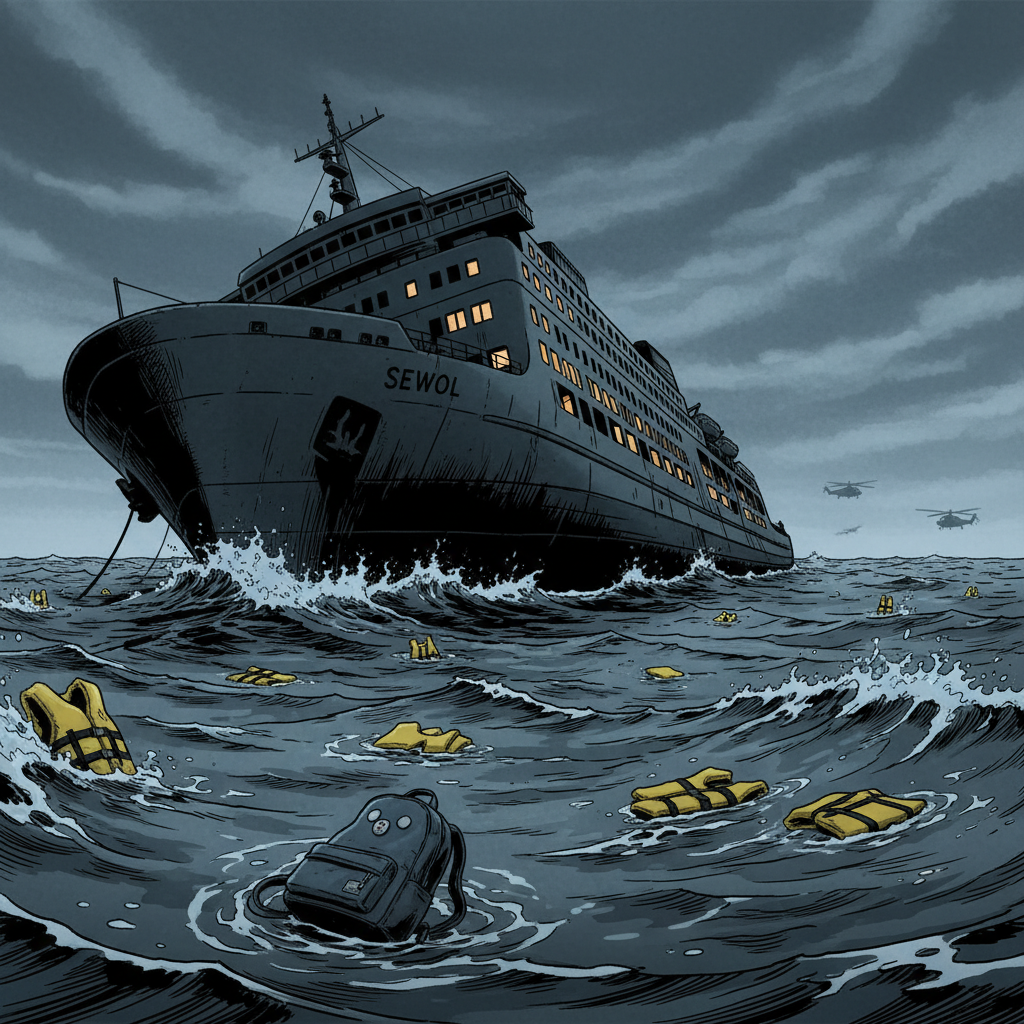
2014년 4월 16일, 대한민국 여객선 세월호가 인천에서 제주도로 향하던 중 전복되어 침몰했다. 탑승자 476명 중 304명이 사망했으며, 이 중 250명은 경기도 안산시 단원고등학교 2학년 학생들(16~17세)로 수학여행 중이었다. 이 참사는 대한민국 해양 안전 체계의 구조적 실패를 드러냈다. 선박은 불법으로 개조되어 더 많은 승객과 화물을 실을 수 있게 되었고, 법정 적재량의 두 배 이상의 화물을 싣고 있었으며, 승무원들은 승객들에게 선실에 머물라고 반복적으로 안내하면서 자신들은 배를 버렸다. 박근혜 대통령의 결정적 초기 시간 동안의 설명되지 않는 7시간 공백은 주요 정치 스캔들이 되어 2017년 탄핵에 기여했다. 세월호 참사는 대한민국의 제도적 실패의 상징이 되었다.
요약
7개 분석 렌즈는 하나의 파괴적 결론으로 수렴한다: 세월호 참사는 사고가 아니라, 속도·이윤·위계적 복종을 인간의 안전보다 체계적으로 우선시한 사회 시스템의 필연적 산물이었다. 모든 렌즈가 개인의 무능이 아닌 체계적 실패를 근본 원인으로 지목하지만, 가장 중요한 체계적 차원이 무엇인지에 대해서는 차이를 보인다. 가장 심오한 통찰은 유교적 분석과 파블로프적 분석의 교차점에서 나온다: 한국 사회가 아이들에게 가장 함양시키는 덕목인 권위에 대한 복종이, 권위가 신뢰에 부합하지 못했을 때 그들의 죽음의 메커니즘이 되었다.
핵심 사실
다중 소스 리서치에서 검증된 사실, 신뢰도 수준별 평가
MV Sewol departed Incheon at approximately 9:00 PM on April 15, 2014, with 476 people: 443 passengers (325 Danwon High School students, 14 teachers) and 33 crew.
high 신뢰도Distress signal sent at 08:58 KST on April 16, 2014. The ship took approximately two and a half hours to sink.
high 신뢰도MV Sewol was originally the Japanese ferry Naminoue (built 1994). Chonghaejin Marine purchased it in 2012 and illegally modified it to add passenger cabins on upper decks, raising center of gravity.
high 신뢰도Sewol carried 2,142.7 tons of cargo against a legal maximum of 987 tons, with only 761.2 tons of ballast water. Included 180 vehicles (recorded as 150) and 1,157+ tons of freight.
high 신뢰도Captain Lee Joon-seok (age 69) and 14 crew evacuated while PA system told passengers to remain in cabins.
high 신뢰도Of 172 survivors, more than half were rescued by civilian fishing boats that arrived ~40 minutes before the Korea Coast Guard.
high 신뢰도304 people died, including ~250 Danwon High School students aged 16-17. About 82% of casualties were children.
high 신뢰도주요 행위자
이 사건에 관련된 주요 행위자와 그들의 행동 및 공식적 이해관계
이준석 선장
individual- ›Failed to issue evacuation order
- ›Abandoned ship while passengers remained below
- ›Was among first crew rescued
청해진해운
corporation- ›Purchased and illegally modified MV Sewol
- ›Routinely overloaded beyond legal limits
- ›Falsified cargo manifests
박근혜 대통령
individual- ›Absent from crisis management for seven hours
- ›Blamed captain and crew publicly
- ›Ordered Coast Guard dissolution
대한민국 해양경찰청
organization- ›Arrived 40 min after civilian boats
- ›Failed to enter sinking vessel
- ›Rescued captain/crew first
단원고등학교 유가족
group- ›Established Paengmok Harbor vigil
- ›Launched yellow ribbon movement
- ›Demanded independent investigation
리서치 및 출처
사건 타임라인
2009-2017
인과 분석
정책, 행위자, 사건이 인과적으로 어떻게 연결되는지 보여주는 인터랙티브 그래프 — 노드를 클릭하여 관계를 탐색하세요
인과 네트워크
14개 노드 · 16개 연결
노드 선택
그래프에서 노드를 클릭하여 연결과 렌즈 관점을 탐색하세요
근본 원인
1핵심 경로
8단계렌즈 분석
각 렌즈는 독자적인 분석 프레임워크를 제공합니다 — 클릭하여 심층 분석을 펼쳐보세요
민간인 피해 영향 분석
civilian-impactThe Sewol disaster inverts the expected moral calculus of obedience: children who followed instructions died while those who defied authority survived. This produced not merely grief but a fundamental crisis of institutional trust in South Korean society, transforming a maritime accident into a civilization-level reckoning with the relationship between authority, obedience, and the duty of care.
유교 윤리
East AsianconfucianThe Sewol disaster reveals the lethal paradox at the heart of Confucian obedience culture: the very virtue of respectful compliance that Korean society cultivates in its children became the mechanism of their deaths when the authority figures they trusted violated every Confucian duty of care. The disaster demands a reckoning not with Confucianism itself but with its distortion — obedience without the reciprocal obligation of benevolent authority that makes Confucian hierarchy ethically coherent.
게임 이론
Western Moderngame-theoryThe Sewol disaster is a textbook case of catastrophic equilibrium: every actor behaved rationally given the incentive structure they faced, and 304 people died. The regulatory capture equilibrium was individually rational for both regulators and industry, the captain's abandonment was individually rational given the payoff structure, and the students' obedience was rational given their information state. The tragedy is that the system produced collectively catastrophic outcomes from individually rational choices at every level.
행동 조건화 분석
Western ModernpavlovThe Sewol disaster demonstrates that behavioral conditioning is not merely a laboratory phenomenon but a lethal social force. The Korean education system's systematic conditioning of obedience produced students who followed fatal instructions as automatically as Pavlov's dogs responded to bells. The tragedy is not that the conditioning 'failed' — it worked perfectly. The students did exactly what they had been trained to do. The failure was in the system that conditioned obedience without ensuring the authorities being obeyed were worthy of that conditioned trust.
마키아벨리적 현실정치
Greco-Roman & ClassicalmachiavelliThe Sewol disaster is a Machiavellian masterclass in how appearance devours substance. Park Geun-hye may or may not have been monitoring the crisis during the seven missing hours — but it does not matter. Machiavelli teaches that for a prince, appearing to act is as important as acting. By disappearing during the crisis, Park violated the cardinal Machiavellian principle: never let your people see you as either incompetent or indifferent, for they will forgive cruelty before they forgive contempt.
기업 이익 분석
Western ModerncorporateThe Sewol disaster demonstrates that regulatory capture is not a market 'imperfection' but a predictable equilibrium outcome when the regulated industry has concentrated interests and the public has diffuse ones. Chonghaejin Marine did not 'break' the system — it operated exactly as the system was designed to allow. The 304 deaths are the externalized cost of a regulatory regime that systematically valued corporate profitability over public safety.
그람시적 분석 (문화적 헤게모니)
Western ModerngramsciThe Sewol disaster reveals that ppalli-ppalli is not a neutral cultural trait but a hegemonic formation — a way of organizing society that serves particular class interests while appearing as universal common sense. When 250 children died because speed and profit were prioritized over safety and care, the hegemonic spell was broken. The yellow ribbon movement and the candlelight protests represent one of the most successful counter-hegemonic mobilizations in recent East Asian history: a war of position that toppled a president and, for a time, made a new common sense — that the state's first duty is to protect life, not to facilitate profit.
수렴점
여러 렌즈가 유사한 결론에 도달하는 지점 — 분석의 견고성을 시사합니다
Systemic institutional failure, not individual incompetence
All four lenses independently identify the disaster as the product of systemic failures — regulatory capture, corporate impunity, deregulation ideology — rather than merely individual bad actors. Captain Lee's abandonment and Park's absence are symptoms, not causes.
Obedience to authority as lethal mechanism
The Confucian, Pavlovian, and civilian impact lenses all identify the students' conditioned obedience as the proximate cause of the extreme casualty concentration. The cultural conditioning that produced compliance (Confucian/Pavlov) directly produced the casualties (civilian impact).
Appearance vs. reality in governance
Machiavelli identifies the failure of political appearance management; Gramsci identifies the hegemonic construction of 'common sense' that masked danger; corporate analysis identifies the regulatory capture that created the appearance of oversight without substance.
Post-1997 deregulation as causal root
Corporate, Gramscian, and game theory analyses all trace the causal chain back to the post-Asian Financial Crisis deregulation regime that created the institutional conditions for the disaster.
생산적 긴장
렌즈들이 의견을 달리하는 지점 — 검토할 가치가 있는 복잡성을 드러냅니다
가능한 미래
렌즈 분석으로부터 도출된 시나리오 — 다양한 프레임워크에 기반하여 전개될 수 있는 상황
Durable reform: Sewol becomes Korea's 'never again' moment
Medium — possible if reforms are institutionalized before political attention fades
Gradual erosion: Reforms decay as memories fade
Medium-high — historical pattern suggests regulatory reforms erode within 15-20 years without sustained political pressure
Cultural transformation: Korean society fundamentally rebalances obedience norms
Low — deep cultural conditioning is resistant to event-driven change
핵심 질문
분석 후에도 미해결로 남은 질문들 — 지속적인 탐구를 위해
- ?What was Park Geun-hye doing during the seven missing hours?
- ?How many previous overloading incidents occurred on Sewol routes before the disaster?
- ?What was the exact relationship between maritime regulators and Chonghaejin Marine personnel?
팩트체크 상세
팩트체크 결과
verified메타 관찰
All seven lenses focus on what went wrong and why, but none adequately accounts for the acts of extraordinary courage that also occurred: the crew member Park Ji-young (age 22) who helped students put on life vests and pushed them toward exits before she herself drowned, or the students who defied instructions to help classmates. The disaster produced both the worst and the best of human behavior, and an exclusive focus on failure risks dishonoring those who chose courage.
The Sewol disaster sits at the intersection of culture (Confucian hierarchy), economics (neoliberal deregulation), politics (regulatory capture and presidential accountability), psychology (conditioned obedience), and technology (maritime engineering). No single lens can capture this intersection; the seven together approach but do not exhaust the event's meaning.
This analysis was conducted from outside Korean culture, primarily using English-language sources. Korean-language scholarship, survivor testimony, and the Sewol families' own articulation of what the disaster means should be weighted more heavily than any external analytical framework. The most important voices in this analysis are those of the 304 who cannot speak and the families who speak for them.
자신의 관점 찾기
다양한 프레임워크는 독자에 따라 다르게 공명합니다 — 자신에게 맞는 진입점을 찾아보세요
Readers who think in terms of incentives, systems, and institutional design. You see the disaster as a predictable outcome of misaligned incentives and regulatory failure.
The disaster was rational at every level — the system produced catastrophic outcomes from individually rational choices. Reform requires changing incentive structures, not just punishing individuals.
Readers who focus on cultural context, human behavior, and the relationship between individuals and the social systems that shape them. You see the disaster as a failure of the social contract between authority and trust.
The obedience that killed the students was a product of the very social system that Korean society values most. Reform requires rethinking the relationship between authority and compliance, not just fixing regulations.
Readers who focus on leadership, governance, and the responsibilities of those in power. You see the disaster as a failure of leadership at every level.
Leaders' failure to fulfill their duty of care — captain, company, president — produced both the disaster and the political consequences. The appearance of caring is inseparable from the substance of governance.
Readers who question dominant narratives and look for whose interests are served by 'common sense.' You see the disaster as the product of a hegemonic system that normalized danger.
Ppalli-ppalli culture and deregulation ideology were not neutral — they served particular class interests while appearing as universal Korean values. The reforms may be transformismo: surface changes that preserve underlying power structures.
Start with the convergences — all seven lenses agree on systemic failure. Then explore the tensions: the debate between individual agency (Machiavelli) and structural determinism (Gramsci) reveals the most productive analytical ground. The Confucian-Pavlovian intersection on obedience is the most distinctive insight this analysis produces.
관련 분석
유사한 렌즈나 카테고리를 통해 분석된 다른 사건들
1986년 4월 26일 오전 1시 23분, 우크라이나 소비에트 사회주의 공화국의 체르노빌 원자력 발전소 4호기가 안전 시험 중 폭발하여 히로시마 원폭의 400배에 달하는 방사성 물질을 방출했다. 소련 당국은 처음에 재앙을 은폐하여 프리피야트 주민 49,000명이 36시간 동안 정상 생활을 계속하도록 강요했다. 약 60만 명의 '리크비다토르(청소부대)'가 투입되었다. 사망자 추정치는 WHO의 4,000명에서 그린피스의 93,000명까지 다양하다.
아랍의 봄은 2010년 12월부터 아랍 세계를 휘쓸은 시위, 봉기, 무장 반란의 혁명적 물결이었다. 2010년 12월 17일 튜니지 노점상 모하메드 부아지지의 분신자살로 촉발되었다. "الشعب يريد إسقاط النظام" (국민은 체제의 붕괴를 원한다)라는 구호가 튜니스에서 카이로, 벤가지에서 다마스쿠스까지 울려 퍼졌다. 군의 선택—시위대 편에 설 것인가 체제에 충성할 것인가—이 모든 나라에서 결정적 변수임이 입증되었다.
1994년 4월 6일부터 7월 18일까지 100일 동안 르완다에서 약 80만 명의 투치족과 온건파 후투족이 체계적으로 학살되었습니다 — 근대 역사상 가장 효율적인 대량 학살이며 홀로코스트보다 높은 일일 사망률을 기록했습니다. 이 제노사이드는 '고대 부족 적대감'의 폭발이 아니라 식민 프로젝트의 파멸적 결말이었습니다: 벨기에 관리자들이 1933년 인구조사와 의무적 민족 신분증을 통해 유동적인 사회적 정체성에서 경직된 인종 범주를 제조했습니다. RTLM 라디오 — '라디오 마쉐테' — 는 수년간의 비인간화 선전을 통해 체계적으로 인구를 조건화했습니다. 25만~50만 명의 여성이 제노사이드의 의도적 무기로 강간당했습니다. 국제사회의 실패는 능동적이었습니다: 달레르는 3개월 전 경고를 보냈고, 5,000명의 병력을 요청했으며, 거부당했습니다. RPF의 군사적 승리는 1994년 7월 제노사이드를 종식시켰지만, 여파는 제1차 콩고 전쟁(1996-97)과 500만 명 이상이 사망한 '아프리카의 세계대전'으로 확산되었습니다.
분석 방법
분석 프로세스, 도구, 한계에 대한 완전한 투명성
Crosslight 엔진
v0.4.0 "Global Lens Expansion"- ⚠Non-Western philosophical lenses rely on translated primary texts — nuance may be lost in translation
- ⚠Some traditions (e.g., Maat, Ubuntu) have limited surviving primary texts; analysis draws on scholarly reconstruction
- ⚠Cross-cultural lens application is inherently interpretive — a Confucian reading of a Western event is an analytical exercise, not a claim of cultural authority
분석 통계
방법론
이 분석은 Crosslight 다중 에이전트 파이프라인에 의해 생성되었습니다. 리서치 에이전트가 여러 출처로부터 사실을 수집하고 검증하였으며, 전문화된 렌즈 에이전트가 각각의 분석 프레임워크를 적용하였고, 종합 에이전트가 인사이트를 통합하여 패턴을 파악하였으며, 팩트체크 에이전트가 주장을 검증하였습니다. 각 렌즈의 관점은 AI의 해석이며 — 기관의 공식 입장을 대변하지 않습니다.더 알아보기 →