
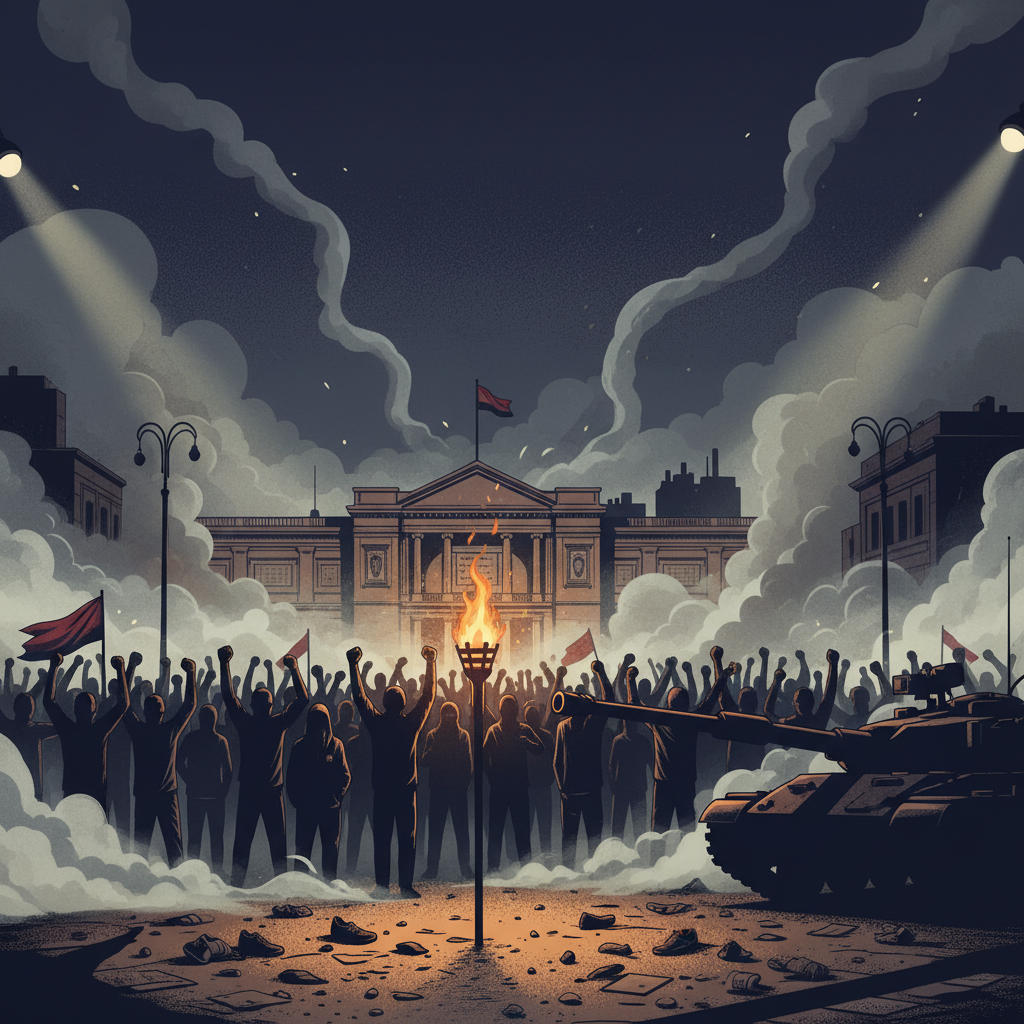
Primavera Árabe 2011
A Primavera Árabe foi uma onda revolucionária de protestos, levantes e rebeliões armadas que varreu o mundo árabe a partir de dezembro de 2010. Desencadeada pela autoimolação do vendedor ambulante tunisiano Mohamed Bouazizi em 17 de dezembro de 2010, o movimento espalhou-se com velocidade impressionante pelo Norte da África e Oriente Médio. O cântico definidor "الشعب يريد إسقاط النظام" (O povo quer a queda do regime) ecoou de Tunís ao Cairo, de Benghazi a Damasco. A escolha dos militares — apoiar os manifestantes ou permanecer leal ao regime — provou ser a variável decisiva em cada país.
Resumo Executivo
Sete perspectivas analíticas convergem para uma constatação central: a Primavera Árabe foi a erupção inevitável de décadas de aspirações humanas reprimidas, mas seus resultados foram determinados não pelas aspirações de milhões, mas pelos cálculos institucionais das elites militares e pelas intervenções estratégicas de potências externas.
Fatos-Chave
Fatos verificados de pesquisa multifonte, classificados por nivel de confianca
Mohamed Bouazizi, a 26-year-old street vendor in Sidi Bouzid, Tunisia, set himself on fire on December 17, 2010, after his produce cart was confiscated and he was humiliated by a municipal official. He died of his injuries on January 4, 2011.
Confianca highTunisian President Zine El Abidine Ben Ali fled to Saudi Arabia on January 14, 2011, ending his 23-year rule. Tunisia's military refused to fire on protesters.
Confianca highMass protests began in Egypt on January 25, 2011 (the 'Day of Rage'), centering on Tahrir Square in Cairo. President Hosni Mubarak resigned on February 11, 2011, after 30 years in power.
Confianca highEgypt's Supreme Council of the Armed Forces (SCAF) sided with protesters and forced Mubarak's resignation, protecting the military's extensive economic and institutional interests.
Confianca highMohamed Morsi of the Muslim Brotherhood won Egypt's first free presidential election in June 2012. He was removed by a military coup led by General Abdel Fattah al-Sisi on July 3, 2013.
Confianca highProtests against Muammar Gaddafi began in Benghazi, Libya on February 15, 2011. UN Security Council Resolution 1973 authorized a no-fly zone. NATO intervened militarily beginning March 19, 2011. Gaddafi was captured and killed on October 20, 2011.
Confianca highAnti-government protests began in Daraa, Syria in mid-March 2011 after schoolchildren were detained for anti-regime graffiti. The Assad regime responded with military force, escalating into civil war.
Confianca highAtores-Chave
Principais atores envolvidos neste evento com suas acoes e interesses declarados
Mohamed Bouazizi
individual- ›Set himself on fire on December 17, 2010 in Sidi Bouzid, Tunisia
Hosni Mubarak
individual- ›Imposed curfew and deployed military to streets
- ›Shut down internet and mobile communications
- ›Resigned on February 11, 2011
Muammar Gaddafi
individual- ›Ordered military to suppress protests violently
- ›Threatened to 'cleanse Libya house by house'
- ›Fought NATO intervention until captured and killed
Bashar al-Assad
individual- ›Deployed military against civilian protesters
- ›Used barrel bombs and chemical weapons against civilian areas
- ›Relied on Iranian and Russian military support
Al Jazeera
organization- ›Provided 24/7 satellite coverage of Arab Spring protests across the region
- ›Amplified protest movements through pan-Arab broadcasts reaching millions
- ›Created a shared narrative space across Arab-speaking populations
Pesquisa e Fontes
Linha do Tempo do Evento
2010-12-17 to 2015-09-01
Analise Causal
Grafo interativo mostrando como politicas, atores e eventos se conectam causalmente — clique nos nos para explorar relacoes
REDE CAUSAL
21 nos · 18 conexoes
Selecione um no
Clique em qualquer no do grafo para explorar suas conexoes e perspectivas de lentes
Causas Raiz
3Caminho Critico
9 etapasAnalises por Lente
Cada lente fornece uma estrutura analitica unica — clique para expandir a analise profunda
Teoria dos Jogos
Western Moderngame-theoryThe Arab Spring was a massive multi-player sequential game where each country's outcome changed the information set for all other players. Tunisia's success solved the collective action problem by demonstrating that revolution was possible — but the game-theoretic insight is that the same initial shock (popular uprising) produced radically different outcomes depending on one variable: whether the military's institutional interests were better served by defecting from or remaining loyal to the regime. This is the 'military kingmaker' dynamic — not a bug in the revolutionary wave but the fundamental strategic variable that determined winners and losers.
Maquiavel
Greco-Roman & ClassicalmachiavelliThe Arab Spring is a masterclass in Machiavellian power dynamics: it demonstrated that power built solely on fear collapses catastrophically when the fear barrier breaks. The military — not the people, not social media, not Western intervention — was the prince-maker in every country. Where the military calculated that its institutional interests were better served by sacrificing the ruler (Tunisia, Egypt), transitions were relatively peaceful. Where the military's survival was bound to the regime (Syria's Alawite officers, Bahrain's Sunni security forces), the result was either civil war or brutal suppression. The tragedy of the Arab Spring, in Machiavellian terms, is that destroying the old order proved far easier than building a new one. As Machiavelli warned: 'There is nothing more difficult to take in hand, more perilous to conduct, or more uncertain in its success, than to take the lead in the introduction of a new order of things.'
Avaliação de Inteligência da CIA
Western InstitutionalciaThe Arab Spring exposed the central paradox of US intelligence engagement in the Middle East: the very authoritarian relationships that provided counter-terrorism intelligence created the conditions for the revolutionary explosions that destroyed those relationships. The CIA's partnerships with Mubarak's GIS, Ben Ali's secret police, and Gaddafi's reformed intelligence services gave the US excellent visibility into specific terrorist networks but no understanding of the structural rage building across Arab societies. The intelligence failure was not in the collection but in the analytical framework — the inability to see that 'stable authoritarian allies' was a contradiction in terms, and that the suppressed frustrations of millions of young Arabs constituted a strategic threat greater than any specific terrorist organization.
Análise de Condicionamento Pavloviano
Western ModernpavlovThe Arab Spring demonstrates that authoritarian control based on conditioned fear is inherently fragile: it works perfectly until it doesn't, and when it fails, it fails catastrophically. Decades of conditioning created a population that appeared compliant but was actually a pressure cooker of suppressed frustration. Bouazizi's act served as the extinction trial that demonstrated the old contingency no longer held. Al Jazeera's broadcasts generalized this extinction across the Arab world. But conditioning theory also explains the tragedy: it is far easier to extinguish a fear response (stop obeying) than to condition new constructive behaviors (build democratic institutions). The Arab Spring succeeded as mass behavioral de-conditioning — the fear was broken — but failed as re-conditioning toward democratic habits, which require years of consistent reinforcement that the post-revolutionary environment could not provide.
Análise Nietzschiana
Western ModernnietzscheThe Arab Spring was a revolt of dignity — ثورة الكرامة — and Nietzsche's philosophy provides the deepest reading of what dignity means in this context. It was not merely a demand for political rights but an existential assertion: the refusal to accept humiliation as the human condition. Bouazizi's act was the purest expression of will against a system that had crushed all will. The tragedy is Nietzsche's own warning: destruction of the old order is the easy part. The hard part — the creation of new values, the emergence of what Nietzsche would call higher types of human organizing — requires precisely the kind of patient, creative work that revolutionary energy cannot sustain. The Arab Spring proved that the will to power can topple any regime, but it cannot, by itself, build what comes next.
Análise Taoísta
East AsiantaoismThe Arab Spring is the Tao's most powerful modern demonstration of the principle of reversal (反, fan): whatever reaches an extreme produces its opposite. Decades of authoritarian rigidity (extreme yang) produced explosive revolutionary energy (extreme yin). Regimes that gripped tighter fell faster — Gaddafi's 42 years of iron control shattered into state collapse; Assad's brutal suppression produced the century's worst humanitarian disaster. Regimes that bent survived — Morocco's limited reforms, Jordan's modest concessions. The Tao's deepest insight about the Arab Spring is this: the revolutionary wave moved not through strategic coordination but through the natural resonance of shared grievances, flowing like water through every crack in authoritarian structures. It could not be stopped because it was not being directed — it was the Tao itself, the natural flow of suppressed human aspiration finding expression. But the Tao also teaches that water, unconstrained, floods and destroys. The Arab Spring's devastation in Libya and Syria is water without banks — natural force without the channels needed to direct it constructively.
Avaliação do Impacto Civil
civilian-impactThe Arab Spring's civilian impact reveals the terrible disproportion between revolutionary aspiration and human cost. Millions of people demanded nothing more than dignity, economic opportunity, and an end to corruption — the most basic human aspirations. In Tunisia, these aspirations were achieved at relatively low cost. In Syria, the same aspirations produced the worst humanitarian catastrophe of the 21st century. The difference was not in what civilians wanted or how they protested, but in the structural variables they could not control: military loyalty, sectarian composition, external intervention, and the willingness of rulers to destroy their own countries rather than relinquish power. The most devastating finding of this analysis is that the people who suffered most — Syrian civilians — had the least agency in determining their fate. They were caught between a regime willing to use chemical weapons, an opposition that fragmented into rival militias, external powers pursuing strategic interests, and a jihadist movement (ISIS) that exploited the chaos. The Arab Spring's human cost is not a story of failed revolution — it is a story of civilians trapped in conflicts they did not choose, determined by forces they could not influence.
Convergencias
Onde multiplas lentes chegam a conclusoes semelhantes — sugerindo robustez
Military loyalty as the decisive variable
All four lenses independently identify the military's institutional choice as the factor that determined whether revolutions succeeded peacefully, devolved into civil war, or were crushed. This is the single strongest convergence across all analyses.
Authoritarian stability is inherently fragile
Game theory shows that fear-based equilibria collapse when the punishment mechanism fails. Pavlov shows that conditioned fear extinguishes when the contingency breaks. Taoism shows that rigid systems produce their own reversal. CIA learned that 'stable authoritarian allies' was a strategic delusion. All agree: apparent authoritarian stability masks fragility.
Destruction of old orders is easier than construction of new ones
Machiavelli warned that establishing new orders is the most difficult political undertaking. Nietzsche identifies the Ubermensch problem — revolutions lack creative vision for what comes after. Taoism sees unconstrained water (revolution without institutional channels) as destructive. Civilian impact documents the human cost of this gap between destruction and construction.
Tensoes Produtivas
Onde as lentes discordam — revelando complexidade que merece exame
Futuros Possiveis
Cenarios derivados das analises por lente — o que pode se desenrolar com base em diferentes estruturas
Second wave of Arab uprisings driven by unresolved structural grievances
Medium — the structural conditions remain, but the memory of Syria's catastrophe acts as a powerful deterrent
Authoritarian adaptation and tech-enabled control prevent future uprisings
Medium-high — authoritarian regimes have invested heavily in learning from the Arab Spring's failures
Tunisia's democratic path consolidates and gradually influences the region
Low — Tunisia's own democracy has faced setbacks since 2021 (Kais Saied's power concentration)
Questoes-Chave
Questoes que permanecem abertas apos a analise — para investigacao continua
- ?What was the precise role of Gulf intelligence services in funding and directing various factions?
- ?To what extent did Al Jazeera's editorial decisions shape the direction of the Arab Spring?
- ?What were the internal deliberations within military high commands that determined their choices?
Detalhes da Verificacao
Resultados da Verificacao
verifiedMeta Observacoes
All seven lenses are fundamentally retrospective — they analyze what happened and why, but none fully captures the lived experience of revolutionary hope before it turned to despair. The Arab Spring was, for millions of people, the most exhilarating experience of their lives — a moment of collective agency and shared purpose that cannot be reduced to strategic calculation, conditioning, or power dynamics. That hope, even though it was largely betrayed by outcomes, was real and transformative for those who experienced it.
The Arab Spring involves simultaneous causation at multiple scales — individual psychology (Bouazizi), institutional dynamics (military choices), regional contagion (media amplification), and global geopolitics (external intervention) — that cannot be adequately captured by any single analytical framework. The seven lenses together approach a more complete picture, but the full complexity of a revolutionary wave affecting 300+ million people across 20 countries over five years exceeds any analytical capacity.
The Arab Spring humbled every analytical framework that tried to predict or explain it in real time. Intelligence agencies did not predict it. Academic experts did not anticipate its trajectory. No single theory — rational choice, structuralism, constructivism, or any other — captured the full dynamic. This analysis, with its seven lenses, is an attempt to triangulate toward truth, but the reader should hold all conclusions with appropriate humility.
Encontre Sua Perspectiva
Diferentes estruturas ressoam com diferentes leitores — encontre seu ponto de entrada
Readers who see the Arab Spring primarily through strategic dynamics, institutional calculations, and power politics — who ask 'what were the incentives?' and 'who benefited?'
The military kingmaker dynamic and the failure of intelligence frameworks to predict popular uprisings
Readers who see the Arab Spring as an expression of deep human aspirations — dignity, freedom, natural flow against artificial constraint — and who feel the movement's moral power
The revolt of dignity and the paradox of control — regimes that gripped tighter fell faster
Readers focused on power structures, institutional dynamics, and the concrete consequences of political action — who ask 'what happened to real people?' and 'who holds power?'
The gap between revolutionary aspiration and institutional capacity to build new orders, and the devastating human cost of that gap
Readers skeptical of grand narratives who focus on mechanisms, costs, and unintended consequences — who ask 'how did it actually spread?' and 'what was the real price?'
The conditioning dynamics that made the wave possible and the cruel arithmetic of human suffering across the spectrum
Start with the lens that resonates most, then deliberately read the lens that challenges your assumptions. If you see strategic rationality (game-theory), read the existential dimension (nietzsche). If you feel the moral power of the movement (nietzsche), confront the human cost (civilian-impact). The Arab Spring's full truth lives in the tension between these perspectives, not in any single lens.
Analises Relacionadas
Outros eventos analisados com lentes ou categorias semelhantes
Em 26 de abril de 1986, às 01h23, o reator n.º 4 da central nuclear de Chernobyl na RSS da Ucrânia explodiu durante um teste de segurança, libertando 400 vezes mais material radioativo que a bomba de Hiroshima. As autoridades soviéticas ocultaram inicialmente o desastre, obrigando os 49.000 residentes de Pripyat a manter a vida normal durante 36 horas. Cerca de 600.000 'liquidadores' foram mobilizados. As estimativas de mortes variam de 4.000 (OMS) a 93.000 (Greenpeace). O desastre destruiu o mito da supremacia tecnológica soviética e forçou Gorbachev à glasnost.
Entre 6 de abril e 18 de julho de 1994, aproximadamente 800.000 tutsis e hutus moderados foram sistematicamente assassinados em Ruanda ao longo de 100 dias — o massacre em massa mais eficiente da história moderna, com uma taxa diária de mortes superior à do Holocausto. O genocídio não foi a erupção de «antigos ódios tribais», mas a culminação de um projeto colonial: os administradores belgas fabricaram categorias raciais rígidas a partir de identidades sociais fluidas através do censo de 1933 e dos cartões de identidade étnica obrigatórios. O regime de Habyarimana e o seu círculo íntimo akazu (casa pequena) escolheram o genocídio como estratégia de sobrevivência política. A rádio RTLM — «Rádio Machete» — condicionou sistematicamente a população através de anos de propaganda desumanizante, chamando os tutsis de «inyenzi» (baratas). Entre 250.000 e 500.000 mulheres foram violadas como arma deliberada de genocídio. O fracasso da comunidade internacional foi ativo: Dallaire enviou o seu «fax do genocídio» três meses antes, solicitou 5.000 soldados e foi recusado. O Conselho de Segurança da ONU reduziu a UNAMIR de 2.500 para 270 soldados durante o genocídio. A vitória militar do FPR pôs fim ao genocídio em julho de 1994, mas as consequências propagaram-se até à Primeira Guerra do Congo (1996-97) e à «Guerra Mundial Africana» que matou mais de 5 milhões de pessoas.
Em 22 de novembro de 1963, o Presidente John F. Kennedy foi assassinado na Dealey Plaza, em Dallas, Texas. Lee Harvey Oswald foi preso, mas morto por Jack Ruby antes do julgamento. A Warren Commission concluiu que Oswald agiu sozinho, enquanto o HSCA posteriormente concluiu haver provável conspiração. Documentos desclassificados até 2025 revelam encobrimentos institucionais pela CIA e pelo FBI, tornando este o caso mais consequente sem resolução na história americana.
Como Isto Foi Analisado
Transparencia total sobre o processo de analise, ferramentas e limitacoes
Crosslight Engine
v0.4.0 "Global Lens Expansion"- ⚠Non-Western philosophical lenses rely on translated primary texts — nuance may be lost in translation
- ⚠Some traditions (e.g., Maat, Ubuntu) have limited surviving primary texts; analysis draws on scholarly reconstruction
- ⚠Cross-cultural lens application is inherently interpretive — a Confucian reading of a Western event is an analytical exercise, not a claim of cultural authority
Estatisticas da Analise
Metodologia
Esta analise foi produzida pelo pipeline multi-agente da Crosslight: um Agente de Pesquisa coletou e verificou fatos de multiplas fontes, Agentes de Lentes especializados aplicaram estruturas analiticas distintas, um Agente de Sintese integrou insights e identificou padroes, e um Agente de Verificacao validou as alegacoes. Cada perspectiva de lente e a interpretacao da IA — nao um endosso institucional.Saiba mais →