
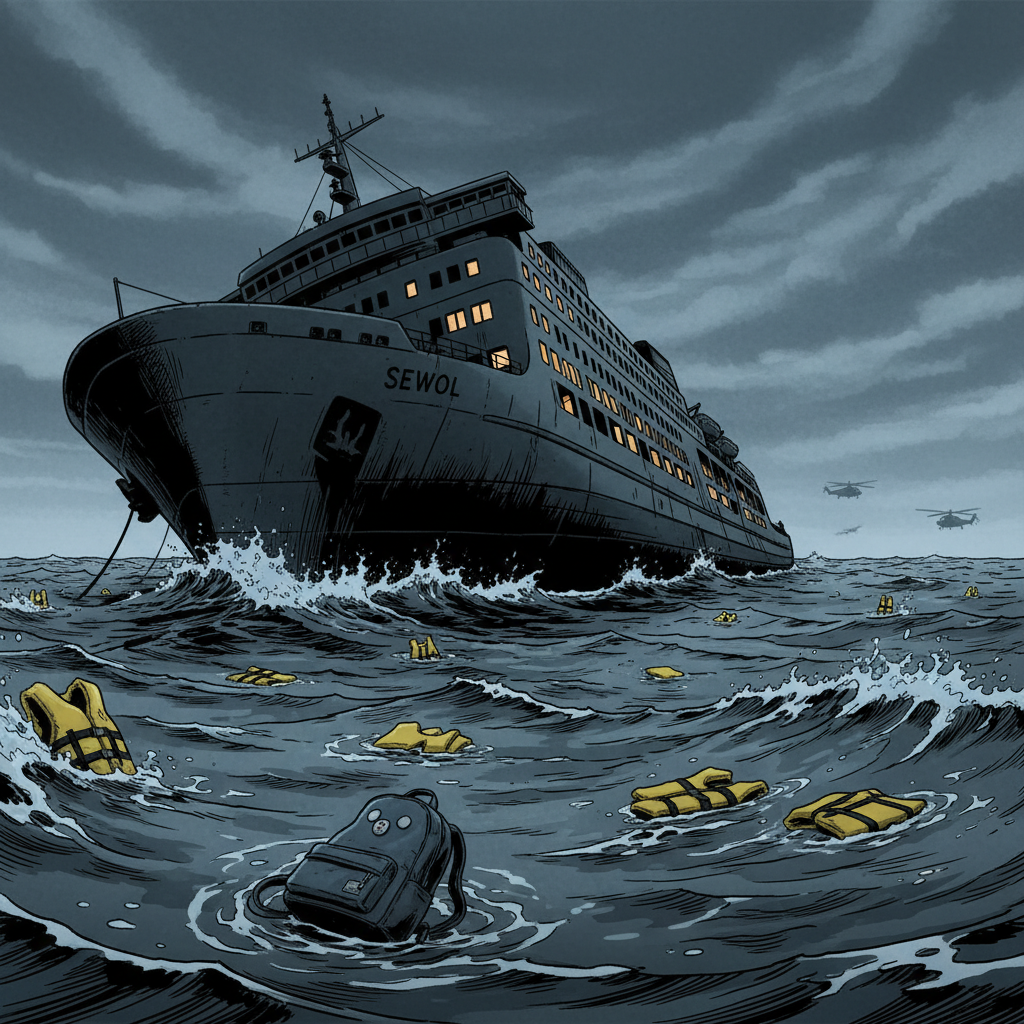
Катастрофа парома «Севоль»
On April 16, 2014, the South Korean ferry MV Sewol capsized and sank while en route from Incheon to Jeju Island, killing 304 of the 476 people on board. Among the dead were 250 students from Danwon High School in Ansan, aged 16-17, on a school field trip. The disaster exposed systemic failures in South Korea's maritime safety regime: the vessel had been illegally modified to carry more passengers and cargo, was loaded to more than twice its legal cargo limit, and its crew abandoned ship while repeatedly instructing passengers to stay in their cabins. President Park Geun-hye's unexplained seven-hour absence during the critical early hours became a major political scandal contributing to her impeachment in 2017. The Sewol disaster became a symbol of institutional failure in South Korea.
Краткое резюме
Seven analytical lenses converge on a single devastating conclusion: the Sewol disaster was not an accident but the inevitable product of a social system that systematically prioritized speed, profit, and hierarchical obedience over human safety. Every lens identifies systemic rather than individual failure as the root cause, though they differ on which systemic dimension is most significant — Confucian hierarchy, neoliberal deregulation, regulatory capture, or behavioral conditioning. The most profound insight emerges from the intersection of the Confucian and Pavlovian analyses: the very virtue Korean society most cultivates in its children — obedience to authority — became the mechanism of their deaths when authority proved unworthy of trust. The disaster catalyzed a counter-hegemonic movement that toppled a president, but whether it produced lasting structural change or merely a temporary disruption of the hegemonic order remains the central open question.
Ключевые факты
Проверенные факты из многоисточникового исследования, оценённые по уровню достоверности
MV Sewol departed Incheon at approximately 9:00 PM on April 15, 2014, with 476 people: 443 passengers (325 Danwon High School students, 14 teachers) and 33 crew.
Достоверность: highDistress signal sent at 08:58 KST on April 16, 2014. The ship took approximately two and a half hours to sink.
Достоверность: highMV Sewol was originally the Japanese ferry Naminoue (built 1994). Chonghaejin Marine purchased it in 2012 and illegally modified it to add passenger cabins on upper decks, raising center of gravity.
Достоверность: highSewol carried 2,142.7 tons of cargo against a legal maximum of 987 tons, with only 761.2 tons of ballast water. Included 180 vehicles (recorded as 150) and 1,157+ tons of freight.
Достоверность: highCaptain Lee Joon-seok (age 69) and 14 crew evacuated while PA system told passengers to remain in cabins.
Достоверность: highOf 172 survivors, more than half were rescued by civilian fishing boats that arrived ~40 minutes before the Korea Coast Guard.
Достоверность: high304 people died, including ~250 Danwon High School students aged 16-17. About 82% of casualties were children.
Достоверность: highКлючевые участники
Основные участники этого события с их действиями и заявленными интересами
Captain Lee Joon-seok
individual- ›Failed to issue evacuation order
- ›Abandoned ship while passengers remained below
- ›Was among first crew rescued
Chonghaejin Marine Company
corporation- ›Purchased and illegally modified MV Sewol
- ›Routinely overloaded beyond legal limits
- ›Falsified cargo manifests
President Park Geun-hye
individual- ›Absent from crisis management for seven hours
- ›Blamed captain and crew publicly
- ›Ordered Coast Guard dissolution
Korea Coast Guard
organization- ›Arrived 40 min after civilian boats
- ›Failed to enter sinking vessel
- ›Rescued captain/crew first
Danwon High School families
group- ›Established Paengmok Harbor vigil
- ›Launched yellow ribbon movement
- ›Demanded independent investigation
Исследования и источники
Хронология событий
2009-2017
Причинно-следственный анализ
Интерактивный граф, показывающий причинно-следственные связи между политиками, актёрами и событиями — нажмите на узлы для изучения связей
ПРИЧИННО-СЛЕДСТВЕННАЯ СЕТЬ
14 узлов · 16 связей
Выберите узел
Нажмите на любой узел графа для изучения его связей и перспектив призм
Первопричины
1Критический путь
8 шаговАнализы по призмам
Каждая призма предоставляет уникальную аналитическую рамку — нажмите для развёртывания глубокого анализа
Анализ воздействия на гражданское население
civilian-impactThe Sewol disaster inverts the expected moral calculus of obedience: children who followed instructions died while those who defied authority survived. This produced not merely grief but a fundamental crisis of institutional trust in South Korean society, transforming a maritime accident into a civilization-level reckoning with the relationship between authority, obedience, and the duty of care.
Конфуцианская этика
East AsianconfucianThe Sewol disaster reveals the lethal paradox at the heart of Confucian obedience culture: the very virtue of respectful compliance that Korean society cultivates in its children became the mechanism of their deaths when the authority figures they trusted violated every Confucian duty of care. The disaster demands a reckoning not with Confucianism itself but with its distortion — obedience without the reciprocal obligation of benevolent authority that makes Confucian hierarchy ethically coherent.
Теория игр
Western Moderngame-theoryThe Sewol disaster is a textbook case of catastrophic equilibrium: every actor behaved rationally given the incentive structure they faced, and 304 people died. The regulatory capture equilibrium was individually rational for both regulators and industry, the captain's abandonment was individually rational given the payoff structure, and the students' obedience was rational given their information state. The tragedy is that the system produced collectively catastrophic outcomes from individually rational choices at every level.
Анализ поведенческого обусловливания
Western ModernpavlovThe Sewol disaster demonstrates that behavioral conditioning is not merely a laboratory phenomenon but a lethal social force. The Korean education system's systematic conditioning of obedience produced students who followed fatal instructions as automatically as Pavlov's dogs responded to bells. The tragedy is not that the conditioning 'failed' — it worked perfectly. The students did exactly what they had been trained to do. The failure was in the system that conditioned obedience without ensuring the authorities being obeyed were worthy of that conditioned trust.
Макиавеллистская реальполитик
Greco-Roman & ClassicalmachiavelliThe Sewol disaster is a Machiavellian masterclass in how appearance devours substance. Park Geun-hye may or may not have been monitoring the crisis during the seven missing hours — but it does not matter. Machiavelli teaches that for a prince, appearing to act is as important as acting. By disappearing during the crisis, Park violated the cardinal Machiavellian principle: never let your people see you as either incompetent or indifferent, for they will forgive cruelty before they forgive contempt.
Анализ корпоративных интересов
Western ModerncorporateThe Sewol disaster demonstrates that regulatory capture is not a market 'imperfection' but a predictable equilibrium outcome when the regulated industry has concentrated interests and the public has diffuse ones. Chonghaejin Marine did not 'break' the system — it operated exactly as the system was designed to allow. The 304 deaths are the externalized cost of a regulatory regime that systematically valued corporate profitability over public safety.
Грамшианский анализ (культурная гегемония)
Western ModerngramsciThe Sewol disaster reveals that ppalli-ppalli is not a neutral cultural trait but a hegemonic formation — a way of organizing society that serves particular class interests while appearing as universal common sense. When 250 children died because speed and profit were prioritized over safety and care, the hegemonic spell was broken. The yellow ribbon movement and the candlelight protests represent one of the most successful counter-hegemonic mobilizations in recent East Asian history: a war of position that toppled a president and, for a time, made a new common sense — that the state's first duty is to protect life, not to facilitate profit.
Конвергенции
Где несколько призм приходят к схожим выводам — что указывает на их устойчивость
Systemic institutional failure, not individual incompetence
All four lenses independently identify the disaster as the product of systemic failures — regulatory capture, corporate impunity, deregulation ideology — rather than merely individual bad actors. Captain Lee's abandonment and Park's absence are symptoms, not causes.
Obedience to authority as lethal mechanism
The Confucian, Pavlovian, and civilian impact lenses all identify the students' conditioned obedience as the proximate cause of the extreme casualty concentration. The cultural conditioning that produced compliance (Confucian/Pavlov) directly produced the casualties (civilian impact).
Appearance vs. reality in governance
Machiavelli identifies the failure of political appearance management; Gramsci identifies the hegemonic construction of 'common sense' that masked danger; corporate analysis identifies the regulatory capture that created the appearance of oversight without substance.
Post-1997 deregulation as causal root
Corporate, Gramscian, and game theory analyses all trace the causal chain back to the post-Asian Financial Crisis deregulation regime that created the institutional conditions for the disaster.
Продуктивные противоречия
Где призмы расходятся — выявляя сложность, заслуживающую изучения
Возможные варианты будущего
Сценарии, выведенные из призменных анализов — что может произойти в зависимости от различных рамок
Durable reform: Sewol becomes Korea's 'never again' moment
Medium — possible if reforms are institutionalized before political attention fades
Gradual erosion: Reforms decay as memories fade
Medium-high — historical pattern suggests regulatory reforms erode within 15-20 years without sustained political pressure
Cultural transformation: Korean society fundamentally rebalances obedience norms
Low — deep cultural conditioning is resistant to event-driven change
Ключевые вопросы
Вопросы, остающиеся открытыми после анализа — для дальнейшего исследования
- ?What was Park Geun-hye doing during the seven missing hours?
- ?How many previous overloading incidents occurred on Sewol routes before the disaster?
- ?What was the exact relationship between maritime regulators and Chonghaejin Marine personnel?
Детали проверки фактов
Результаты проверки фактов
verifiedМета-наблюдения
All seven lenses focus on what went wrong and why, but none adequately accounts for the acts of extraordinary courage that also occurred: the crew member Park Ji-young (age 22) who helped students put on life vests and pushed them toward exits before she herself drowned, or the students who defied instructions to help classmates. The disaster produced both the worst and the best of human behavior, and an exclusive focus on failure risks dishonoring those who chose courage.
The Sewol disaster sits at the intersection of culture (Confucian hierarchy), economics (neoliberal deregulation), politics (regulatory capture and presidential accountability), psychology (conditioned obedience), and technology (maritime engineering). No single lens can capture this intersection; the seven together approach but do not exhaust the event's meaning.
This analysis was conducted from outside Korean culture, primarily using English-language sources. Korean-language scholarship, survivor testimony, and the Sewol families' own articulation of what the disaster means should be weighted more heavily than any external analytical framework. The most important voices in this analysis are those of the 304 who cannot speak and the families who speak for them.
Найдите свою перспективу
Разные рамки резонируют с разными читателями — найдите свою точку входа
Readers who think in terms of incentives, systems, and institutional design. You see the disaster as a predictable outcome of misaligned incentives and regulatory failure.
The disaster was rational at every level — the system produced catastrophic outcomes from individually rational choices. Reform requires changing incentive structures, not just punishing individuals.
Readers who focus on cultural context, human behavior, and the relationship between individuals and the social systems that shape them. You see the disaster as a failure of the social contract between authority and trust.
The obedience that killed the students was a product of the very social system that Korean society values most. Reform requires rethinking the relationship between authority and compliance, not just fixing regulations.
Readers who focus on leadership, governance, and the responsibilities of those in power. You see the disaster as a failure of leadership at every level.
Leaders' failure to fulfill their duty of care — captain, company, president — produced both the disaster and the political consequences. The appearance of caring is inseparable from the substance of governance.
Readers who question dominant narratives and look for whose interests are served by 'common sense.' You see the disaster as the product of a hegemonic system that normalized danger.
Ppalli-ppalli culture and deregulation ideology were not neutral — they served particular class interests while appearing as universal Korean values. The reforms may be transformismo: surface changes that preserve underlying power structures.
Start with the convergences — all seven lenses agree on systemic failure. Then explore the tensions: the debate between individual agency (Machiavelli) and structural determinism (Gramsci) reveals the most productive analytical ground. The Confucian-Pavlovian intersection on obedience is the most distinctive insight this analysis produces.
Связанные анализы
Другие события, проанализированные через схожие призмы или категории
26 апреля 1986 года в 01:23 реактор №4 Чернобыльской атомной электростанции в Украинской ССР взорвался во время испытания на безопасность, выбросив в атмосферу в 400 раз больше радиоактивных материалов, чем бомба, сброшенная на Хиросиму. Взрыв и последовавший за ним пожар отправили облако радиоактивных осадков над западной частью СССР и Европой. Советские власти первоначально скрывали катастрофу, вынуждая 49 000 жителей Припяти продолжать обычную жизнь в течение 36 часов до эвакуации. Около 600 000 ликвидаторов были мобилизованы для ликвидации последствий катастрофы — в том числе «биороботы», добровольцы, заменившие вышедшую из строя технику, чтобы сгребать радиоактивный графит с крыши реактора 90-секундными сменами, получая пожизненную дозу облучения за каждый выход. Официальное советское число погибших — 31 человек — остаётся оспариваемым; оценки варьируются от 4 000 (ВОЗ) до 93 000 (Greenpeace) избыточных смертей от рака. Катастрофа разрушила миф о советском технологическом превосходстве, вынудила Горбачёва перейти к гласности и — по собственной более поздней оценке Горбачёва — стала «возможно, истинной причиной распада Советского Союза», более значимой, чем любая политика или реформа. Зона отчуждения площадью 2 600 квадратных километров остаётся непригодной для проживания — постоянный шрам на украинской земле, где решения Москвы обернулись последствиями для Украины.
Арабская весна была революционной волной протестов, восстаний и вооружённых мятежей, охватившей арабский мир с декабря 2010 года. Спровоцированная самосожжением тунисского уличного торговца Мухаммеда Буазизи 17 декабря 2010 года, движение распространилось с поразительной скоростью по Северной Африке и Ближнему Востоку. Лозунг «الشعب يريد إسقاط النظام» (Народ хочет падения режима) звучал от Туниса до Каира, от Бенгази до Дамаска. Выбор армии — встать на сторону протестующих или остаться верной режиму — оказался решающей переменной в каждой стране.
С 6 апреля по 18 июля 1994 года в Руанде за 100 дней было систематически убито около 800 000 тутси и умеренных хуту — самое эффективное массовое убийство в современной истории с ежедневным уровнем смертности, превышающим Холокост. Геноцид не был вспышкой «древней племенной вражды», а кульминацией колониального проекта: бельгийские администраторы создали жёсткие расовые категории из подвижных социальных идентичностей посредством переписи 1933 года и обязательных этнических удостоверений личности. Радио RTLM — «Радио Мачете» — систематически обуславливало население годами дегуманизирующей пропаганды, называя тутси «inyenzi» (тараканы). От 250 000 до 500 000 женщин были изнасилованы как орудие геноцида. Провал международного сообщества был активным: Даллэр отправил предупреждение за три месяца, запросил 5000 солдат и получил отказ. Совет Безопасности ООН сократил МООНПР с 2500 до 270 солдат во время геноцида. Военная победа РПФ прекратила геноцид в июле 1994 года, но последствия распространились на Первую конголезскую войну (1996-97) и «Мировую войну Африки», унёсшую более 5 миллионов жизней.
Как проводился этот анализ
Полная прозрачность процесса анализа, инструментов и ограничений
Движок Crosslight
v0.4.0 "Global Lens Expansion"- ⚠Non-Western philosophical lenses rely on translated primary texts — nuance may be lost in translation
- ⚠Some traditions (e.g., Maat, Ubuntu) have limited surviving primary texts; analysis draws on scholarly reconstruction
- ⚠Cross-cultural lens application is inherently interpretive — a Confucian reading of a Western event is an analytical exercise, not a claim of cultural authority
Статистика анализа
Методология
Этот анализ был произведён многоагентным конвейером Crosslight: Агент исследования собирал и проверял факты из множества источников, специализированные агенты призм применяли отдельные аналитические рамки, Агент синтеза интегрировал выводы и выявлял паттерны, а Агент проверки фактов верифицировал утверждения. Каждая призменная перспектива является интерпретацией ИИ — а не институциональным одобрением.Узнать больше →