
Folkmördet i Rwanda
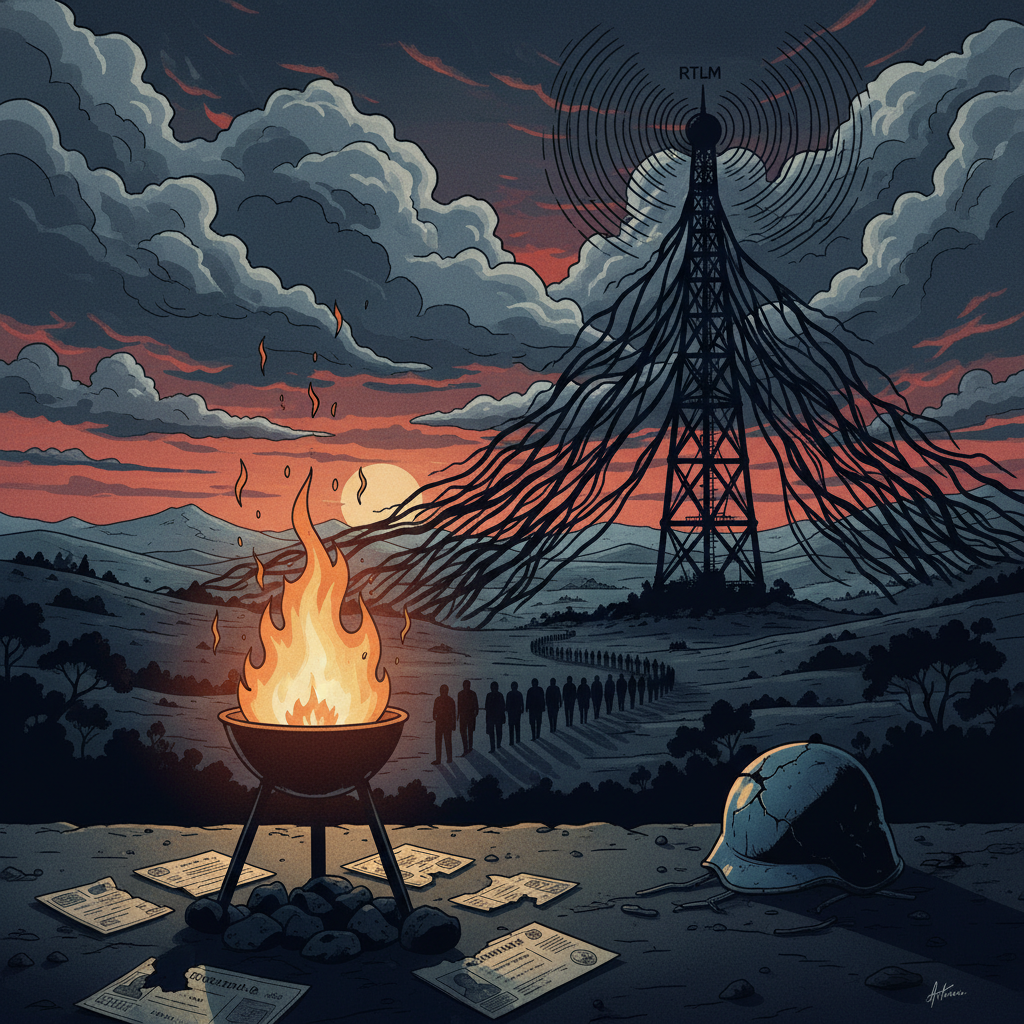
Mellan 6 april och 18 juli 1994 mördades systematiskt cirka 800 000 tutsis och moderata hutus i Rwanda under loppet av 100 dagar — det mest effektiva massdödandet i modern historia, med en daglig dödstakt som översteg Förintelsens. Folkmördet var inte ett utbrott av ”urgamla stamfejder” utan kulmen på ett kolonialt projekt: belgiska administratörer hade tillverkat rigida raskategorier från flytande sociala identiteter genom folkräkningen 1933 och obligatoriska etniska identitetskort. Habyarimanas regim och dess inre krets akazu (lilla huset) valde folkmörd som politisk överlevnadsstrategi inför militärt tryck från Rwandas patriotiska front och Arusha-avtalens krav på maktdelning. RTLM-radio — ”Radio Machete” — konditionerade systematiskt befolkningen genom år av avhumaniserande propaganda och kallade tutsis för ”inyenzi” (kackerlackor). Mellan 250 000 och 500 000 kvinnor våldtogs som avsiktligt vapen för folkmörd. Det internationella samfundets misslyckande var aktivt: Dallaire skickade sin ”folkmördsfax” tre månader före, begärde 5 000 soldater och nekades. FN:s säkerhetsråd reducerade UNAMIR från 2 500 till 270 soldater under folkmördet. RPF:s militära seger avslutade folkmördet i juli 1994, men konsekvenserna spred sig till första Kongokriget (1996-97) och ”Afrikas världskrig” som dödade över 5 miljoner människor.
Sammanfattning
Seven lenses converge on a central insight: the Rwandan genocide was not the eruption of ancient tribal hatreds but the catastrophic endpoint of a colonial project weaponized by political elites and enabled by international indifference. Belgian colonial racial engineering created the categories (colonial-legacy); decades of political manipulation hardened them into existential identities (machiavelli); RTLM radio conditioned the population to act on them (pavlov); the international community's strategic calculations ensured no external check existed (game-theory, cia); and the resulting human cost — 800,000 dead, 500,000 raped, millions displaced — cascaded into Africa's deadliest conflict (civilian-impact). The moral inversion at the heart of the genocide — framing extermination as liberation — reveals the deepest danger of manufactured victimhood narratives (nietzsche). The lenses agree that every major failure was a choice: Belgium chose to create racial categories; Habyarimana chose to maintain them; Hutu Power chose to weaponize them; the international community chose not to intervene. The genocide was not inevitable — it was chosen.
Nyckelfakta
Verifierade fakta fran flerkallsforskning, bedomda efter konfidensgrad
Between April 6 and July 18, 1994, approximately 800,000 Tutsi and moderate Hutu were killed in Rwanda over approximately 100 days.
high konfidensBelgian colonial authorities introduced mandatory ethnic identity cards after the 1933 census, classifying every Rwandan as Hutu, Tutsi, or Twa based on cattle ownership (10+ cattle = Tutsi) and pseudoscientific racial measurements (nose width, skull shape, height).
high konfidensOn January 11, 1994, UNAMIR force commander Roméo Dallaire sent the 'genocide fax' to UN headquarters warning that a high-level informant had revealed plans to register all Tutsi in Kigali for extermination and to distribute weapons to Interahamwe militias.
high konfidensKofi Annan, then head of UN Peacekeeping Operations, ordered Dallaire not to raid arms caches and to strictly adhere to his mandate. Dallaire's request for 5,000 reinforcement troops was denied.
high konfidensOn April 21, 1994, the UN Security Council passed Resolution 912 reducing UNAMIR from 2,500 to 270 troops — during the active genocide.
high konfidensRTLM (Radio Télévision Libre des Mille Collines) was established in July 1993, funded by Hutu extremists. It systematically dehumanized Tutsis as 'inyenzi' (cockroaches) and during the genocide broadcast names and locations of people to be killed.
high konfidensBetween 250,000 and 500,000 women were raped during the genocide. UN Special Rapporteur René Degni-Ségui stated: 'Rape was the rule, and its absence the exception.' An estimated two-thirds of genocide widows tested positive for HIV.
high konfidensNyckelaktorer
Huvudaktorer involverade i denna handelse med deras atgarder och uttalade intressen
Juvénal Habyarimana
individual- ›Seized power in 1973 military coup
- ›Maintained single-party Hutu-dominated state for 21 years
- ›Permitted akazu inner circle to consolidate power
Paul Kagame
individual- ›Led RPF military campaign from Uganda into Rwanda (1990)
- ›Commanded RPF forces that ended the genocide through military victory (July 1994)
- ›Became Vice President and Minister of Defence (1994-2000), then President (2000-present)
Roméo Dallaire
individual- ›Commanded UNAMIR peacekeeping force (October 1993 - August 1994)
- ›Sent genocide fax warning three months before the killing began
- ›Requested 5,000 reinforcement troops — denied by UN
Théoneste Bagosora
individual- ›Chaired crisis committee that coordinated genocide in hours after Habyarimana's assassination
- ›Ordered the murder of Prime Minister Agathe Uwilingiyimana
- ›Ordered the murder of ten Belgian UNAMIR peacekeepers at Camp Kigali
Forskning och källor
Händelsetidslinje
1933-01-01 to 1997-05-17
Kausal analys
Interaktiv graf som visar hur policyer, aktörer och händelser hänger kausalt samman — klicka på noder för att utforska relationer
KAUSALT NÄTVERK
16 noder · 19 kopplingar
Välj en nod
Klicka på valfri nod i grafen för att utforska dess kopplingar och linsperspektiv
Grundorsaker
1Kritisk väg
9 stegLinsanalyser
Varje lins tillhandahåller ett unikt analytiskt ramverk — klicka för att expandera och fördjupa analysen
Spelteori
Western Moderngame-theoryThe Rwandan genocide was not a failure of information but a failure of incentive structures. Every relevant actor had sufficient information to predict and prevent the genocide — Dallaire's fax, intelligence reports, RTLM's open broadcasting of genocidal intent. The failure occurred because the incentive structure rewarded inaction: no UNSC member faced costs for non-intervention, while each faced potential costs for intervention. Hutu Power solved its coordination problem brilliantly through RTLM and institutional infrastructure; the international community failed to solve the much simpler coordination problem of deploying 5,000 troops. The game-theoretic lesson is stark: 'never again' without enforcement mechanisms is just words.
Machiavelli
Greco-Roman & ClassicalmachiavelliThe Rwandan genocide was not a descent into chaos but an exercise in ruthless political calculation. Bagosora and the akazu chose genocide as a political strategy when they concluded that Arusha's power-sharing would end their dominance. They transformed the state itself into a killing machine: the colonial bureaucratic infrastructure (identity cards, local administration) became the instrument of extermination. The international community's failure was equally calculated — the US chose linguistic evasion, the UN chose mandate compliance over civilian protection, and France chose client-state loyalty over moral obligation. Machiavelli would recognize every actor's logic, even as he would note that Hutu Power committed the cardinal Machiavellian sin: they pursued a strategy whose success depended on eliminating an entire people, a goal that is always ultimately self-defeating.
Kolonialt arv
colonial-legacyThe Rwandan genocide is the most devastating consequence of colonial racial engineering in modern history. Belgian administrators, applying European pseudoscientific racism and the Hamitic hypothesis, converted fluid social categories into fixed racial identities through the 1933 census and mandatory identity cards. These colonial instruments became the bureaucratic infrastructure of genocide — the identity cards checked at every roadblock in 1994 were the same cards introduced 61 years earlier by Belgian colonizers. The genocide was not the eruption of 'ancient tribal hatreds' — it was the catastrophic endpoint of a colonial project that manufactured ethnicity, froze it in bureaucratic systems, and then abandoned the consequences when Belgian administrators left. The colonial-legacy lens does not diminish Rwandan perpetrators' agency; it reveals the deeper structural conditions that made genocide possible and, critically, rejects the racist 'tribal conflict' narrative that implies Africans were simply predisposed to killing each other.
CIA
Western InstitutionalciaThe Rwandan genocide exposed the fundamental limitation of intelligence in the absence of political will. Western intelligence agencies — particularly the CIA, DIA, and French services — had sufficient information to assess and potentially prevent the genocide. Dallaire's genocide fax was explicit. RTLM's broadcasts were monitored. Weapons distribution was tracked. Satellite imagery documented mass graves in real time. The failure was not informational but political: the Clinton administration's post-Somalia risk aversion, Rwanda's lack of strategic value, and the deliberate legal strategy of avoiding the word 'genocide' to circumvent Convention obligations. The intelligence lesson is stark: the best intelligence in the world is worthless when policymakers have decided that the lives at stake do not warrant action. The geopolitical lesson is equally stark: the international system's response to mass atrocity is not determined by the severity of the atrocity but by the strategic interests of the intervening powers.
Civil påverkan
civilian-impactThe Rwandan genocide was the most intimate mass killing in modern history — 800,000 people murdered in 100 days, primarily by their neighbors, with machetes, in the communities where they had lived together. The civilian impact extends far beyond the death toll: 250,000-500,000 women raped as a systematic weapon with deliberate HIV transmission, 400,000 orphans, 2 million refugees, the complete destruction of social trust in a society where perpetrators and survivors must now live side by side. The refugee crisis that followed triggered the Congo Wars (5+ million dead), making the genocide the catalyst for the deadliest conflict since World War II. The civilian-impact lens reveals not only the horror of the genocide itself but the cascading humanitarian consequences that continue across generations and across borders.
Pavlov
Western ModernpavlovRTLM radio was the most successful mass behavioral conditioning program for violence in recorded history. Through a systematic five-phase escalation — from entertainment to political framing to dehumanization to urgency to direct coordination — it transformed ordinary Rwandans into genocide participants. The conditioning operated at both the mass media level (RTLM's daily broadcasts) and the social reinforcement level (neighbor pressure making participation the expected behavior and refusal the deviant behavior punished by death). The identity card system served as the conditioned stimulus that triggered the kill-or-release response at every roadblock. The Pavlov lens reveals that the Rwandan genocide was not a spontaneous eruption of hatred but the product of a deliberate, systematic conditioning program that exploited the power of media repetition, dehumanizing language, and social conformity pressure to override the human inhibition against killing.
Nietzsche
Western ModernnietzscheThe Rwandan genocide is the most extreme expression of ressentiment in modern history: a narrative of victimhood ('the Tutsis oppressed us') transformed into a moral justification for the extermination of 800,000 people. Hutu Power performed a complete moral inversion, reframing genocide as 'self-defense' and 'completing the 1959 revolution,' making mass murder feel not just permissible but righteous. The will to power operated at every level — from elite political calculation to the roadblock operator's absolute power over life and death. Kagame's post-genocide Rwanda represents the counter-project: the will to create new values from the ruins, to refuse victimhood, to build a new society — but at the cost of authoritarian control that suppresses the very ethnic identification that the colonial project created. The deepest Nietzschean question remains unanswered: how do survivors create meaning after the total collapse of moral order?
Konvergenspunkter
Där flera linser når liknande slutsatser — vilket tyder på robusthet
Manufactured ethnicity as foundational cause
All four lenses point to the colonial construction of rigid Hutu-Tutsi ethnic categories as the necessary precondition for genocide. Colonial-legacy traces the 1933 census and identity cards. Pavlov shows how RTLM weaponized the manufactured categories through conditioning. Nietzsche reveals how the colonial framework was transformed into a ressentiment narrative. Machiavelli demonstrates how political elites instrumentalized the categories for power.
International failure as active choice, not passive neglect
All four lenses demonstrate that the international community's failure to prevent the genocide was a deliberate choice, not an intelligence failure or bureaucratic accident. Game-theory reveals the incentive structure that rewarded inaction. CIA documents the available intelligence. Machiavelli traces the strategic calculations. Civilian-impact shows the consequences of those choices in human terms.
Genocide as political strategy, not ethnic explosion
The genocide was chosen as a political survival strategy by the akazu when they faced existential threats from the RPF and Arusha. Machiavelli traces the cold calculus. Game-theory models the coordination problem and its solution. Colonial-legacy provides the ethnic infrastructure that made the strategy executable. All three reject the 'spontaneous tribal violence' narrative.
Media as weapon of mass conditioning
RTLM's role as both conditioning tool and coordination mechanism is confirmed by all three lenses. Pavlov traces the graduated escalation from entertainment to kill instructions. Game-theory shows how RTLM solved the coordination problem for mass participation. Civilian-impact documents the human consequences of that conditioning.
Produktiva spänningar
Där linserna är oense — vilket avslöjar komplexitet värd att undersöka
Möjliga framtider
Scenarier härledda från linsanalyser — vad som kan utspela sig baserat på olika ramverk
Post-Kagame democratic transition
Uncertain but significant. Rwanda's remarkable stability is strongly associated with Kagame's personal authority. A democratic transition could either release suppressed tensions or channel them productively depending on institutional strength.
Rwanda as model for post-conflict reconstruction
Partially already realized — Rwanda is frequently cited as a development success story. The question is whether the model is replicable without the specific conditions (national trauma, strong leader, external guilt-driven aid) that shaped it.
Renewed Great Lakes regional instability
Ongoing risk. Eastern DRC remains unstable, with Rwanda-backed armed groups active. The genocide's regional consequences continue to generate conflict.
Nyckelfrågor
Frågor som förblir öppna efter analysen — för fortsatt undersökning
- ?Who definitively ordered the shooting down of Habyarimana's plane?
- ?What was the exact scale of RPF atrocities during the 1994 campaign and in the subsequent Congo Wars?
- ?How many of the estimated 200,000 genocide participants were acting under genuine coercion versus willing participation?
Detaljer om faktakontroll
Faktakontrollresultat
verifiedMetaobservationer
No lens fully captures the experience of the individual Tutsi person at the roadblock — the moment when a colonial-era identity card determined their death. The lenses analyze structures, strategies, conditioning, and moral frameworks, but the irreducible horror is personal: a human being murdered by their neighbor because of what is written on a piece of paper. All analysis is, at some level, an abstraction from this reality.
The genocide was simultaneously a colonial legacy, a political strategy, a conditioning achievement, a game-theoretic outcome, a moral catastrophe, an intelligence failure, and a human tragedy. No single framework can contain all of these dimensions. The most honest analysis holds multiple frameworks simultaneously and acknowledges the tensions between them.
Analyzing the Rwandan genocide from the safety of distance — temporal, geographic, and existential — carries inherent limitations. Those who were not there cannot fully understand. Those who survived carry knowledge that no lens can capture. The purpose of multi-lens analysis is not to 'explain' the genocide but to ensure it is not explained away — not reduced to 'tribal conflict,' 'ancient hatreds,' or 'African chaos.' The analysis must serve the memory of the dead by insisting on the truth of how and why they were killed.
Hitta ditt perspektiv
Olika ramverk resonerar med olika läsare — hitta din ingångspunkt
Readers who think in terms of systems, incentives, and strategic calculation. Those who want to understand the mechanisms that enabled genocide and the structural reasons for international failure.
The genocide was not irrational — it operated within a perverse but coherent incentive structure. International failure was not accidental — it reflected the revealed preference that Rwandan lives did not justify intervention costs.
Readers who feel the horror first and seek to understand how moral order can collapse so completely. Those who center the human experience of both victims and perpetrators.
The genocide was the most intimate mass killing in history — 800,000 people murdered by their neighbors. The moral inversion that made this possible reveals the fragility of moral order and the power of manufactured narratives of victimhood.
Readers who focus on structures, institutions, and power. Those who want to trace how colonial decisions created the conditions for genocide and how political actors exploited those conditions.
The genocide was structurally prepared by colonial racial engineering and strategically executed by political actors who chose extermination as a survival strategy. Both the colonial structure and the political choices were necessary conditions.
Readers who question official narratives and want to understand how populations are manipulated. Those who are suspicious of simplistic explanations like 'tribal conflict.'
The 'ancient tribal hatreds' narrative is itself a form of colonial thinking. The ethnic categories were manufactured. The population was conditioned. The genocide was produced, not spontaneous.
All readers should engage with the colonial-legacy lens, which provides the foundational context that all other lenses depend on. The tension between game-theory's rational analysis and nietzsche's moral analysis is particularly productive: neither alone captures the genocide's full character, but together they illuminate how moral collapse can be rationally produced.
Relaterade analyser
Andra händelser analyserade genom liknande linser eller kategorier
Arabiska våren var en revolutionär våg av protester, uppror och väpnade revolter som svepte över arabvärlden från december 2010. Utlöst av den tunisiske gatuhandlaren Mohamed Bouazizis självförbränning den 17 december 2010 spred sig rörelsen med häpnadsväckande hastighet över Nordafrika och Mellanöstern. Slagordet "الشعب يريد إسقاط النظام" (Folket vill ha regimens fall) ekade från Tunis till Kairo. Militärens val — att ställa sig på demonstranternas sida eller förbli lojala mot regimen — visade sig vara den avgörande variabeln i varje land.
Den 26 april 1986 klockan 01:23 exploderade reaktor nr 4 vid Tjernobyl-kärnkraftverket i Ukrainska SSR under ett säkerhetstest och frigjorde 400 gånger mer radioaktivt material än Hiroshimabomben. De sovjetiska myndigheterna hemlighöll katastrofen och tvingade Pripjats 49 000 invånare att fortsätta sitt normala liv i 36 timmar. Omkring 600 000 'likvidatorer' sattes in. Uppskattningarna av dödstalet sträcker sig från 4 000 (WHO) till 93 000 (Greenpeace). Katastrofen krossade myten om sovjetisk teknologisk överlägsenhet och tvingade Gorbatjov mot glasnost.
The Partition of British India in August 1947 divided the subcontinent into the independent dominions of India and Pakistan (later splitting into Pakistan and Bangladesh in 1971). Accompanied by one of the largest mass migrations in human history — an estimated 14 to 20 million people displaced — and catastrophic communal violence that killed between 200,000 and 2 million people, the Partition reshaped the political, demographic, and cultural landscape of South Asia. Driven by the interplay of British colonial withdrawal strategy, Hindu-Muslim communal tensions inflamed over decades, and the political maneuvering of leaders including Mountbatten, Nehru, Jinnah, Gandhi, and Patel, the Partition remains one of the most consequential and contested events of the twentieth century. Its reverberations continue in the India-Pakistan rivalry, the Kashmir conflict, communal politics across the subcontinent, and the lived trauma of millions of partition survivors and their descendants.
Hur detta analyserades
Full transparens om analysprocessen, verktygen och begränsningarna
Crosslight-motorn
v0.4.0 "Global Lens Expansion"- ⚠Non-Western philosophical lenses rely on translated primary texts — nuance may be lost in translation
- ⚠Some traditions (e.g., Maat, Ubuntu) have limited surviving primary texts; analysis draws on scholarly reconstruction
- ⚠Cross-cultural lens application is inherently interpretive — a Confucian reading of a Western event is an analytical exercise, not a claim of cultural authority
Analysstatistik
Metodik
Denna analys producerades av Crosslights multiagent-pipeline: en forskningsagent samlade in och verifierade fakta från flera källor, specialiserade linsagenter tillämpade distinkta analytiska ramverk, en syntesagent integrerade insikter och identifierade mönster, och en faktakontrollagent verifierade påståenden. Varje linsperspektiv är AI:ns tolkning — inte institutionellt godkännande.Läs mer →