
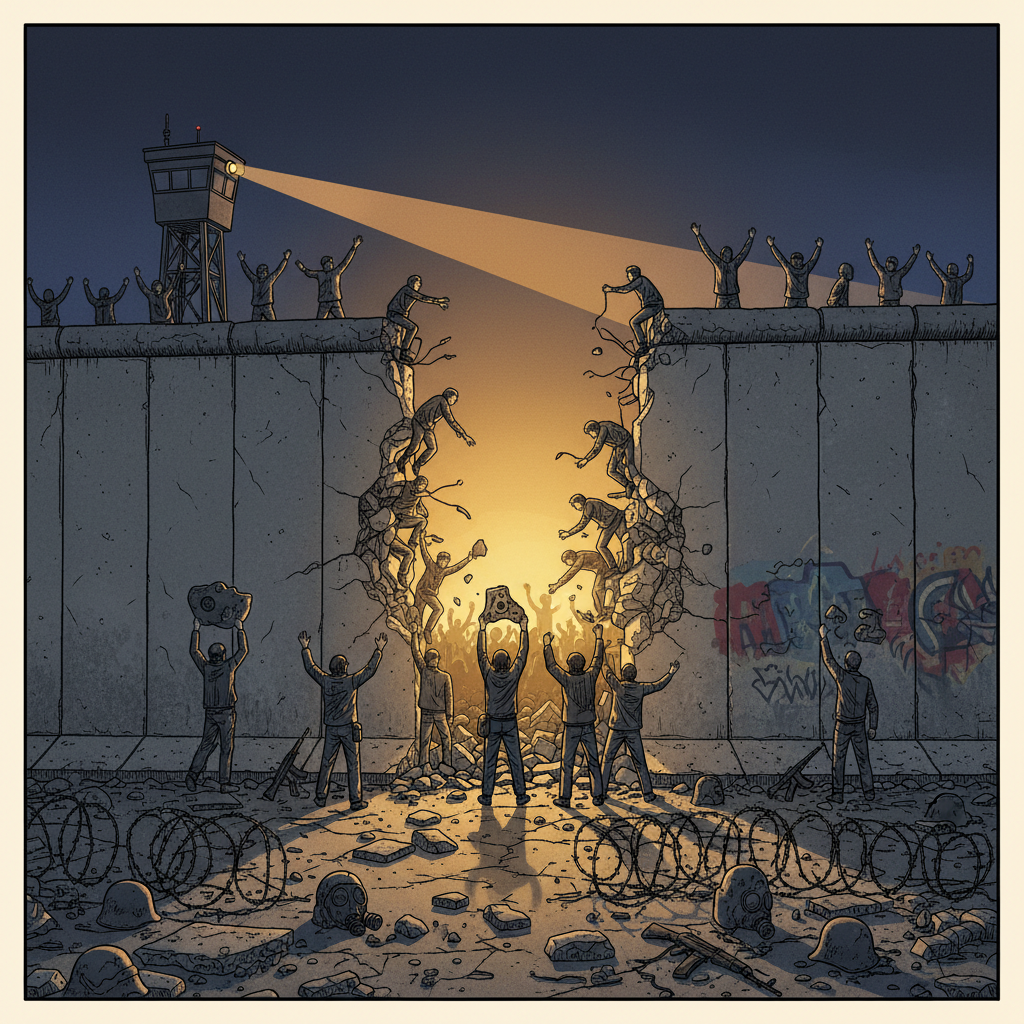
Kuanguka kwa Ukuta wa Berlin
Jioni ya Novemba 9, 1989, Ukuta wa Berlin — ishara yenye nguvu zaidi ya Vita Baridi — ulifunguliwa bila kutarajiwa baada ya msemaji wa DDR Günter Schabowski kutangaza kwa makosa uhuru wa kusafiri wa haraka wakati wa mkutano na waandishi wa habari. Kuanguka kwa ukuta kulikuwa kilele cha mageuzi ya glasnost na perestroika ya Gorbachev, athari ya domino katika Kambi ya Mashariki, na miezi ya shinikizo la wananchi. Ujerumani iliunganishwa rasmi tarehe 3 Oktoba 1990.
Muhtasari Mkuu
Five lenses converge on the fundamental insight that the Berlin Wall's fall was overdetermined — the division was unsustainable and some form of collapse was inevitable — but diverge sharply on why and how. Game theory highlights the rational calculus of cooperation replacing confrontation; Machiavelli focuses on elite agency and political opportunism; Jung reveals the psychological dimensions of division and incomplete integration; the CIA lens claims Western strategic pressure as a significant cause; and Taoism sees the Wall's fall as natural correction of artificial forcing. The most productive tension is between the CIA's triumphalism (the West won) and Taoism's inevitabilism (the Wall dissolved under its own contradictions), with the other lenses occupying the spectrum between these poles. All lenses agree on three things: Gorbachev's non-intervention was the single most critical enabling factor; the grassroots movements (Leipzig, Mauerspechte) were as important as elite decisions; and the Schabowski gaffe was the accidental catalyst that collapsed a fragile equilibrium.
Ukweli Muhimu
Ukweli uliothibitishwa kutoka utafiti wa vyanzo vingi, uliokadiriwa kwa kiwango cha imani
Mikhail Gorbachev became General Secretary of the Communist Party of the Soviet Union on March 11, 1985, and initiated glasnost (openness) and perestroika (restructuring) reforms.
Imani ya highThe Sinatra Doctrine, articulated by Soviet Foreign Ministry spokesman Gennadi Gerasimov in October 1989, replaced the Brezhnev Doctrine, signaling that the USSR would no longer intervene militarily to prevent political change in Eastern Bloc states.
Imani ya highThe Leipzig Monday Demonstrations began on September 4, 1989, at the Nikolaikirche (St. Nicholas Church) and grew from hundreds to over 300,000 participants by late October 1989.
Imani ya highThe chant "Wir sind das Volk" (We are the people) became the rallying cry of the Leipzig Monday demonstrators, explicitly claiming popular sovereignty against the SED regime.
Imani ya highErich Honecker was forced to resign as General Secretary of the SED on October 18, 1989, replaced by Egon Krenz.
Imani ya highOn the evening of November 9, 1989, SED Politburo member Günter Schabowski held a press conference announcing new travel regulations. When asked when the regulations took effect, he replied "sofort, unverzüglich" (immediately, without delay), though the regulations were supposed to take effect the next morning.
Imani ya highThe press conference was broadcast live on West German television, widely watched in East Berlin. Thousands gathered at border crossings, particularly Bornholmer Straße.
Imani ya highWaigizaji Wakuu
Waigizaji wakuu wanaohusika katika tukio hili pamoja na vitendo vyao na maslahi yaliyoelezwa
Mikhail Gorbachev
individual- ›Initiated glasnost and perestroika reforms
- ›Articulated Sinatra Doctrine
- ›Refused to authorize military intervention in GDR
Helmut Kohl
individual- ›Seized reunification window within days
- ›Negotiated monetary union
- ›Secured Allied and Soviet consent via Two Plus Four Agreement
Günter Schabowski
individual- ›Delivered the press conference that inadvertently opened the Wall
Leipzig Monday Demonstrators
group- ›Organized weekly Monday demonstrations from September 1989
- ›Grew from hundreds to over 300,000 participants
- ›Maintained nonviolent discipline
George H.W. Bush
individual- ›Exercised deliberate restraint
- ›Supported Kohl's reunification agenda
- ›Worked to reassure Gorbachev
Utafiti na Vyanzo
Ratiba ya Tukio
1985-03-11 to 1990-10-03
Uchambuzi wa Kisababu
Grafu inayoweza kuingiliana inayoonyesha jinsi sera, waigizaji, na matukio yanavyounganika kisababu — bonyeza nodi ili kuchunguza mahusiano
MTANDAO WA KISABABU
nodi 15 · muunganiko 15
Chagua nodi
Bonyeza nodi yoyote kwenye grafu ili kuchunguza muunganiko wake na mitazamo ya lenses
Sababu Kuu
2Njia Muhimu
hatua 11Uchambuzi wa Lenses
Kila lens hutoa mfumo wa kipekee wa uchambuzi — bonyeza ili kupanua kwa uchambuzi wa kina
Nadharia ya Michezo
Western Moderngame-theoryThe Fall of the Berlin Wall was a multi-player game that resolved through a remarkable convergence of cooperative strategies — but the timing was determined by an exogenous shock (Schabowski's gaffe) that no rational actor model could have predicted. The most significant game-theoretic insight is that the Cold War's most dangerous confrontation point was defused not through deterrence or brinksmanship, but through one leader's decision not to play the game at all (Gorbachev's non-intervention) and millions of citizens solving their collective action problem on Monday evenings in Leipzig.
Uchambuzi wa Machiavelli
Greco-Roman & ClassicalmachiavelliThe Fall of the Berlin Wall reveals Machiavelli's deepest insight: that fortuna governs at least half of human affairs, and the virtuous prince is one who can adapt to fortune's changes. Gorbachev had virtù in choosing reform over repression, but lacked the capacity to control its consequences. Kohl had virtù in seizing the moment with extraordinary speed. The SED regime had neither virtù nor fortuna — its power was borrowed from Moscow, and when Moscow withdrew, the regime had nothing of its own. The most Machiavellian lesson: Schabowski's gaffe demonstrates that even the most consequential historical events can turn on a moment of incompetence, and the prince who cannot recover from accidents is no prince at all.
Saikolojia ya Kina ya Jung
Western ModernjungThe Berlin Wall was not just a political structure but a psychic one — the externalization of Germany's collective shadow after the catastrophe of the Nazi period. Its fall on November 9, 1989, was a moment of numinous collective experience, but true individuation requires integrating what the Wall divided, not merely removing the barrier. The Mauer im Kopf persists because political reunification was not accompanied by psychological reunification. Schabowski's gaffe was the collective unconscious speaking through a bureaucrat's error what the political system could not yet say: that the division was unsustainable, and history would find its own way through the Wall.
CIA / Tathmini ya Ujasusi wa Magharibi
Western InstitutionalciaThe Fall of the Berlin Wall was the Western alliance's greatest strategic achievement and one of the intelligence community's most instructive analytical failures. Western pressure — military, economic, and ideological — was a significant contributing factor to the Soviet system's crisis, but the specific mechanism and timing of the Wall's fall were driven by forces no intelligence agency predicted: Gorbachev's personal commitment to non-violence, the nonlinear dynamics of collective citizen action, and the bureaucratic accident of Schabowski's press conference. The greatest intelligence success of the entire episode was not an assessment but a policy recommendation: Bush's restraint, which preserved the cooperative dynamic that made peaceful reunification possible.
Utao
East AsiantaoismThe Fall of the Berlin Wall is the Tao made visible in history. The Wall was the ultimate act of forcing — the attempt to divide by concrete what nature had joined. For 28 years the pressure built like water behind a dam, and on November 9, 1989, a crack appeared through a bureaucrat's fumbled words, and 28 years of accumulated force flowed through it in a single night. The most consequential actions were non-actions: Gorbachev not intervening, Bush not gloating, border guards not shooting. The Mauerspechte, chipping away with hammers, were water wearing away stone. The Tao Te Ching teaches: 'Nothing in the world is as soft and yielding as water. Yet for dissolving the hard and inflexible, nothing can surpass it.' The Berlin Wall dissolved not under military assault but under the soft, persistent, irresistible pressure of human freedom.
Mwelekeo wa Pamoja
Pale lenses nyingi zinapofika hitimisho sawa — kuonyesha nguvu
Gorbachev's non-intervention was the single most critical factor enabling peaceful change
All five lenses identify Gorbachev's decision not to use military force as the necessary precondition for everything else. Without it, the Monday Demonstrations could have been crushed (Budapest 1956, Prague 1968), Schabowski's gaffe would have been irrelevant, and the Wall would have stood.
Grassroots citizen action was as consequential as elite political decisions
Game theory identifies the Leipzig demonstrations as solving the collective action problem; Jung sees 'Wir sind das Volk' as collective individuation; Taoism sees citizens as water finding cracks. The Machiavelli and CIA lenses, while acknowledging citizen agency, give more weight to elite actors.
The Schabowski gaffe was an accidental catalyst that collapsed a fragile equilibrium
Game theory calls it an exogenous shock; Machiavelli sees it as fortuna overriding virtues; Jung interprets it as the collective unconscious speaking through a bureaucratic error; Taoism sees it as the Tao finding its own path through a crack. The CIA lens is less focused on the gaffe itself, treating it as acceleration of an inevitable process.
The Mauer im Kopf (wall in the head) represents incomplete integration after political reunification
Jung sees it as unintegrated shadow material; Taoism sees it as the natural yin-yang cycle after forced reunification; Machiavelli notes the political consequences of Kohl's speed (unification on Western terms without genuine negotiation). Game theory and CIA are less focused on post-reunification psychology.
Mvutano Wenye Tija
Pale lenses zinapotofautiana — kufunua ugumu unaostahili kuchunguzwa
Mustakabali Unaowezekana
Hali zilizopatikana kutoka uchambuzi wa lenses — kinachoweza kutokea kulingana na mifumo tofauti
Gradual dissolution of the Mauer im Kopf through generational change
Likely over a 50-100 year horizon. Jung and Taoism both suggest that integration follows its own timeline and cannot be forced.
Korean reunification following the Berlin Wall model
Low in the near term. The Berlin Wall model required a reformist Soviet leader willing to accept Eastern Bloc self-determination. No equivalent Chinese policy shift is visible.
Russian revanchism produces new East-West confrontation
Already materializing. The Russia-Ukraine War is a direct consequence of the unresolved tensions from 1989.
Maswali Muhimu
Maswali yanayobaki wazi baada ya uchambuzi — kwa uchunguzi unaoendelea
- ?What were the full contents of the classified Soviet Politburo deliberations on non-intervention in November 1989?
- ?To what extent did CIA covert operations materially support Eastern Bloc dissident movements, as opposed to merely monitoring them?
- ?What was Gorbachev's internal calculus: did he genuinely believe he could reform communism, or had he accepted the system's end?
Maelezo ya Ukaguzi wa Ukweli
Matokeo ya Ukaguzi wa Ukweli
verifiedUchunguzi wa Meta
All five lenses struggle with the ordinary human dimension of the Wall's fall: the families reunited after decades, the woman who walked from East Berlin to West Berlin for the first time in 28 years to visit her sister, the border guard who decided to open the gate because he could not look into the faces of the crowd and say no. No analytical framework fully captures the emotional reality of that night. The lenses provide understanding; the human experience provides meaning.
The Fall of the Berlin Wall resists single-cause explanation. It was simultaneously a strategic outcome (game-theory), a political opportunity seized (Machiavelli), a collective psychological breakthrough (Jung), a Western strategic achievement (CIA), and a natural correction (Taoism). Any interpretation that privileges one cause over all others is necessarily incomplete. The irreducible complexity is the point: historical events of this magnitude are overdetermined, and their meaning depends on where you stand.
No intelligence agency predicted November 9, 1989. No political leader planned it. No analytical framework can fully explain it. The most honest response to the Fall of the Berlin Wall is epistemic humility: we can analyze it from multiple angles, identify contributing factors, and trace consequences, but we cannot reduce it to a single cause or narrative without distorting it. The five lenses in this analysis are five windows onto a reality too large for any single frame.
Pata Mtazamo Wako
Mifumo tofauti inawavutia wasomaji tofauti — pata mahali pako pa kuingia
Readers who think in terms of strategic calculation, rational actors, and geopolitical competition. You see the Cold War as a contest that was won through superior strategy and resources.
The Wall fell because the strategic balance shifted: Soviet economic decline, Western pressure, and Gorbachev's rational calculation that intervention was costlier than acceptance. The game-theoretic and CIA lenses provide the most actionable framework for understanding geopolitical change.
Readers who sense deeper currents beneath political events. You see the Wall's fall as expressing something about human nature, collective psychology, or the natural order of things — not just strategic calculation.
The Wall was a psychic structure as much as a physical one, and its fall represented a moment of collective liberation that transcended political calculation. The Mauer im Kopf reveals that true integration requires psychological work, not just political treaties.
Readers who focus on power, institutions, and political skill. You see history as shaped by individuals and organizations making calculated decisions in pursuit of their interests.
Kohl's Machiavellian speed in seizing the reunification window was the defining political performance of the crisis. Leaders shaped the outcome, even if citizens provided the pressure.
Readers who distrust official narratives and look for hidden motives and strategic calculations behind public rhetoric.
Every major actor had stated goals that differed from their real goals. Gorbachev's 'reform' masked a survival strategy. Kohl's 'historical destiny' masked electoral calculation. Bush's 'restraint' masked strategic positioning. The CIA lens reveals that intelligence agencies got the direction right but the timeline wrong, a humbling reminder of analytical limitations.
If you gravitate toward the strategic/analytical cluster (game-theory, CIA), challenge yourself with the Jungian and Taoist perspectives on collective psychology and natural flow. If you gravitate toward the intuitive cluster (Jung, Taoism), engage seriously with the game-theoretic analysis of rational incentives and the CIA's evidence of Western strategic pressure. The most complete understanding requires holding the tension between these frameworks without resolving it prematurely.
Uchambuzi Unaohusiana
Matukio mengine yaliyochambuliwa kupitia lenses au kategoria zinazofanana
Usiku wa tarehe 28 Februari 1986, saa 23:21, Waziri Mkuu wa Uswidi Olof Palme alipigwa risasi na kuuawa katika barabara ya Sveavägen katikati mwa Stockholm alipokuwa akitembea nyumbani kutoka sinema na mkewe Lisbeth.
Tarehe 22 Novemba 1963, Rais John F. Kennedy aliuawa katika Dealey Plaza, Dallas, Texas. Lee Harvey Oswald alikamatwa lakini aliuawa na Jack Ruby kabla ya kusikilizwa kwa kesi yake. Tume ya Warren ilihitimisha kwamba Oswald alitenda peke yake, wakati HSCA baadaye ilipata uwezekano wa njama. Nyaraka zilizofunguliwa hadi 2025 zinaonyesha ufichaji wa kimataasisi na CIA na FBI, na kuifanya kuwa kesi kubwa zaidi isiyosuluhiwa katika historia ya Amerika.
Tarehe 26 Aprili 1986, saa 01:23 asubuhi, kinu cha nne cha kiwanda cha nguvu za nyuklia cha Chernobyl katika Jamhuri ya Kisovieti ya Ukraine kilipasuka wakati wa jaribio la usalama, kikitoa nyenzo za mionzi mara 400 zaidi ya bomu la Hiroshima. Mamlaka za Kisovieti ziliweka siri janga hilo, na kuwalazimisha wakazi 49,000 wa Pripyat kuendelea na maisha ya kawaida kwa masaa 36. Takriban 'waondoaji' 600,000 walipelekwa. Makadirio ya vifo yanakadiriwa kuwa kati ya 4,000 (WHO) na 93,000 (Greenpeace). Janga hilo liliharibu hadithi ya ubora wa kiteknolojia wa Usovieti na kumlazimisha Gorbachev kuelekea glasnost.
Jinsi Hii Ilivyochambuliwa
Uwazi kamili kuhusu mchakato wa uchambuzi, zana, na mipaka
Injini ya Crosslight
v0.4.0 "Global Lens Expansion"- ⚠Non-Western philosophical lenses rely on translated primary texts — nuance may be lost in translation
- ⚠Some traditions (e.g., Maat, Ubuntu) have limited surviving primary texts; analysis draws on scholarly reconstruction
- ⚠Cross-cultural lens application is inherently interpretive — a Confucian reading of a Western event is an analytical exercise, not a claim of cultural authority
Takwimu za Uchambuzi
Mbinu
Uchambuzi huu ulitengenezwa na mfumo wa mawakala wengi wa Crosslight: Wakala wa Utafiti alikusanya na kuthibitisha ukweli kutoka vyanzo vingi, Mawakala Maalum wa Lenses walitumia mifumo tofauti ya uchambuzi, Wakala wa Muhtasari alichanganya maarifa na kutambua mifumo, na Wakala wa Ukaguzi wa Ukweli alithibitisha madai. Kila mtazamo wa lens ni tafsiri ya AI — si idhini ya kitaasisi.Jifunze zaidi →