Sewol-Faehrunglueck
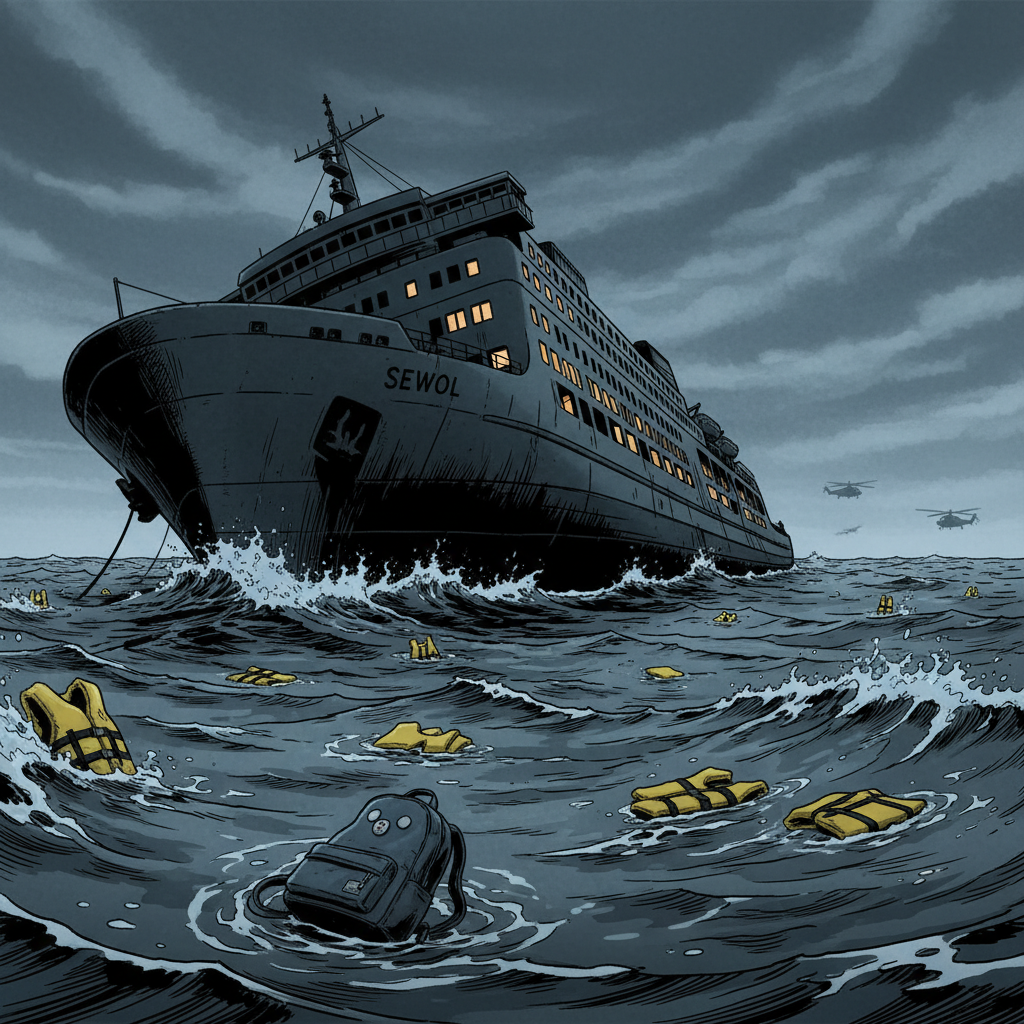
On April 16, 2014, the South Korean ferry MV Sewol capsized and sank while en route from Incheon to Jeju Island, killing 304 of the 476 people on board. Among the dead were 250 students from Danwon High School in Ansan, aged 16-17, on a school field trip. The disaster exposed systemic failures in South Korea's maritime safety regime: the vessel had been illegally modified to carry more passengers and cargo, was loaded to more than twice its legal cargo limit, and its crew abandoned ship while repeatedly instructing passengers to stay in their cabins. President Park Geun-hye's unexplained seven-hour absence during the critical early hours became a major political scandal contributing to her impeachment in 2017. The Sewol disaster became a symbol of institutional failure in South Korea.
Zusammenfassung
Seven analytical lenses converge on a single devastating conclusion: the Sewol disaster was not an accident but the inevitable product of a social system that systematically prioritized speed, profit, and hierarchical obedience over human safety. Every lens identifies systemic rather than individual failure as the root cause, though they differ on which systemic dimension is most significant — Confucian hierarchy, neoliberal deregulation, regulatory capture, or behavioral conditioning. The most profound insight emerges from the intersection of the Confucian and Pavlovian analyses: the very virtue Korean society most cultivates in its children — obedience to authority — became the mechanism of their deaths when authority proved unworthy of trust. The disaster catalyzed a counter-hegemonic movement that toppled a president, but whether it produced lasting structural change or merely a temporary disruption of the hegemonic order remains the central open question.
Wichtige Fakten
Verifizierte Fakten aus Mehrquellen-Recherche, bewertet nach Konfidenzgrad
MV Sewol departed Incheon at approximately 9:00 PM on April 15, 2014, with 476 people: 443 passengers (325 Danwon High School students, 14 teachers) and 33 crew.
high KonfidenzDistress signal sent at 08:58 KST on April 16, 2014. The ship took approximately two and a half hours to sink.
high KonfidenzMV Sewol was originally the Japanese ferry Naminoue (built 1994). Chonghaejin Marine purchased it in 2012 and illegally modified it to add passenger cabins on upper decks, raising center of gravity.
high KonfidenzSewol carried 2,142.7 tons of cargo against a legal maximum of 987 tons, with only 761.2 tons of ballast water. Included 180 vehicles (recorded as 150) and 1,157+ tons of freight.
high KonfidenzCaptain Lee Joon-seok (age 69) and 14 crew evacuated while PA system told passengers to remain in cabins.
high KonfidenzOf 172 survivors, more than half were rescued by civilian fishing boats that arrived ~40 minutes before the Korea Coast Guard.
high Konfidenz304 people died, including ~250 Danwon High School students aged 16-17. About 82% of casualties were children.
high KonfidenzWichtige Akteure
Hauptakteure dieses Ereignisses mit ihren Handlungen und erklärten Interessen
Kapitaen Lee Joon-seok
individual- ›Evakuierungsbefehl nicht erteilt
- ›Schiff verlassen waehrend Passagiere unter Deck blieben
- ›Gehoerte zu den ersten geretteten Besatzungsmitgliedern
Chonghaejin Marine Company
corporation- ›MV Sewol gekauft und illegal umgebaut
- ›Routinemaessig ueber die gesetzlichen Grenzen hinaus ueberladen
- ›Ladungsmanifeste gefaelscht
Praesidentin Park Geun-hye
individual- ›Sieben Stunden lang abwesend vom Krisenmanagement
- ›Kapitaen und Besatzung oeffentlich beschuldigt
- ›Aufloesung der Kuestenwache angeordnet
Koreanische Kuestenwache
organization- ›40 Minuten nach zivilen Booten eingetroffen
- ›Konnte das sinkende Schiff nicht betreten
- ›Kapitaen/Besatzung zuerst gerettet
Familien der Danwon-Oberschule
group- ›Mahnwache im Hafen von Paengmok eingerichtet
- ›Gelbe-Schleife-Bewegung gestartet
- ›Unabhaengige Untersuchung gefordert
Recherche & Quellen
Ereigniszeitlinie
2009-2017
Kausalanalyse
Interaktiver Graph, der zeigt, wie Richtlinien, Akteure und Ereignisse kausal zusammenhängen — klicken Sie auf Knoten, um Beziehungen zu erkunden
KAUSALES NETZWERK
14 Knoten · 16 Verbindungen
Knoten auswählen
Klicken Sie auf einen beliebigen Knoten im Graphen, um seine Verbindungen und Linsenperspektiven zu erkunden
Grundursachen
1Kritischer Pfad
8 SchritteLinsenanalysen
Jede Linse bietet einen einzigartigen analytischen Rahmen — klicken Sie zum Aufklappen für eine tiefgehende Analyse
Analyse der Auswirkungen auf die Zivilbevoelkerung
civilian-impactThe Sewol disaster inverts the expected moral calculus of obedience: children who followed instructions died while those who defied authority survived. This produced not merely grief but a fundamental crisis of institutional trust in South Korean society, transforming a maritime accident into a civilization-level reckoning with the relationship between authority, obedience, and the duty of care.
Konfuzianische Ethik
East AsianconfucianThe Sewol disaster reveals the lethal paradox at the heart of Confucian obedience culture: the very virtue of respectful compliance that Korean society cultivates in its children became the mechanism of their deaths when the authority figures they trusted violated every Confucian duty of care. The disaster demands a reckoning not with Confucianism itself but with its distortion — obedience without the reciprocal obligation of benevolent authority that makes Confucian hierarchy ethically coherent.
Spieltheorie
Western Moderngame-theoryThe Sewol disaster is a textbook case of catastrophic equilibrium: every actor behaved rationally given the incentive structure they faced, and 304 people died. The regulatory capture equilibrium was individually rational for both regulators and industry, the captain's abandonment was individually rational given the payoff structure, and the students' obedience was rational given their information state. The tragedy is that the system produced collectively catastrophic outcomes from individually rational choices at every level.
Verhaltenskonditionierungsanalyse
Western ModernpavlovThe Sewol disaster demonstrates that behavioral conditioning is not merely a laboratory phenomenon but a lethal social force. The Korean education system's systematic conditioning of obedience produced students who followed fatal instructions as automatically as Pavlov's dogs responded to bells. The tragedy is not that the conditioning 'failed' — it worked perfectly. The students did exactly what they had been trained to do. The failure was in the system that conditioned obedience without ensuring the authorities being obeyed were worthy of that conditioned trust.
Machiavellistische Realpolitik
Greco-Roman & ClassicalmachiavelliThe Sewol disaster is a Machiavellian masterclass in how appearance devours substance. Park Geun-hye may or may not have been monitoring the crisis during the seven missing hours — but it does not matter. Machiavelli teaches that for a prince, appearing to act is as important as acting. By disappearing during the crisis, Park violated the cardinal Machiavellian principle: never let your people see you as either incompetent or indifferent, for they will forgive cruelty before they forgive contempt.
Analyse der Unternehmensinteressen
Western ModerncorporateThe Sewol disaster demonstrates that regulatory capture is not a market 'imperfection' but a predictable equilibrium outcome when the regulated industry has concentrated interests and the public has diffuse ones. Chonghaejin Marine did not 'break' the system — it operated exactly as the system was designed to allow. The 304 deaths are the externalized cost of a regulatory regime that systematically valued corporate profitability over public safety.
Gramscianische Analyse (Kulturelle Hegemonie)
Western ModerngramsciThe Sewol disaster reveals that ppalli-ppalli is not a neutral cultural trait but a hegemonic formation — a way of organizing society that serves particular class interests while appearing as universal common sense. When 250 children died because speed and profit were prioritized over safety and care, the hegemonic spell was broken. The yellow ribbon movement and the candlelight protests represent one of the most successful counter-hegemonic mobilizations in recent East Asian history: a war of position that toppled a president and, for a time, made a new common sense — that the state's first duty is to protect life, not to facilitate profit.
Konvergenzen
Wo mehrere Linsen zu ähnlichen Schlussfolgerungen gelangen — was auf Robustheit hindeutet
Systemic institutional failure, not individual incompetence
All four lenses independently identify the disaster as the product of systemic failures — regulatory capture, corporate impunity, deregulation ideology — rather than merely individual bad actors. Captain Lee's abandonment and Park's absence are symptoms, not causes.
Obedience to authority as lethal mechanism
The Confucian, Pavlovian, and civilian impact lenses all identify the students' conditioned obedience as the proximate cause of the extreme casualty concentration. The cultural conditioning that produced compliance (Confucian/Pavlov) directly produced the casualties (civilian impact).
Appearance vs. reality in governance
Machiavelli identifies the failure of political appearance management; Gramsci identifies the hegemonic construction of 'common sense' that masked danger; corporate analysis identifies the regulatory capture that created the appearance of oversight without substance.
Post-1997 deregulation as causal root
Corporate, Gramscian, and game theory analyses all trace the causal chain back to the post-Asian Financial Crisis deregulation regime that created the institutional conditions for the disaster.
Produktive Spannungen
Wo Linsen nicht übereinstimmen — und Komplexität offenbaren, die es zu untersuchen lohnt
Mögliche Zukünfte
Szenarien, die aus Linsenanalysen abgeleitet wurden — was sich auf Basis verschiedener Rahmen entfalten könnte
Durable reform: Sewol becomes Korea's 'never again' moment
Medium — possible if reforms are institutionalized before political attention fades
Gradual erosion: Reforms decay as memories fade
Medium-high — historical pattern suggests regulatory reforms erode within 15-20 years without sustained political pressure
Cultural transformation: Korean society fundamentally rebalances obedience norms
Low — deep cultural conditioning is resistant to event-driven change
Schlüsselfragen
Fragen, die nach der Analyse offen bleiben — für weitere Untersuchungen
- ?What was Park Geun-hye doing during the seven missing hours?
- ?How many previous overloading incidents occurred on Sewol routes before the disaster?
- ?What was the exact relationship between maritime regulators and Chonghaejin Marine personnel?
Details der Faktenprüfung
Ergebnisse der Faktenprüfung
verifiedMeta-Beobachtungen
All seven lenses focus on what went wrong and why, but none adequately accounts for the acts of extraordinary courage that also occurred: the crew member Park Ji-young (age 22) who helped students put on life vests and pushed them toward exits before she herself drowned, or the students who defied instructions to help classmates. The disaster produced both the worst and the best of human behavior, and an exclusive focus on failure risks dishonoring those who chose courage.
The Sewol disaster sits at the intersection of culture (Confucian hierarchy), economics (neoliberal deregulation), politics (regulatory capture and presidential accountability), psychology (conditioned obedience), and technology (maritime engineering). No single lens can capture this intersection; the seven together approach but do not exhaust the event's meaning.
This analysis was conducted from outside Korean culture, primarily using English-language sources. Korean-language scholarship, survivor testimony, and the Sewol families' own articulation of what the disaster means should be weighted more heavily than any external analytical framework. The most important voices in this analysis are those of the 304 who cannot speak and the families who speak for them.
Ihre Perspektive finden
Verschiedene Rahmen sprechen unterschiedliche Leser an — finden Sie Ihren Einstiegspunkt
Readers who think in terms of incentives, systems, and institutional design. You see the disaster as a predictable outcome of misaligned incentives and regulatory failure.
The disaster was rational at every level — the system produced catastrophic outcomes from individually rational choices. Reform requires changing incentive structures, not just punishing individuals.
Readers who focus on cultural context, human behavior, and the relationship between individuals and the social systems that shape them. You see the disaster as a failure of the social contract between authority and trust.
The obedience that killed the students was a product of the very social system that Korean society values most. Reform requires rethinking the relationship between authority and compliance, not just fixing regulations.
Readers who focus on leadership, governance, and the responsibilities of those in power. You see the disaster as a failure of leadership at every level.
Leaders' failure to fulfill their duty of care — captain, company, president — produced both the disaster and the political consequences. The appearance of caring is inseparable from the substance of governance.
Readers who question dominant narratives and look for whose interests are served by 'common sense.' You see the disaster as the product of a hegemonic system that normalized danger.
Ppalli-ppalli culture and deregulation ideology were not neutral — they served particular class interests while appearing as universal Korean values. The reforms may be transformismo: surface changes that preserve underlying power structures.
Start with the convergences — all seven lenses agree on systemic failure. Then explore the tensions: the debate between individual agency (Machiavelli) and structural determinism (Gramsci) reveals the most productive analytical ground. The Confucian-Pavlovian intersection on obedience is the most distinctive insight this analysis produces.
Verwandte Analysen
Andere Ereignisse, die durch ähnliche Linsen oder Kategorien analysiert wurden
Am 26. April 1986 um 01:23 Uhr explodierte Reaktor Nr. 4 des Kernkraftwerks Tschernobyl in der Ukrainischen SSR während eines Sicherheitstests und setzte 400-mal mehr radioaktives Material frei als die Hiroshima-Bombe. Die sowjetischen Behörden verheimlichten die Katastrophe zunächst und zwangen die 49.000 Einwohner von Prypjat, 36 Stunden lang ihr normales Leben fortzusetzen. Etwa 600.000 Liquidatoren wurden zum Einsatz gebracht. Die geschätzte Todeszahl reicht von 4.000 (WHO) bis 93.000 (Greenpeace). Die Katastrophe zerstörte den Mythos der sowjetischen technologischen Überlegenheit und trieb Gorbatschow zur Glasnost — und war nach seiner eigenen Einschätzung «vielleicht die wahre Ursache für den Zusammenbruch der Sowjetunion».
Der Arabische Frühling war eine revolutionäre Welle von Protesten, Aufständen und bewaffneten Rebellionen, die ab Dezember 2010 über die arabische Welt hinwegfegte. Ausgelöst durch die Selbstverbrennung des tunesischen Straßenverkäufers Mohamed Bouazizi am 17. Dezember 2010 — ein Akt der Verzweiflung gegen Jahrzehnte autoritärer Korruption, Demütigung und Jugendarbeitslosigkeit — breitete sich die Bewegung mit atemberaubender Geschwindigkeit über Nordafrika und den Nahen Osten aus. Der prägende Sprechchor „الشعب يريد إسقاط النظام“ (Das Volk will den Sturz des Regimes) hallte von Tunis bis Kairo, von Bengasi bis Damaskus. Tunesiens Ben Ali floh nach 23 Jahren (14. Januar 2011); Ägyptens Mubarak fiel nach 30 Jahren in nur 18 Tagen (11. Februar 2011); Libyens Gaddafi wurde nach einer NATO-Intervention gestürzt und getötet (Oktober 2011); Syriens Assad wählte brutale Unterdrückung und entfachte einen Bürgerkrieg, der über 500.000 Menschen tötete und 13 Millionen vertrieb. Die Entscheidung des Militärs — sich auf die Seite der Demonstranten zu stellen oder dem Regime treu zu bleiben — erwies sich in jedem Land als entscheidende Variable.
Zwischen dem 6. April und dem 18. Juli 1994 wurden in Ruanda innerhalb von 100 Tagen systematisch etwa 800.000 Tutsi und gemäßigte Hutu ermordet — das effizienteste Massentöten der modernen Geschichte mit einer höheren täglichen Todesrate als der Holocaust. Der Völkermord war nicht der Ausbruch „alter Stammeskonflikte“, sondern der Höhepunkt eines Kolonialprojekts: Belgische Verwalter hatten durch die Volkszählung von 1933 und obligatorische ethnische Ausweise starre Rassenkategorien aus fließenden sozialen Identitäten geschaffen und die Hutu-Tutsi-Spaltung erzeugt, die politische Eliten später als Waffe einsetzten. Das Habyarimana-Regime und sein innerer Kreis der akazu (kleines Haus) wählten angesichts des militärischen Drucks der Ruandischen Patriotischen Front und der Machtteilungsforderungen der Arusha-Abkommen den Völkermord als politische Überlebensstrategie. RTLM-Radio — „Radio Machete“ — konditionierte die Bevölkerung systematisch durch jahrelange entmenschlichende Propaganda, nannte Tutsi „inyenzi“ (Kakerlaken) und sendete während des Völkermordes explizite Tötungsbefehle und Standorte der Opfer. Zwischen 250.000 und 500.000 Frauen wurden als vorsätzliche Waffe des Völkermordes vergewaltigt. Das Versagen der internationalen Gemeinschaft war nicht passiv, sondern aktiv: UNAMIR-Kommandeur Dallaire sandte seinen „Völkermord-Fax“ drei Monate vor Beginn der Morde, forderte 5.000 Soldaten und wurde abgewiesen. Der UN-Sicherheitsrat reduzierte UNAMIR von 2.500 auf 270 Soldaten während des Völkermordes. Der militärische Sieg der RPF beendete den Völkermord im Juli 1994, doch die Folgen kaskadieren in den Ersten Kongokrieg (1996-97) und „Afrikas Weltkrieg“ mit über 5 Millionen Toten.
Wie dies analysiert wurde
Vollständige Transparenz über den Analyseprozess, die verwendeten Werkzeuge und die Einschränkungen
Crosslight Engine
v0.4.0 "Global Lens Expansion"- ⚠Non-Western philosophical lenses rely on translated primary texts — nuance may be lost in translation
- ⚠Some traditions (e.g., Maat, Ubuntu) have limited surviving primary texts; analysis draws on scholarly reconstruction
- ⚠Cross-cultural lens application is inherently interpretive — a Confucian reading of a Western event is an analytical exercise, not a claim of cultural authority
Analysestatistiken
Methodik
Diese Analyse wurde von der Crosslight-Multi-Agenten-Pipeline erstellt: Ein Rechercheagent sammelte und verifizierte Fakten aus mehreren Quellen, spezialisierte Linsenagenten wendeten verschiedene analytische Rahmen an, ein Syntheseagent integrierte Erkenntnisse und identifizierte Muster, und ein Faktenprüfungsagent überprüfte Behauptungen. Jede Linsenperspektive ist die KI-Interpretation — keine institutionelle Empfehlung.Mehr erfahren →