The 1995 Rugby World Cup Final: Mandela and the Springboks
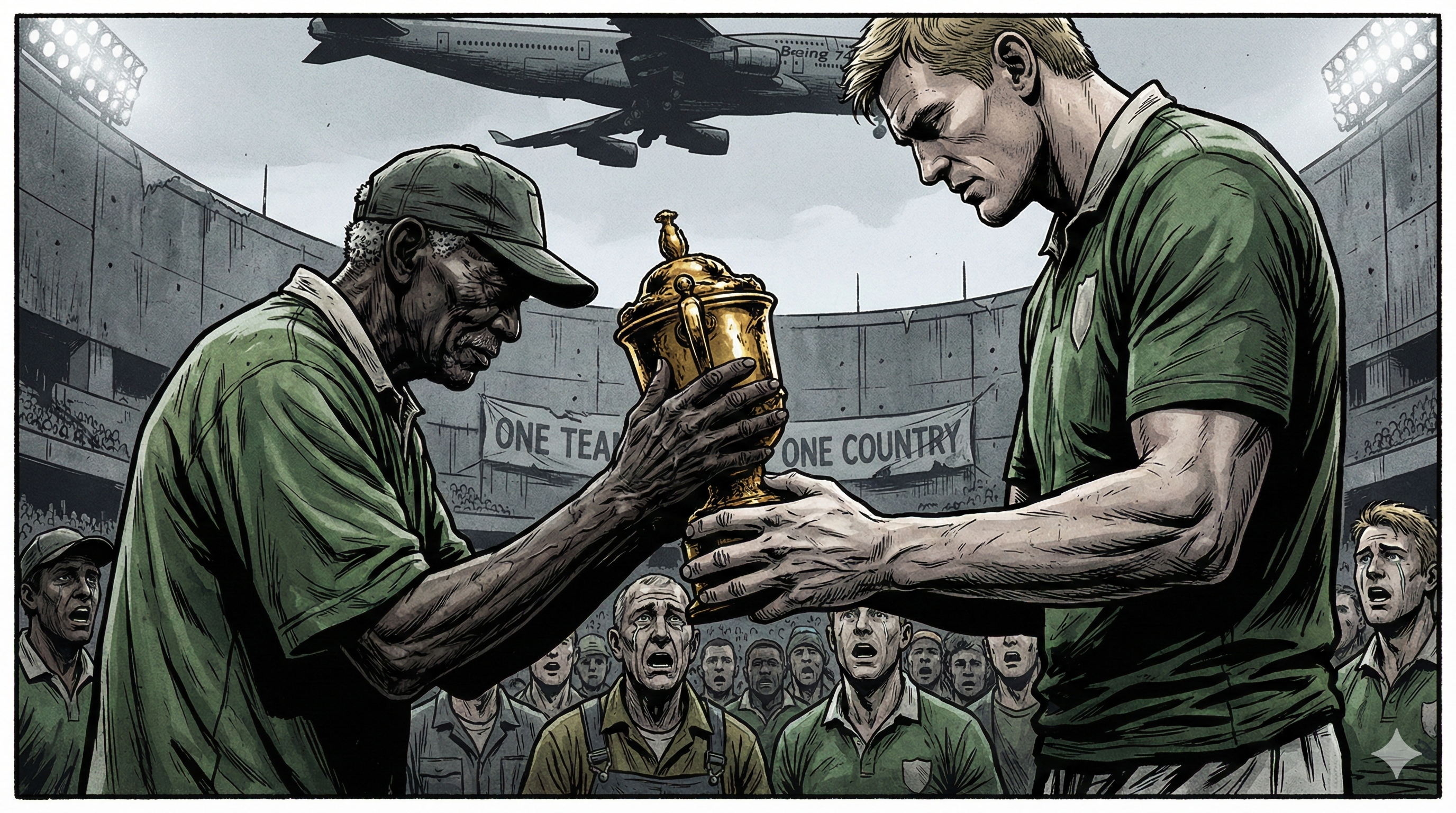
The 1995 Rugby World Cup Final at Ellis Park, Johannesburg on June 24, 1995, where Nelson Mandela wore a Springbok jersey to present the Webb Ellis Cup to captain Francois Pienaar after South Africa's 15-12 victory over New Zealand. This event—South Africa's first major international sporting event after apartheid—became one of history's most powerful symbols of reconciliation, transforming the Springbok from a hated emblem of white oppression into a unifying national symbol virtually overnight.
Executive Summary
The 1995 Rugby World Cup Final was simultaneously a sporting event, a political masterstroke, a collective psychological healing, and a contested symbol. All six analytical lenses converge on one point: what happened on June 24, 1995 at Ellis Park transcended rugby. But they diverge on what it means. Game theory sees a coordination mechanism that helped South Africa reach a cooperative equilibrium; Machiavelli sees brilliant statecraft that converted enemies' symbols into tools of power; Taoism sees the natural flow of reconciliation released by Mandela's wu-wei approach; Jung sees collective shadow integration; sports sociology sees symbolic change that may have substituted for structural change; and the talking-head sees the greatest clutch moment in sports history. Each lens captures something true while missing something else. The synthesis must hold these perspectives in tension: yes, it was transformative AND incomplete; yes, it was genuine emotion AND calculated politics; yes, it was a beginning AND not an end.
Key Facts
Verified facts from multi-source research, scored by confidence level
The 1995 Rugby World Cup was South Africa's first appearance in the tournament. They had been banned from the first two World Cups (1987, 1991) due to international sporting sanctions against apartheid.
high confidenceNelson Mandela was released from Victor Verster Prison on February 11, 1990, after 27 years of imprisonment. He was inaugurated as South Africa's first democratically elected president on May 10, 1994—just over one year before the World Cup final.
high confidenceThe Springbok emblem had been the exclusive symbol of white South African rugby since 1906. During apartheid, black South Africans were barred from playing for the national team and elite clubs. Black South Africans traditionally supported whoever was playing against the Springboks.
high confidenceChester Williams was the only non-white player on the 1995 Springbok squad. He was nicknamed 'The Black Pearl' and scored four tries in the quarter-final against Western Samoa. Williams later revealed in his 2002 autobiography that some teammates shunned him and teammate James Small allegedly called him racist names.
high confidenceMandela met with Francois Pienaar before the tournament to discuss how the Springboks could help broker peace between black and white South Africans. Mandela gave Pienaar a copy of Theodore Roosevelt's 'Man in the Arena' speech, not the poem 'Invictus' as depicted in the 2009 film.
high confidenceThe ANC's National Sports Council had voted to abolish the Springbok emblem as a symbol of apartheid oppression. Mandela argued against this decision and persuaded his party to retain the emblem for the World Cup, understanding its importance to Afrikaner identity.
high confidenceThe tournament's official slogan was 'One Team, One Country'—a deliberate message of national unity orchestrated by Mandela's government.
high confidenceKey Actors
Major actors involved in this event with their actions and stated interests
Nelson Mandela
individual- ›Persuaded ANC to retain Springbok emblem
- ›Met personally with Francois Pienaar before tournament
- ›Learned names of all Springbok players
Francois Pienaar
individual- ›Met with Mandela before tournament
- ›Led team with unity message
- ›Accepted trophy from Mandela in iconic moment
Chester Williams
individual- ›Became only non-white player on squad
- ›Scored 4 tries in quarter-final vs Western Samoa
- ›Represented black South Africa symbolically
Research & Sources
Event Timeline
1995-05-25 to 1995-06-24
Causal Analysis
Interactive graph showing how policies, actors, and events connect causally — click nodes to explore relationships
CAUSAL NETWORK
21 nodes · 22 connections
Select a node
Click any node in the graph to explore its connections and lens perspectives
Root Causes
2Critical Path
7 stepsLens Analyses
Each lens provides a unique analytical framework — click to expand for deep analysis
Game Theory & Strategic Interaction
Western Moderngame-theoryThe 1995 Rugby World Cup Final was a masterpiece of game-theoretic strategy. Mandela understood that South Africa faced a coordination problem: both communities needed to cooperate, but neither trusted the other to do so first. He used the World Cup as a coordination device—a focal point where cooperation could be demonstrated publicly and irrevocably. His wearing of the Springbok jersey was a commitment device that bound him to reconciliation; the crowd's response was a reciprocal commitment. The genius was recognizing that a rugby match could serve as a low-stakes trial run for high-stakes cooperation. What happened on the field mattered less than what happened in the stands and in living rooms across South Africa: the demonstration that cooperation was possible.
Machiavellian Power Analysis
Greco-Roman & ClassicalmachiavelliMandela's performance at Ellis Park was Machiavellian in the highest sense—not deceitful, but supremely strategic. He understood that symbols are power, that embracing opponents' symbols is more powerful than destroying them, and that magnanimity from a position of moral strength creates more durable loyalty than demands for submission. The Springbok jersey, which had symbolized oppression, became in Mandela's hands a symbol of redemption precisely because he chose to wear it. Had the ANC abolished it, whites would have mourned and resented. By preserving it and claiming it, Mandela made it serve his purposes. This is statecraft at its finest: converting your enemies' weapons into your own.
Taoist Flow Analysis
East AsiantaoismThe 1995 Rugby World Cup Final demonstrates the Taoist principle that the soft overcomes the hard, the yielding overcomes the rigid. Apartheid was maintained by hardness—laws, guns, walls. Its end came through softness—negotiation, reconciliation, symbol-sharing. Mandela wearing the Springbok jersey was the ultimate soft power: he did not defeat Afrikaner identity but absorbed it, did not destroy the symbol but transformed it. This is the water that wears away stone, the empty center of the wheel that makes it useful. The crowd's chanting of 'Nelson!' was spontaneous wu-wei—they acted without thinking because Mandela had created conditions where non-action felt natural. This is the highest achievement: transformation that doesn't feel like transformation, change that feels like coming home.
Jungian Psychological Analysis
Western ModernjungThe 1995 Rugby World Cup Final was not primarily a sporting event but a collective ritual of psychological transformation—what Jung would recognize as a moment of mass individuation. Mandela wearing the Springbok jersey was the nation's shadow made conscious, embraced, and transformed. The crowd's ecstatic response was the release of decades of projected shadow material—the Afrikaner confronting his guilt and fear, the black South African seeing his oppressor's symbol claimed by his leader. This is the psychological work that political negotiation cannot accomplish: the integration of split-off parts of the national psyche. But Jung would also warn that one ritual cannot complete the work. Chester Williams' experience reveals shadow persisting beneath reconciliation's surface. The nation performed integration while individuals remained unintegrated. This is always the challenge: collective symbols can open the door to transformation, but each individual must walk through it alone.
Critical Sports Sociology Analysis
Entertainment & Sportssports-sociologyThe 1995 Rugby World Cup Final was a genuine moment of emotional connection across racial lines, but critical analysis requires asking: connection in service of what? The match did not end racism in South African rugby—Chester Williams' experience proves this. It did not transform the sport's demographics, its economic structure, or its power relationships. What it accomplished was legitimation: of the new government, of the transition's approach, of South Africa's re-entry into global capitalism. These may be worthwhile accomplishments, but they are not the same as justice. The 'miracle' narrative does ideological work, positioning reconciliation as complete when it had barely begun. Thirty years later, debates about transformation in South African rugby continue, suggesting the 1995 moment opened a door but did not walk through it. The critical sports sociologist must honor the genuine emotion of the moment while insisting that emotion is not enough.
Sports Media Hot Take Analysis
Entertainment & Sportstalking-headLook, I know I get paid to have hot takes, but this isn't a hot take—this is just FACTS. The 1995 Rugby World Cup Final is the greatest example of sports transcending sports in human history. You had a man who could have been bitter, who could have demanded revenge, who could have destroyed the thing his enemies loved most—and instead he EMBRACED it. He turned their symbol into his symbol. He turned their team into everyone's team. That's not just good politics—that's GOAT-level leadership. And then the team went out and WON. In extra time. Against the best team in the world. With their best player contained. That's called delivering on the moment. That's called championship mentality. Thirty years later, we're still talking about it. That's legacy. That's immortality. That's what sports can be at their absolute best.
Confucian Ethics
East AsianconfucianThe 1995 Rugby World Cup Final is, in Confucian terms, a textbook demonstration of governance through de (moral power) rather than coercion: Mandela's jersey gesture was an act of li (ritual propriety) so perfectly calibrated that it activated ren (humaneness) across the Five Relationships simultaneously -- ruler and subject, elder and younger, friend and friend -- and in doing so achieved what Confucius called the rectification of names, transforming 'Springbok' from a word meaning oppression into a word meaning reconciliation, because in Confucian thought, when names are correct, the social order follows.
Ubuntu Relational Ethics
AfricanubuntuThe 1995 Rugby World Cup Final was the most powerful enactment of sawubona ('I see you') in modern South African history: Mandela's jersey gesture told an entire community 'I see your humanity even though you denied mine,' and the crowd's response -- chanting the name of the man their system had imprisoned -- was the spontaneous return of that recognition, enacting at national scale the ubuntu truth that umuntu ngumuntu ngabantu, a person is a person through other persons, which means that Mandela's humanity was enlarged, not diminished, by choosing to see the humanity of those who had not seen his.
Gramscian Analysis (Cultural Hegemony)
Western ModerngramsciThe 1995 Rugby World Cup Final was a masterclass in Gramscian guerra di posizione (war of position): rather than attacking the Springbok as a symbol of oppression -- which would have been guerra di manovra, a frontal assault certain to provoke Afrikaner resistance -- Mandela appropriated the symbol from within, changing its hegemonic content while preserving its cultural form, thereby building the blocco storico (historic bloc) necessary for stable post-apartheid governance; yet Gramsci would insist that this superstructural transformation of symbols and consent must be judged against the material base, and Chester Williams' solitary presence on the squad reveals the gap between hegemonic transformation at the level of common sense and structural transformation at the level of who actually plays, coaches, and profits from the sport.
Convergences
Where multiple lenses reach similar conclusions — suggesting robustness
Mandela's strategic genius
All six lenses recognize Mandela as the central actor whose choices shaped the event's meaning. Whether described as game-theoretic strategy, Machiavellian statecraft, wu-wei, shadow integration facilitation, or championship mindset, all agree Mandela's decision to wear the Springbok jersey was the defining act.
Sports as more than sports
Every lens agrees that the event's significance exceeded its sporting content. Whether the 'more' is political, psychological, symbolic, or narrative, all recognize that Ellis Park 1995 cannot be understood as merely a rugby match.
Symbol transformation as key mechanism
Three lenses emphasize that the Springbok symbol itself was transformed—from oppressor's emblem to national symbol—through Mandela's embrace. The mechanism differs (power capture vs. natural flow vs. shadow integration) but the phenomenon is consistent.
Productive Tensions
Where lenses disagree — revealing complexity worth examining
Possible Futures
Scenarios derived from lens analyses — what might unfold based on different frameworks
The 1995 moment is seen as foundational to a successfully transformed South Africa
Partial realization—transformation ongoing but incomplete
The 1995 moment is reassessed as performative reconciliation that substituted for justice
Possible if inequality persists and new voices challenge dominant narrative
The moment fades from memory as time passes and participants die
Unlikely given institutional memorialization (Invictus film, etc.)
Key Questions
Questions that remain open after analysis — for continued inquiry
- ?What exactly did Mandela say to Pienaar before the tournament about the team's role?
- ?Was the food poisoning incident genuine or deliberate, and will we ever know?
- ?How many black South Africans actually watched the match versus the later celebration?
Fact Check Details
Fact Check Results
verifiedMeta Observations
All six lenses underemphasize the New Zealand perspective. The All Blacks were not just opponents but participants in a global moment, and their experience (including the food poisoning controversy) deserves more attention. The event is typically analyzed from the South African perspective, but the match required both teams.
The 1995 moment's meaning cannot be reduced to any single framework. It was simultaneously strategic and authentic, transformative and incomplete, a beginning and an end. Any lens that claims to fully explain it is overclaiming. The synthesis must preserve this irreducibility.
We cannot know what would have happened without the World Cup, whether the reconciliation would have proceeded anyway, or whether the symbolic moment created more change than it obscured. Historical counter-factuals are permanently unknowable. We can analyze; we cannot prove.
Find Your Perspective
Different frameworks resonate with different readers — find your entry point
Those who see politics as strategic interaction and want to understand the mechanics of how reconciliation worked
Mandela used the World Cup as a coordination device; the jersey was a commitment mechanism; symbols are tools of power that can be captured rather than destroyed
Those who sense deeper patterns and believe in psychological/spiritual transformation
The crowd's response was collective shadow integration; Mandela practiced wu-wei; the Springbok's polarity reversed from oppression to inclusion
Those focused on structures, power, and persistent inequality
Symbolic change is not structural change; Chester Williams' experience reveals limits of reconciliation; the 'miracle' narrative does ideological work
Those who question dominant narratives and ask who benefits
The celebration may have premature-declared victory; tokenism is not representation; spectacular moments can substitute for substantive change
If game theory resonates, explore how Taoism's natural tendency concept explains why the coordination worked. If Jung resonates, consider how sports sociology challenges whether individual transformation aggregates to social change. The richest understanding holds multiple perspectives simultaneously.
Related Analyses
Other events analyzed through similar lenses or categories
The construction of the three Great Pyramids at Giza (c. 2589–2504 BCE) during Egypt's Fourth Dynasty represents humanity's first megaproject—a multi-generational, state-directed engineering endeavor that mobilized 20,000–25,000 workers, 2.3 million limestone blocks, and the full administrative apparatus of the world's first nation-state to build monuments that remain standing 4,500 years later.
On November 22, 1963, President John F. Kennedy was assassinated in Dealey Plaza, Dallas, Texas. Lee Harvey Oswald was arrested but killed by Jack Ruby before trial. The Warren Commission concluded Oswald acted alone, while the HSCA later found probable conspiracy. Declassified documents through 2025 reveal institutional cover-ups by the CIA and FBI, making it the most consequential unsolved case in American history.
On the night of February 28, 1986, at 23:21, Swedish Prime Minister Olof Palme was shot and killed on the central Stockholm street Sveavägen while walking home from a cinema with his wife Lisbeth. He had dismissed his security detail earlier that day — a prime minister walking unguarded through his capital on a Friday night, the very embodiment of Swedish democratic openness. A second shot grazed Lisbeth Palme. The killer fled up the steps of Tunnelgatan and vanished into the night. What followed was not merely a murder investigation but a national trauma that consumed Sweden for nearly four decades: a catastrophically botched crime scene, an investigation fixated on the wrong suspects, 134 people who confessed to the murder, over 10,000 tips that created information paralysis, the wrongful conviction and acquittal of Christer Pettersson, and dozens of competing conspiracy theories implicating South African intelligence, the CIA, NATO's Stay Behind/Gladio networks, the Kurdish PKK, and elements within the Swedish police themselves. In 2020, Chief Prosecutor Krister Petersson named graphic designer Stig Engström — the 'Skandia Man' — as the probable killer and closed the case. Engström had died by suicide in 2000, so could never be tried. The announcement was met with widespread criticism as circumstantial and unprovable. In December 2025, Sweden's director of public prosecutions formally reversed the conclusion, stating there was insufficient evidence to consider Engström the main suspect — but the investigation would not be reopened. The case remains, in effect, unsolved: Sweden's defining political wound, still open after nearly forty years.
How This Was Analyzed
Full transparency about the analysis process, tools, and limitations
Crosslight Engine
v0.3.1 "Arena & Stage"- ⚠Entertainment/sports lenses reflect domain stereotypes for analytical color, not endorsement
- ⚠Celebrity and sports events have limited 'ground truth' - analysis is inherently interpretive
- ⚠Hot take and tabloid personas are satirical framing devices for accessible analysis
Analysis Statistics
Methodology
This analysis was produced by the Crosslight multi-agent pipeline: a Research Agent gathered and verified facts from multiple sources, specialized Lens Agents applied distinct analytical frameworks, a Synthesis Agent integrated insights and identified patterns, and a Fact-Check Agent verified claims. Each lens perspective is the AI's interpretation — not institutional endorsement.Learn more →