
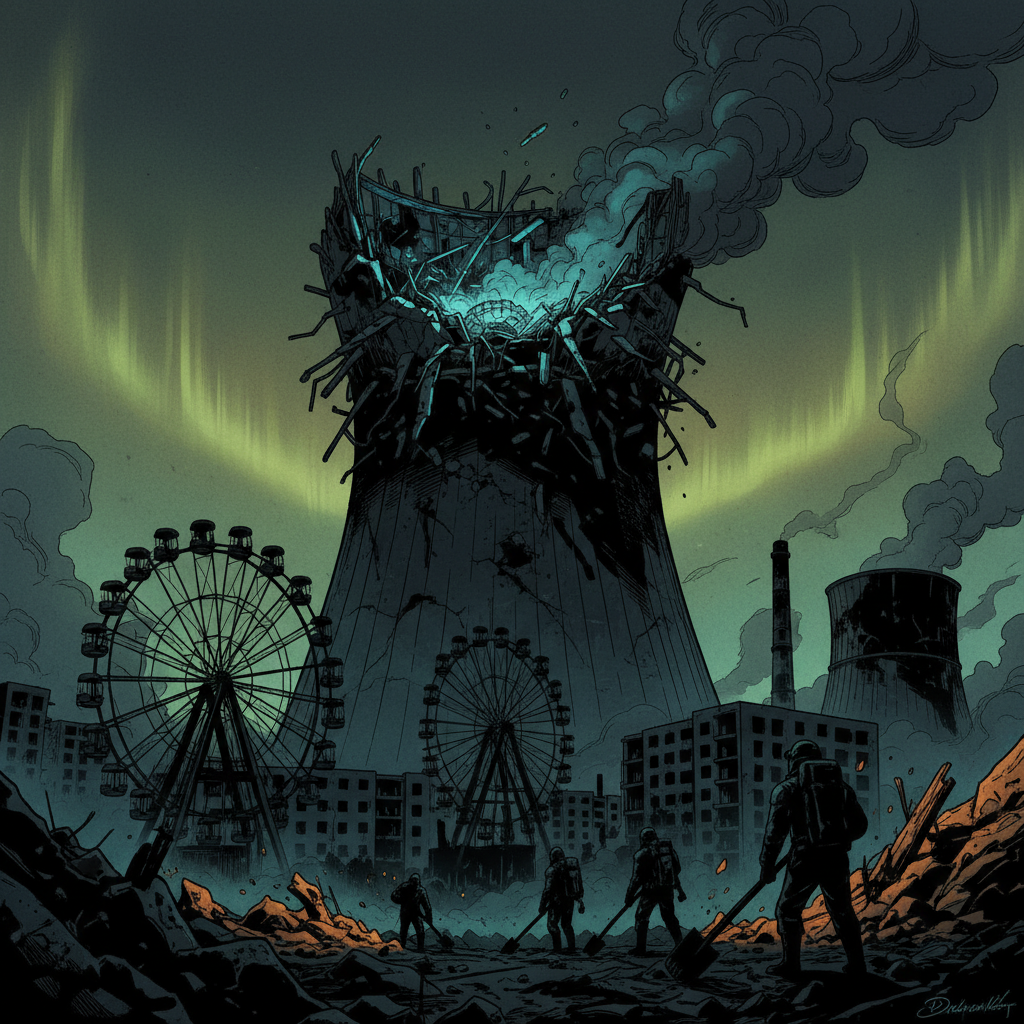
Chernobyl Disaster
On April 26, 1986, at 01:23 AM, Reactor No. 4 at the Chernobyl Nuclear Power Plant in the Ukrainian SSR exploded during a safety test, releasing 400 times more radioactive material than the Hiroshima bomb. The explosion and subsequent fire sent a plume of radioactive fallout across much of the western USSR and Europe. Soviet authorities initially concealed the disaster, forcing Pripyat’s 49,000 residents to continue normal life for 36 hours before evacuation. Some 600,000 ‘liquidators’ were eventually deployed to contain the catastrophe — including the ‘bio-robots,’ human volunteers who replaced failed machines to shovel radioactive graphite from the roof in 90-second shifts, each receiving a lifetime’s radiation dose. The official Soviet death toll of 31 remains contested; estimates range from the WHO’s 4,000 to Greenpeace’s 93,000 excess cancer deaths. The disaster shattered the myth of Soviet technological supremacy, forced Gorbachev’s hand on glasnost, and — in Gorbachev’s own later assessment — was ‘perhaps the real cause of the collapse of the Soviet Union’ more than any policy or reform. The 2,600-square-kilometer Exclusion Zone remains uninhabitable, a permanent scar on Ukrainian territory where Moscow’s decisions played out at Ukraine’s expense.
Executive Summary
Seven lenses converge on a central finding: the Chernobyl disaster was a dual catastrophe — a technical failure rooted in reactor design compromises, compounded and magnified by an institutional failure in which every level of the Soviet system prioritized self-preservation over human safety. Game theory reveals how rational individual decisions within pathological incentive structures produced collectively catastrophic outcomes. Machiavelli exposes how institutional power dynamics turned a reactor accident into a civilizational crisis. CIA confirms Western intelligence correctly assessed Soviet opacity but underestimated how a single accident could catalyze collapse. Pavlov demonstrates how decades of conditioning created reflexive patterns that worsened every decision point. Civilian impact documents the human toll across generations. Taoism reads the disaster as nature's response to hubris. Nietzsche explores the liquidators' sacrifice and Legasov's truth-telling. All seven agree: the institutional failure was as catastrophic as the technical failure, and arguably more preventable.
Key Facts
Verified facts from multi-source research, scored by confidence level
At 01:23 AM on April 26, 1986, Reactor No. 4 at the Chernobyl Nuclear Power Plant exploded during a turbine rundown safety test.
high confidenceThe RBMK-1000 reactor design had a known positive void coefficient of reactivity, meaning loss of coolant water increased reactivity. This was accepted as a trade-off for dual-use capability and cost savings.
high confidenceDeputy chief engineer Anatoly Dyatlov pressured operators to continue the test despite dangerously low power levels (~200 MW vs. planned 700-1000 MW). Operators disabled the ECCS and overrode automatic shutdown signals.
high confidencePripyat (population 49,000), 3 km from the reactor, was not evacuated until 36 hours after the explosion. Children played outdoors, weddings were held, and residents observed the fire from the 'Bridge of Death.'
high confidenceSwedish radiation monitoring stations at Forsmark detected elevated levels on April 28, forcing Soviet acknowledgment. The Soviets initially blamed a 'minor accident.'
high confidenceApproximately 600,000 liquidators were deployed between 1986 and 1990. 'Bio-robots' on the roof worked in 90-second shifts, each receiving a near-lifetime dose.
high confidenceOf 134 plant workers and firefighters diagnosed with acute radiation syndrome, 28 died within months. Their deaths were documented in clinical detail.
high confidenceKey Actors
Major actors involved in this event with their actions and stated interests
Anatoly Dyatlov
individual- ›Supervised the safety test
- ›Pressured operators to continue at low power
- ›Ordered disabled safety systems
Mikhail Gorbachev
individual- ›Delayed public acknowledgment 18 days
- ›Blamed Western media
- ›Used Chernobyl to accelerate glasnost
Valery Legasov
individual- ›Led scientific investigation
- ›Presented Soviet narrative to IAEA
- ›Recorded truth-telling tapes
Liquidators
group- ›Built sarcophagus
- ›Cleared radioactive graphite from roof
- ›Decontaminated surrounding areas
Research & Sources
Event Timeline
1954-06-27 to 1991-12-26
Causal Analysis
Interactive graph showing how policies, actors, and events connect causally — click nodes to explore relationships
CAUSAL NETWORK
18 nodes · 19 connections
Select a node
Click any node in the graph to explore its connections and lens perspectives
Root Causes
3Critical Path
8 stepsLens Analyses
Each lens provides a unique analytical framework — click to expand for deep analysis
Game Theory
Western Moderngame-theoryChernobyl was not a failure of rationality but a masterclass in how rational individual decisions within a pathological institutional structure produce collectively catastrophic outcomes. The system's information architecture was the root cause: by classifying safety data, punishing dissent, and rewarding concealment, the system guaranteed that each actor's rational choice would aggregate into civilizational disaster. The 'peaceful atom' ideology functioned as a corrupted focal point coordinating the entire system toward catastrophe. A system that makes honesty irrational will produce dishonesty at scale, and a nuclear power program built on institutional dishonesty will eventually produce Chernobyl.
Machiavelli
Greco-Roman & ClassicalmachiavelliChernobyl is a perfect Machiavellian case study in institutional self-preservation becoming self-destruction. The Soviet system followed the classic playbook: conceal weakness, project strength, control information, blame subordinates. This works for political competition between elites. It fails catastrophically for governing complex technical systems where accurate information is a safety prerequisite. Nuclear reactors do not respond to political narratives — they respond to physics. When the Soviet system treated safety information as a political resource rather than a physical reality, it created conditions for an accident that physics, not politics, would determine. Gorbachev's subsequent use of Chernobyl to accelerate glasnost was genuinely Machiavellian: converting catastrophic weakness into reform leverage. But glasnost could not be confined to nuclear safety.
CIA
Western InstitutionalciaChernobyl's intelligence significance lies not in the reactor failure but in what it revealed about Soviet decision-making under crisis. The disaster stress-tested the Soviet information architecture and it failed comprehensively: upward reporting filtered bad news, lateral communication was impeded by classification, downward communication prioritized messaging over safety, international communication was dishonest until forced. The pattern — institutional mendacity as structural feature — became a key lens for assessing authoritarian fragility. The insight that information-controlled systems are brittle rather than resilient remains one of the most durable Cold War intelligence lessons.
Pavlov
Western ModernpavlovChernobyl demonstrates that institutional conditioning is a safety-critical infrastructure vulnerability. Decades of conditioning — obedience, news suppression, trust in official narratives, punishment of dissent — created patterns individually adaptive (kept people employed) but collectively catastrophic (prevented detection of and response to existential threats). The disaster was caused not by a few bad decisions on April 26 but by forty years of conditioning that made those decisions inevitable. When you condition operators to obey authority over instruments, managers to filter reality, officials to prioritize narrative over facts, and citizens to trust silence as safety — you create an anti-safety culture where every reflex moves toward catastrophe.
Civilian Impact
civilian-impactChernobyl's civilian impact reveals a disaster on geological timescales: centuries of contamination, generational health consequences, and psychological wounds transmitted through families. The contested death toll is ongoing harm: when official count is 31 and the range extends to 93,000, communities exist in unresolved grief. The most important lesson: the institutional failure caused as much damage as the explosion. Without the 36-hour delay, the thyroid cancer epidemic would have been significantly reduced. Without the May Day parade, Kyiv's children would not have marched through fallout. The civilian toll is a consequence not merely of the explosion but of every subsequent institutional decision that prioritized image over human life.
Taoism
East AsiantaoismChernobyl is the Tao's answer to the 'peaceful atom.' The Taoist reading reveals a disaster driven by fundamental violation of the principle that nature cannot be conquered, only cooperated with. The Soviet system forced the atom, forced secrecy, forced obedience, forced ignorance, forced fiction. At every point, forcing produced its opposite. The Exclusion Zone — where nature flourishes in humanity's absence — is the most eloquent Taoist commentary. The wolves of Chernobyl embody the Tao Te Ching: 'the Tao nourishes all things.' The deepest lesson: systems that deny uncertainty will be destroyed by it.
Nietzsche
Western ModernnietzscheChernobyl is the story of a will to power that confused institutional dominance with genuine mastery. The Soviet system had power to classify, conceal, command, and coerce — but not to control nuclear fission when the reactor exceeded institutional narrative. The liquidators embody Nietzsche's central question: what distinguishes authentic heroism from coerced sacrifice? The Soviet system, by making genuine choice impossible, destroyed the conditions that make heroism meaningful — then claimed the sacrifice as institutional virtue. Legasov's arc is the most purely Nietzschean story: beginning in slave morality, recognizing institutional values as lies, destroying himself in self-overcoming that affirmed individual truth. The Soviet response — blaming individuals, concealing flaws, claiming liquidator sacrifice as institutional virtue — was slave morality: inverting truth and power, making institutional survival the highest value. Chernobyl shattered that inversion at a cost measured in human lives.
Convergences
Where multiple lenses reach similar conclusions — suggesting robustness
Institutional mendacity as root cause
All four identify Soviet information architecture — classification, punishment of dissent, rewarding optimism — as the fundamental cause transforming technical failure into civilizational catastrophe.
The coverup caused more harm than the explosion
36-hour evacuation delay, Kyiv May Day, continued milk distribution all caused measurable additional harm. The thyroid cancer epidemic was largely preventable with timely response.
Hubris and limits of institutional control
All four converge on the insight that Soviet confidence in its own control was the precondition for losing control catastrophically.
Productive Tensions
Where lenses disagree — revealing complexity worth examining
Possible Futures
Scenarios derived from lens analyses — what might unfold based on different frameworks
Nuclear renaissance with institutional learning
Moderate. Institutional learning genuine but incomplete. Climate pressures make expansion likely.
Another major nuclear accident exposing institutional failure
Low but non-negligible per decade.
Key Questions
Questions that remain open after analysis — for continued inquiry
- ?What is the true death toll? Will advances in epidemiology resolve the 4,000-93,000 range?
- ?How many liquidators developed radiation-related conditions and were denied recognition?
- ?What was the full chain of command in the first 72 hours?
Fact Check Details
Fact Check Results
verifiedMeta Observations
All seven share a bias toward explanation. What all miss is the irreducibly incomprehensible dimension: ARS as documented by Alexievich, the three-day lie's cruelty, children's thyroid cancers. Some dimensions of Chernobyl resist comprehension and should resist it.
The relationship between technical and institutional failure is irreducibly complex: they are co-produced effects of the same Soviet institutional culture. Separating them is analytically useful but ultimately misrepresents a disaster in which technology and institutions were inseparable.
The contested death toll — 31 to 93,000 — is a permanent reminder of irreducible uncertainty. Any analysis claiming certainty is less honest than one acknowledging the range.
Find Your Perspective
Different frameworks resonate with different readers — find your entry point
Readers drawn to structural explanations and institutional design. You see Chernobyl as fixable through better incentive structures.
The Soviet information architecture was the root cause. Information-controlled systems are brittle, not strong.
Readers drawn to questions about hubris, nature's limits, and moral weight of choices. Chernobyl as parable about humanity's relationship with uncontrollable forces.
The 'peaceful atom' embodied a fundamental misunderstanding: institutional will cannot master natural forces through political commitment.
Readers focused on how organizations function and how institutional cultures shape behavior. Chernobyl as case study in institutional pathology.
Behavioral conditioning and power dynamics made every actor behave rationally within their context while producing collective catastrophe.
Readers prioritizing human experience over analytical frameworks. Skeptical that any lens captures the horror of radiation sickness or the injustice of the contested death toll.
All frameworks risk abstracting away individual suffering. The thyroid cancer in a child's throat exceeds what any theory contains.
If in the analytical cluster, read civilian-impact to ground structural understanding in human experience. If intuitive, game-theory shows how 'hubris' operated through fixable mechanisms. If institutional, Nietzsche reminds that individual choices cannot be fully explained by conditioning. All readers: engage with the liquidator heroism/victimization tension without resolving it prematurely.
Related Analyses
Other events analyzed through similar lenses or categories
The Arab Spring was a revolutionary wave of protests, uprisings, and armed rebellions that swept across the Arab world beginning in December 2010. Triggered by the self-immolation of Tunisian street vendor Mohamed Bouazizi on December 17, 2010 — an act of desperation against decades of authoritarian corruption, humiliation, and youth unemployment — the movement spread with breathtaking speed across North Africa and the Middle East. The defining chant "الشعب يريد إسقاط النظام" (The people want the fall of the regime) echoed from Tunis to Cairo to Benghazi to Damascus. Tunisia's Ben Ali fled after 23 years (January 14, 2011); Egypt's Mubarak fell after 30 years in just 18 days (February 11, 2011); Libya's Gaddafi was overthrown and killed after NATO intervention (October 2011); Syria's Assad chose brutal suppression, igniting a civil war that killed over 500,000 and displaced 13 million. The military's choice — to side with protesters or stay loyal to the regime — proved the decisive variable in every country. Al Jazeera's satellite broadcasts and social media amplified the contagion, but the underlying causes were structural: decades of stagnation, corruption, and humiliation across a generation with no economic prospects. Western media characterized this as a democratic awakening; Gulf monarchies framed it as foreign-backed destabilization; authoritarian regimes described it as terrorist infiltration; participants called it ثورة الكرامة — the Dignity Revolution. A decade later, only Tunisia achieved democratic transition. Egypt reverted to military rule. Libya collapsed into a failed state. Syria became the century's worst humanitarian catastrophe, birthing ISIS and triggering the European refugee crisis. The Arab Spring remains the most consequential geopolitical event of the 2010s — a story of extraordinary courage, tragic outcomes, and the enduring question of whether revolution can deliver the dignity it promises.
Between April 6 and July 18, 1994, approximately 800,000 Tutsi and moderate Hutu were systematically murdered in Rwanda over the course of 100 days — the most efficient mass killing in modern history, with a faster per-day death rate than the Holocaust. The genocide was not the eruption of 'ancient tribal hatreds' but the culmination of a colonial project: Belgian administrators had manufactured rigid racial categories from fluid social identities through the 1933 census and mandatory ethnic identity cards, creating the very Hutu-Tutsi divide that political elites later weaponized. The Habyarimana regime's akazu inner circle, facing military pressure from the Rwandan Patriotic Front and the power-sharing demands of the Arusha Accords, chose genocide as a political survival strategy. RTLM radio — 'Radio Machete' — systematically conditioned the population through years of dehumanizing propaganda, calling Tutsis 'inyenzi' (cockroaches) before broadcasting explicit kill instructions and victim locations during the genocide itself. Between 250,000 and 500,000 women were raped as a deliberate weapon of genocide, with the ICTR's landmark Akayesu judgment recognizing rape as an act of genocide for the first time in international law. The international community's failure was not passive but active: UN force commander Roméo Dallaire sent his 'genocide fax' warning three months before the killing began, requested 5,000 troops, and was denied. The UN Security Council reduced UNAMIR from 2,500 to 270 soldiers during the genocide. The United States deliberately avoided using the word 'genocide' to circumvent legal obligations to intervene. The RPF's military victory ended the genocide in July 1994, but the aftermath cascaded into the First Congo War (1996-97) and 'Africa's World War' that killed over 5 million people.
On November 22, 1963, President John F. Kennedy was assassinated in Dealey Plaza, Dallas, Texas. Lee Harvey Oswald was arrested but killed by Jack Ruby before trial. The Warren Commission concluded Oswald acted alone, while the HSCA later found probable conspiracy. Declassified documents through 2025 reveal institutional cover-ups by the CIA and FBI, making it the most consequential unsolved case in American history.
How This Was Analyzed
Full transparency about the analysis process, tools, and limitations
Crosslight Engine
v0.4.0 "Global Lens Expansion"- ⚠Non-Western philosophical lenses rely on translated primary texts — nuance may be lost in translation
- ⚠Some traditions (e.g., Maat, Ubuntu) have limited surviving primary texts; analysis draws on scholarly reconstruction
- ⚠Cross-cultural lens application is inherently interpretive — a Confucian reading of a Western event is an analytical exercise, not a claim of cultural authority
Analysis Statistics
Methodology
This analysis was produced by the Crosslight multi-agent pipeline: a Research Agent gathered and verified facts from multiple sources, specialized Lens Agents applied distinct analytical frameworks, a Synthesis Agent integrated insights and identified patterns, and a Fact-Check Agent verified claims. Each lens perspective is the AI's interpretation — not institutional endorsement.Learn more →