
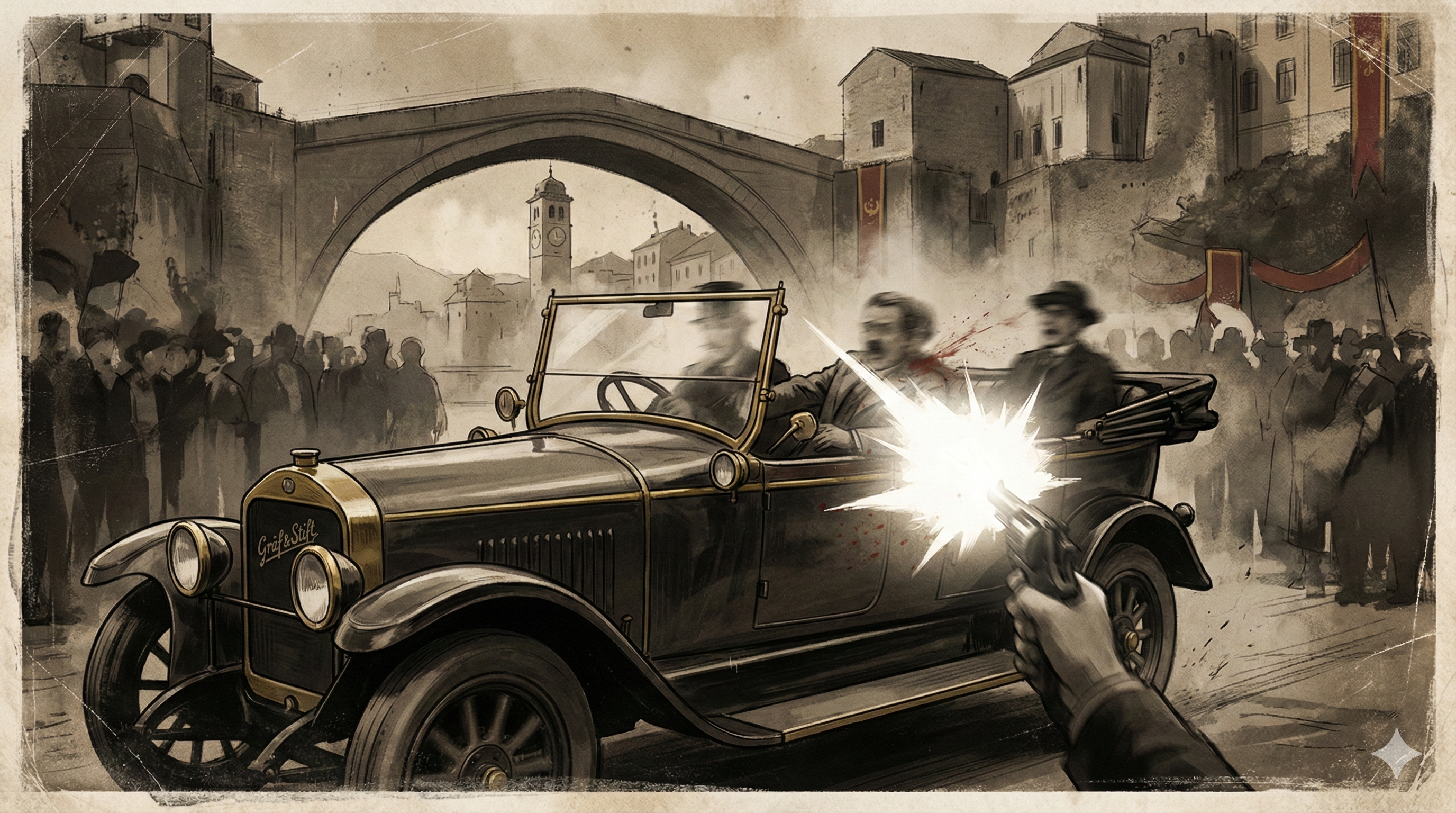
The Assassination of Archduke Franz Ferdinand
The assassination of Archduke Franz Ferdinand in Sarajevo on June 28, 1914, by Gavrilo Princip triggered the July Crisis and World War I, reshaping the 20th century through the destruction of four empires.
Executive Summary
The assassination of Archduke Franz Ferdinand emerges across all four lenses as a trigger event that exposed and activated deep structural flaws in the European international system. Game theory reveals how alliance commitments designed as deterrents became escalation mechanisms. Machiavelli exposes the desperate power calculations of declining empires. Taoism sees an inevitable correction of accumulated imbalance. CFR identifies the institutional vacuum that allowed a local crisis to become a world war. All lenses converge on the conclusion that the specific assassination mattered less than the system's inability to contain any spark. The tragedy was not that Franz Ferdinand died, but that the death of one man could kill 20 million.
Causal Analysis
Interactive graph showing how policies, actors, and events connect causally — click nodes to explore relationships
CAUSAL NETWORK
25 nodes · 25 connections
Select a node
Click any node in the graph to explore its connections and lens perspectives
Root Causes
5Critical Path
10 stepsLens Analyses
Each lens provides a unique analytical framework — click to expand for deep analysis
Game Theory Analysis
Western Moderngame-theoryThe July Crisis represents a catastrophic failure of deterrence through commitment devices. The alliance system, designed to prevent war through mutual assured destruction, instead created an escalation spiral where each nation's rational response to the previous move led inexorably to general war. The German 'blank check' removed Austria's incentive for restraint. Russian mobilization, once begun, could not be halted due to technical constraints. The Schlieffen Plan required Germany to attack France immediately upon Russian mobilization. Each player acted rationally given their constraints, yet the collective outcome was catastrophically irrational.
Machiavellian Power Analysis
Greco-Roman & ClassicalmachiavelliThe assassination exposed the fundamental weakness of Austria-Hungary: a multi-ethnic empire that could not accommodate rising nationalism. Franz Joseph chose war not from strength but from desperation - a final gamble to reassert Habsburg relevance. Germany's 'blank check' reflected Wilhelm II's desire for a 'splendid little war' to break Franco-Russian encirclement before Russia's military modernization was complete. Every major power saw opportunity in crisis: Austria to crush Serbia, Germany to achieve continental hegemony, Russia to dominate the Balkans, France to recover Alsace-Lorraine. The tragedy is that all pursued power and all lost it catastrophically.
Taoist Wisdom Analysis
East AsiantaoismThe Great War emerged from a profound imbalance of yang energies - aggressive nationalism, industrial militarism, imperial ambition, and masculine honor culture - that had accumulated throughout the 19th century with no corresponding yin correction. Europe had experienced nearly a century of rising tension without release. The assassination was merely the trigger for a system already at breaking point. The resulting four-year conflagration was the Tao's inevitable correction - an explosion of yin destruction that dissolved the old order. The empires that fell had all been forcing (yu wei) against the natural tendency toward national self-determination. Those that survived (Britain, France) adapted; those that forced (Austria-Hungary, Ottoman, Romanov) perished.
Council on Foreign Relations Perspective
Western InstitutionalcfrThe assassination and subsequent war demonstrated the catastrophic failure of the 19th-century balance of power system. The Concert of Europe, designed to prevent great power conflict, had devolved into rigid alliance blocs that guaranteed any local conflict would escalate into general war. The system lacked effective mechanisms for crisis management, arms control, or conflict resolution. International institutions (the Hague Conventions) were too weak to constrain state behavior. The result was the destruction of the European-dominated international order and the beginning of American rise to global power. The war's lesson - that balance of power without institutional frameworks produces catastrophe - informed the League of Nations and United Nations experiments.
Convergences
Where multiple lenses reach similar conclusions — suggesting robustness
Systemic causation over individual responsibility
All three lenses emphasize that structural factors - alliance commitments, accumulated tensions, institutional weakness - mattered more than individual decisions. Princip pulled the trigger, but any trigger would have eventually ignited the powder keg.
The 'blank check' as critical decision point
Germany's unconditional guarantee to Austria-Hungary removed restraints and committed Europe's most powerful military to whatever Austria decided. This transformed a Balkan crisis into a world war.
War as the result of declining power desperation
Austria-Hungary was a declining multi-ethnic empire that could not accommodate rising nationalism. It chose war as a desperate gamble rather than accept gradual dissolution.
Institutional failure enabled escalation
The absence of effective crisis management mechanisms, arms control agreements, or conflict resolution institutions allowed the crisis to escalate unchecked.
Productive Tensions
Where lenses disagree — revealing complexity worth examining
Possible Futures
Scenarios derived from lens analyses — what might unfold based on different frameworks
Franz Ferdinand survives, implements federalist reforms
Low-medium; reform would have faced massive opposition from Hungarian aristocracy
War limited to Austria-Serbia without great power involvement
Low; alliance commitments were too binding
Key Questions
Questions that remain open after analysis — for continued inquiry
- ?What was the exact chain of command from Serbian military intelligence to the Black Hand to Princip?
- ?Did Franz Ferdinand's reform plans have any realistic chance of implementation?
- ?What was discussed in the key diplomatic meetings during the July Crisis?
Meta Observations
The profound contingency of the specific sequence of events. The first assassination attempt failed; Franz Ferdinand survived. His car took a wrong turn, stalled, and happened to stop in front of Princip. Different traffic patterns could have changed history.
The interaction of alliance commitments, mobilization timetables, domestic politics, individual psychology, and sheer chance cannot be reduced to any single explanatory factor.
We can explain why war was likely, but not why it happened exactly when and how it did. History is not a science with predictable laws but a realm of constrained contingency.
Find Your Perspective
Different frameworks resonate with different readers — find your entry point
Readers who prefer structural explanations, institutional analysis, and systemic thinking
Alliance systems and institutional failures made war nearly inevitable once the trigger occurred
Readers who see history as cycles, emphasize balance and imbalance, and distrust forcing
The war was an inevitable correction of a century of accumulated yang imbalance
Readers who believe in international institutions and cooperative security
Better institutions could have prevented the escalation; this lesson informed post-war order-building
Readers who see power politics and self-interest as primary drivers
Each power pursued its interests; the tragedy is that rational pursuit of power led to mutual destruction
Consider that structural and individual factors interact: the system created pressures, but individuals made choices within those pressures. The Cuban Missile Crisis shows similar pressures managed differently.
Related Analyses
Other events analyzed through similar lenses or categories
On November 22, 1963, President John F. Kennedy was assassinated in Dealey Plaza, Dallas, Texas. Lee Harvey Oswald was arrested but killed by Jack Ruby before trial. The Warren Commission concluded Oswald acted alone, while the HSCA later found probable conspiracy. Declassified documents through 2025 reveal institutional cover-ups by the CIA and FBI, making it the most consequential unsolved case in American history.
The 13-day confrontation between the United States and Soviet Union in October 1962 over nuclear missiles in Cuba—the closest the Cold War came to nuclear war.
The decade-long radical transformation of France (1789-1799) that established principles of popular sovereignty and human rights that continue to shape modern political systems.
How This Was Analyzed
Full transparency about the analysis process, tools, and limitations
Crosslight Engine
v0.3.0 "Causality"- ⚠Causal attribution is inherently interpretive — graphs represent analysis, not ground truth
- ⚠Actor discovery limited by available public information and source accessibility
- ⚠Lobbying data availability varies significantly by jurisdiction
Analysis Statistics
Methodology
This analysis was produced by the Crosslight multi-agent pipeline: a Research Agent gathered and verified facts from multiple sources, specialized Lens Agents applied distinct analytical frameworks, a Synthesis Agent integrated insights and identified patterns, and a Fact-Check Agent verified claims. Each lens perspective is the AI's interpretation — not institutional endorsement.Learn more →