
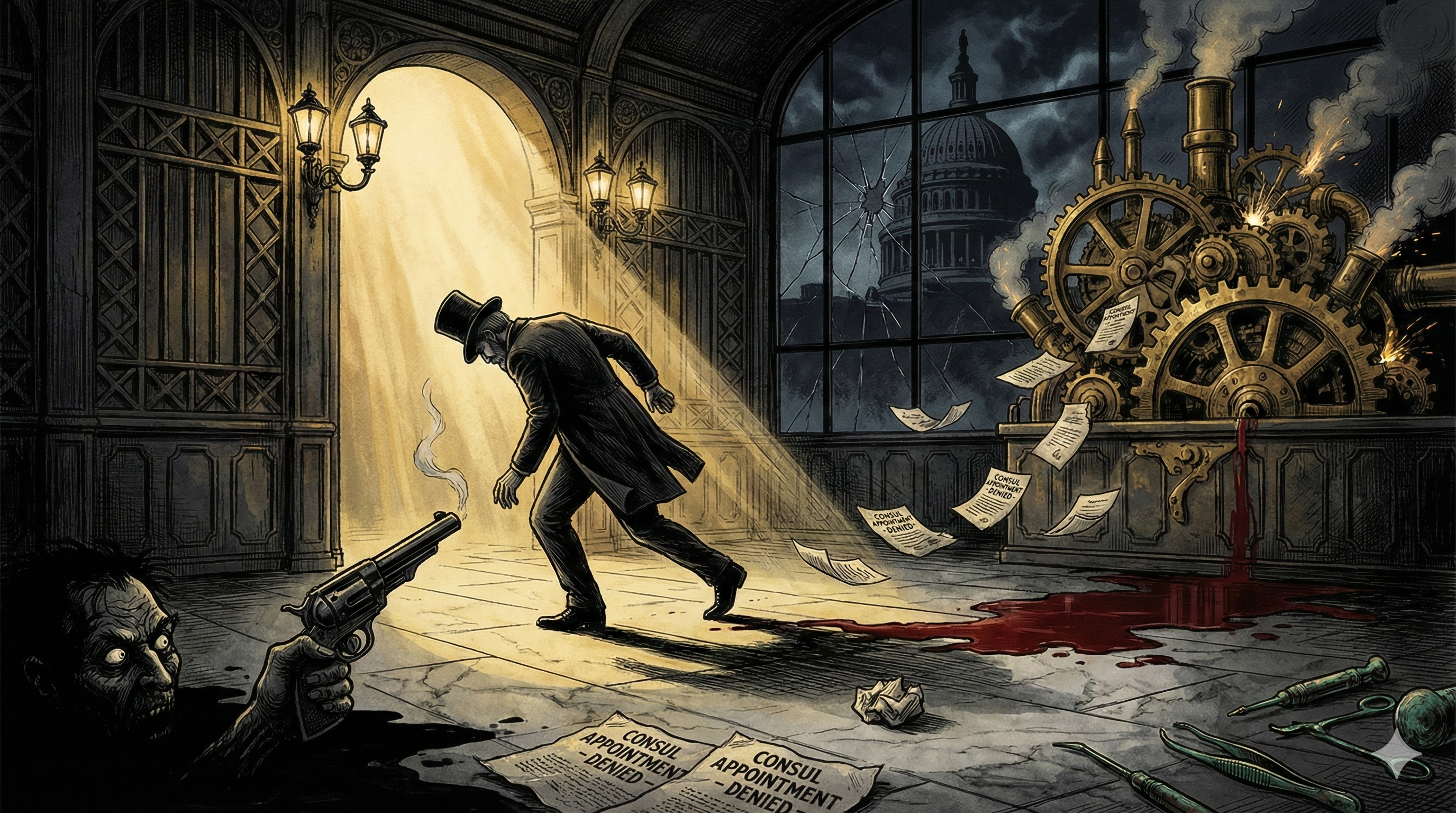
The Assassination of President James A. Garfield
The assassination of President James A. Garfield on July 2, 1881 by Charles Guiteau, a delusional office-seeker who declared 'I am a Stalwart of the Stalwarts,' and the President's agonizing 80-day death from medical malpractice rather than the bullet itself. The assassination transformed American politics by destroying the spoils system and creating the modern civil service.
Executive Summary
The assassination of James A. Garfield reveals how irrational violence can paradoxically create rational institutional reform. A delusional office-seeker, embodying the shadow of Gilded Age patronage politics, destroyed a president who represented America's self-made ideal—and in doing so, accelerated the very reforms the victim sought and the assassin opposed. Chester Arthur's remarkable transformation from machine crony to reform president demonstrates that individuals can transcend their origins when circumstances demand it. The tragedy's ultimate legacy—the Pendleton Act and modern civil service—shows how American democracy has repeatedly converted crisis into institution-building, though the human cost (Garfield's 80 days of needless suffering at doctors' hands) reminds us that progress is neither clean nor inevitable.
Key Facts
Verified facts from multi-source research, scored by confidence level
James A. Garfield was born in a log cabin in Orange Township, Cuyahoga County, Ohio on November 19, 1831, the last American president born in a log cabin.
high confidenceGarfield's father Abram died when James was just 2 years old, leaving his mother Eliza to raise four children in rural poverty. Young Garfield worked as a canal boat driver—the 'canal boy' who became a beloved American success story.
high confidenceGarfield was genuinely ambidextrous and a classical scholar proficient in both Latin and Greek. Legend held he could write in Latin with one hand while simultaneously writing in Greek with the other. However, Garfield biographer Allan Peskin investigated this claim and found no eyewitness verification—Garfield's own son tried to track down evidence after his father's death by writing to relatives and friends, but none confirmed seeing it.
medium confidenceAt age 26, Garfield became president of the Western Reserve Eclectic Institute (later Hiram College) in Ohio, where he had previously worked his way through as a student. He was also a preacher in the Disciples of Christ movement.
high confidenceAt the 1880 Republican National Convention in Chicago, Garfield delivered the nominating speech for fellow Ohioan John Sherman. Midway through, when Garfield asked rhetorically 'And now gentlemen of the Convention, what do we want?', a voice from the crowd shouted 'We want Garfield!' This electrifying moment, combined with his stirring oratory comparing the convention to 'a human ocean in tempest,' shifted momentum toward Garfield himself.
high confidenceGarfield protested from the podium: 'The announcement of votes for me is not in accordance with my wishes.' He genuinely did not seek the nomination—it was, as one historian noted, 'bad luck, really, that his nominating speech for another candidate was so stirring as to inflame the convention in his own favor.'
high confidenceThe 1880 Republican Convention was deadlocked between the Stalwart faction supporting Ulysses S. Grant for an unprecedented third term and the Half-Breed faction supporting James G. Blaine. After 35 ballots with no resolution, Blaine and Sherman delegates shifted to Garfield as a compromise 'dark horse' candidate. On the 36th ballot, Garfield won with 399 votes.
high confidenceKey Actors
Major actors involved in this event with their actions and stated interests
James A. Garfield
individual- ›Delivered electrifying nominating speech for John Sherman
- ›Reluctantly accepted Republican nomination as dark horse
- ›Appointed James G. Blaine as Secretary of State, enraging Stalwarts
Charles J. Guiteau
individual- ›Wrote speech supporting Garfield that was barely noticed
- ›Stalked Garfield for weeks before shooting
- ›Purchased .442 British Bulldog revolver specifically because it would look good in a museum
Roscoe Conkling
individual- ›Led Stalwart faction supporting Grant for third term
- ›Controlled New York Customs House patronage machine
- ›Provided campaign support to Garfield expecting reward
Chester A. Arthur
individual- ›Served as Collector of Port of New York under Conkling machine
- ›Was fired by Rutherford B. Hayes as part of reform efforts
- ›Became Vice President on Garfield ticket to appease Stalwarts
Research & Sources
Event Timeline
1881-07-02 to 1881-09-19
Causal Analysis
Interactive graph showing how policies, actors, and events connect causally — click nodes to explore relationships
CAUSAL NETWORK
17 nodes · 18 connections
Select a node
Click any node in the graph to explore its connections and lens perspectives
Root Causes
1Critical Path
7 stepsLens Analyses
Each lens provides a unique analytical framework — click to expand for deep analysis
Game Theory & Strategic Interaction
Western Moderngame-theoryThe Garfield assassination demonstrates how irrational actors can shock a political system out of dysfunctional equilibrium. The Stalwart-Half Breed conflict was a repeated game heading toward indefinite stalemate; Guiteau's delusional violence, and Arthur's unexpected moral transformation, broke the deadlock and created lasting institutional change. Sometimes the most consequential political actors are those who refuse to play by the rules of the game—whether through insanity or through transcending their expected roles.
Machiavellian Power Analysis
Greco-Roman & ClassicalmachiavelliThe Garfield assassination reveals the fragility of machine power: Conkling's empire, built over decades, collapsed within months because it rested entirely on the patronage system. When that system was delegitimized by Guiteau's bullet, Conkling had nothing. Machiavelli warned that power built on fortune rather than virtue is unstable—Conkling's fortune was the spoils system, and when public opinion turned against it, his 'virtue' (machine-building skill) became worthless. Arthur's transformation shows the opposite principle: even a man with no apparent virtue can acquire it when circumstances demand, if he has the character to rise to the moment.
Taoist Flow Analysis
East AsiantaoismThe Garfield assassination teaches the Taoist truth that extreme forcing creates its opposite. The spoils system was maintained through constant force—political pressure, patronage threats, loyalty demands. Guiteau's bullet was the ultimate forcing action, and it destroyed what he sought to preserve. Arthur's transformation illustrates the opposite principle: by not forcing, by allowing his office to transform him, he achieved more reform than any deliberate reform president could have. The Tao that can be named is not the eternal Tao—and the spoils system, which could be precisely named and calculated (X jobs for Y votes), was therefore impermanent. What replaced it—merit, professionalism, public service—is closer to the nameless, effortless order the Tao describes.
Jungian Psychological Analysis
Western ModernjungThe Garfield assassination is a drama of American shadow material: the self-made man archetype (Garfield) destroyed by its shadow (Guiteau), followed by shadow integration and redemption (Arthur). Guiteau embodied everything the American success narrative must repress—failure, delusion, desperate grasping—and his violence forced collective confrontation with this shadow. Arthur's transformation shows that shadow integration is possible even for those most identified with the darkness. The continuing mystery of Garfield's relative obscurity (compared to Lincoln) suggests incomplete integration: Americans remember Lincoln's assassination as tragic apotheosis but repress Garfield's as merely 'unfortunate,' avoiding the uncomfortable truth that a nobody's delusion and doctors' incompetence killed a president.
Convergences
Where multiple lenses reach similar conclusions — suggesting robustness
Forcing creates its opposite
Game theory shows Conkling's aggressive patronage defense triggered his destruction; Taoism identifies Guiteau's violence as extreme yang creating yin reversal; Machiavelli notes that Conkling's power, built on force rather than virtue, collapsed when confronted. All agree: the spoils system's defenders destroyed it through overreach.
Arthur's transformation as redemption
Jung sees individuation and shadow integration; Taoism sees wu-wei (Arthur not forcing his role); Machiavelli sees virtue emerging from fortune. All lenses agree that Arthur's change was genuine and historically consequential.
Garfield as idealized American archetype
Jung identifies Garfield as the collective Self of American aspiration; Taoism sees his balanced nature (yang ambition, yin scholarship) as embodying proper harmony. Both frameworks explain why his death resonated so deeply.
Productive Tensions
Where lenses disagree — revealing complexity worth examining
Possible Futures
Scenarios derived from lens analyses — what might unfold based on different frameworks
Civil service reform is celebrated; Garfield becomes prominent martyr
This was the immediate outcome—Garfield was mourned intensely
Garfield fades from memory; medical malpractice overlooked
This was the longer-term outcome—Garfield became the 'forgotten' assassinated president
Key Questions
Questions that remain open after analysis — for continued inquiry
- ?What exactly did Garfield's convention speech say that so electrified the crowd?
- ?Did the metal bed springs actually interfere with Bell's device, or was Dr. Bliss's restriction the main problem?
- ?What did the autopsy of Guiteau's brain actually show about his mental state?
Fact Check Details
Fact Check Results
verifiedMeta Observations
All four lenses underemphasize the role of medical malpractice in Garfield's death. The political story is compelling, but the medical story—American doctors' arrogant rejection of European antiseptic methods—is equally important and often overlooked. Garfield's death was as much a failure of American medicine as a tragedy of American politics.
The confluence of factors—factional warfare, a delusional assassin, incompetent doctors, a vice president capable of growth—cannot be reduced to any single lens. Remove any element and history changes. This irreducible complexity humbles all our analytical frameworks.
We cannot know whether Garfield would have been a great president, whether reform would have happened without assassination, or whether Arthur would have found his better nature in other circumstances. These counterfactuals are permanently unknowable. Analysis illuminates; it does not resolve.
Find Your Perspective
Different frameworks resonate with different readers — find your entry point
Those who see politics as strategic competition, power dynamics, and institutional incentives
The assassination was an out-of-equilibrium shock that destroyed the patronage system more effectively than gradual reform could have. Conkling's machine power collapsed because it rested on the spoils system's legitimacy.
Those who see deeper patterns, psychological forces, and natural cycles in historical events
Guiteau embodied the shadow of American ambition; Arthur's transformation shows individuation is possible at any age. Extreme forcing creates its opposite—the spoils system's defenders destroyed it.
Those focused on how institutions shape behavior and how reforms create new equilibria
The Pendleton Act changed the game's rules—merit-based civil service created new incentives that made patronage-based politics increasingly difficult.
Those who question stated motives and look for hidden power dynamics
Conkling's 'senatorial courtesy' was cover for patronage control; Arthur's 'transformation' may have reflected calculation as much as redemption.
If you find game theory compelling, explore how Taoism's cyclical patterns provide context for why equilibria shift. If Jung resonates, consider how Machiavelli's power analysis grounds psychological insights in political reality.
Related Analyses
Other events analyzed through similar lenses or categories
On November 22, 1963, President John F. Kennedy was assassinated in Dealey Plaza, Dallas, Texas. Lee Harvey Oswald was arrested but killed by Jack Ruby before trial. The Warren Commission concluded Oswald acted alone, while the HSCA later found probable conspiracy. Declassified documents through 2025 reveal institutional cover-ups by the CIA and FBI, making it the most consequential unsolved case in American history.
The construction of the three Great Pyramids at Giza (c. 2589–2504 BCE) during Egypt's Fourth Dynasty represents humanity's first megaproject—a multi-generational, state-directed engineering endeavor that mobilized 20,000–25,000 workers, 2.3 million limestone blocks, and the full administrative apparatus of the world's first nation-state to build monuments that remain standing 4,500 years later.
On the night of February 28, 1986, at 23:21, Swedish Prime Minister Olof Palme was shot and killed on the central Stockholm street Sveavägen while walking home from a cinema with his wife Lisbeth. He had dismissed his security detail earlier that day — a prime minister walking unguarded through his capital on a Friday night, the very embodiment of Swedish democratic openness. A second shot grazed Lisbeth Palme. The killer fled up the steps of Tunnelgatan and vanished into the night. What followed was not merely a murder investigation but a national trauma that consumed Sweden for nearly four decades: a catastrophically botched crime scene, an investigation fixated on the wrong suspects, 134 people who confessed to the murder, over 10,000 tips that created information paralysis, the wrongful conviction and acquittal of Christer Pettersson, and dozens of competing conspiracy theories implicating South African intelligence, the CIA, NATO's Stay Behind/Gladio networks, the Kurdish PKK, and elements within the Swedish police themselves. In 2020, Chief Prosecutor Krister Petersson named graphic designer Stig Engström — the 'Skandia Man' — as the probable killer and closed the case. Engström had died by suicide in 2000, so could never be tried. The announcement was met with widespread criticism as circumstantial and unprovable. In December 2025, Sweden's director of public prosecutions formally reversed the conclusion, stating there was insufficient evidence to consider Engström the main suspect — but the investigation would not be reopened. The case remains, in effect, unsolved: Sweden's defining political wound, still open after nearly forty years.
How This Was Analyzed
Full transparency about the analysis process, tools, and limitations
Crosslight Engine
v0.3.1 "Arena & Stage"- ⚠Entertainment/sports lenses reflect domain stereotypes for analytical color, not endorsement
- ⚠Celebrity and sports events have limited 'ground truth' - analysis is inherently interpretive
- ⚠Hot take and tabloid personas are satirical framing devices for accessible analysis
Analysis Statistics
Methodology
This analysis was produced by the Crosslight multi-agent pipeline: a Research Agent gathered and verified facts from multiple sources, specialized Lens Agents applied distinct analytical frameworks, a Synthesis Agent integrated insights and identified patterns, and a Fact-Check Agent verified claims. Each lens perspective is the AI's interpretation — not institutional endorsement.Learn more →