Catastrophe du ferry Sewol
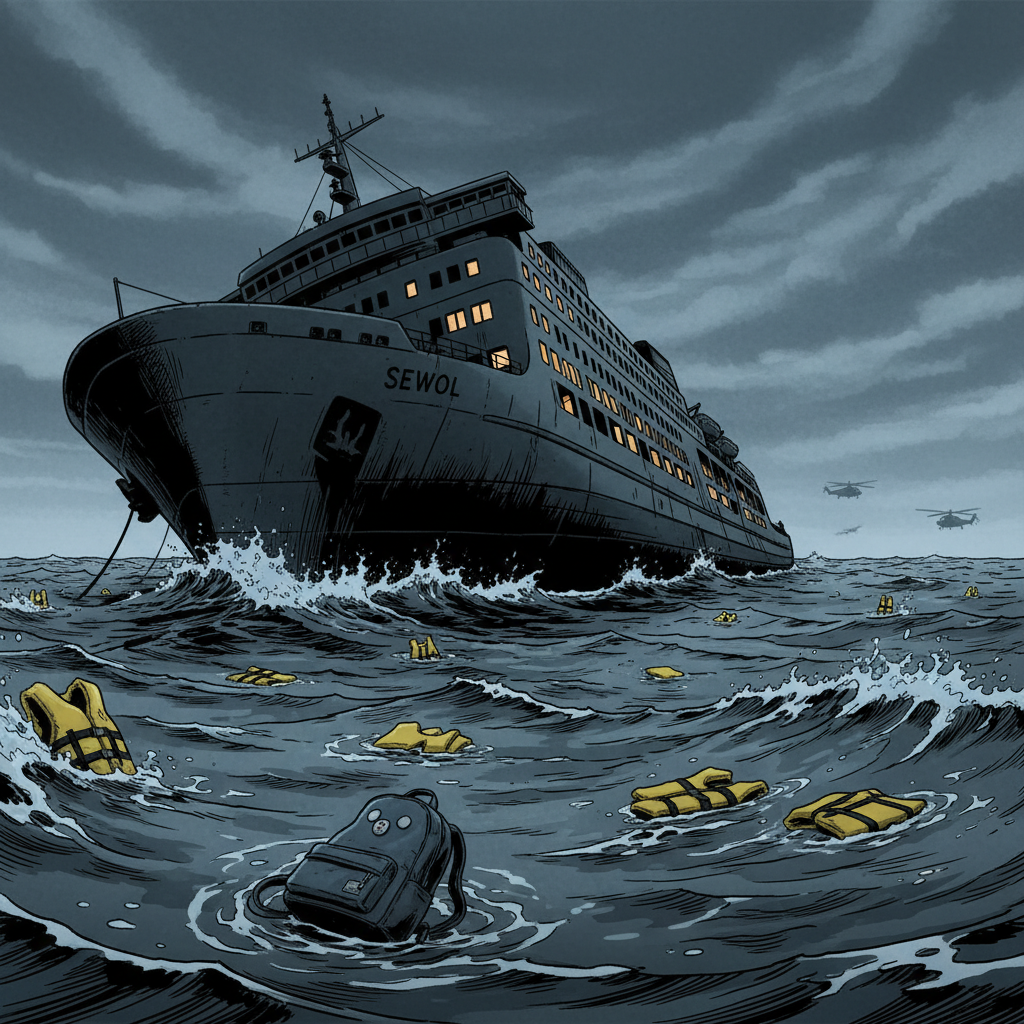
On April 16, 2014, the South Korean ferry MV Sewol capsized and sank while en route from Incheon to Jeju Island, killing 304 of the 476 people on board. Among the dead were 250 students from Danwon High School in Ansan, aged 16-17, on a school field trip. The disaster exposed systemic failures in South Korea's maritime safety regime: the vessel had been illegally modified to carry more passengers and cargo, was loaded to more than twice its legal cargo limit, and its crew abandoned ship while repeatedly instructing passengers to stay in their cabins. President Park Geun-hye's unexplained seven-hour absence during the critical early hours became a major political scandal contributing to her impeachment in 2017. The Sewol disaster became a symbol of institutional failure in South Korea.
Resume Executif
Seven analytical lenses converge on a single devastating conclusion: the Sewol disaster was not an accident but the inevitable product of a social system that systematically prioritized speed, profit, and hierarchical obedience over human safety. Every lens identifies systemic rather than individual failure as the root cause, though they differ on which systemic dimension is most significant — Confucian hierarchy, neoliberal deregulation, regulatory capture, or behavioral conditioning. The most profound insight emerges from the intersection of the Confucian and Pavlovian analyses: the very virtue Korean society most cultivates in its children — obedience to authority — became the mechanism of their deaths when authority proved unworthy of trust. The disaster catalyzed a counter-hegemonic movement that toppled a president, but whether it produced lasting structural change or merely a temporary disruption of the hegemonic order remains the central open question.
Faits Cles
Faits verifies issus de recherches multi-sources, notes par niveau de confiance
MV Sewol departed Incheon at approximately 9:00 PM on April 15, 2014, with 476 people: 443 passengers (325 Danwon High School students, 14 teachers) and 33 crew.
Confiance highDistress signal sent at 08:58 KST on April 16, 2014. The ship took approximately two and a half hours to sink.
Confiance highMV Sewol was originally the Japanese ferry Naminoue (built 1994). Chonghaejin Marine purchased it in 2012 and illegally modified it to add passenger cabins on upper decks, raising center of gravity.
Confiance highSewol carried 2,142.7 tons of cargo against a legal maximum of 987 tons, with only 761.2 tons of ballast water. Included 180 vehicles (recorded as 150) and 1,157+ tons of freight.
Confiance highCaptain Lee Joon-seok (age 69) and 14 crew evacuated while PA system told passengers to remain in cabins.
Confiance highOf 172 survivors, more than half were rescued by civilian fishing boats that arrived ~40 minutes before the Korea Coast Guard.
Confiance high304 people died, including ~250 Danwon High School students aged 16-17. About 82% of casualties were children.
Confiance highActeurs Cles
Acteurs majeurs impliques dans cet evenement avec leurs actions et interets declares
Capitaine Lee Joon-seok
individual- ›N'a pas donne l'ordre d'evacuation
- ›A abandonne le navire alors que les passagers restaient en bas
- ›Faisait partie des premiers membres d'equipage secourus
Chonghaejin Marine Company
corporation- ›A achete et illegalement modifie le MV Sewol
- ›Surchargeait regulierement au-dela des limites legales
- ›A falsifie les manifestes de cargaison
Presidente Park Geun-hye
individual- ›Absente de la gestion de crise pendant sept heures
- ›A blame publiquement le capitaine et l'equipage
- ›A ordonne la dissolution de la Garde cotiere
Garde cotiere de Coree
organization- ›Arrivee 40 minutes apres les bateaux civils
- ›N'a pas reussi a entrer dans le navire en train de couler
- ›A secouru le capitaine/equipage en premier
Familles du lycee Danwon
group- ›A etabli une veille au port de Paengmok
- ›A lance le mouvement du ruban jaune
- ›A exige une enquete independante
Recherche et Sources
Chronologie de l'Evenement
2009-2017
Analyse Causale
Graphe interactif montrant comment les politiques, acteurs et evenements sont relies causalement — cliquez sur les noeuds pour explorer les relations
RESEAU CAUSAL
14 noeuds · 16 connexions
Selectionnez un noeud
Cliquez sur n'importe quel noeud du graphe pour explorer ses connexions et les perspectives des prismes
Causes Profondes
1Chemin Critique
8 etapesAnalyses par Prisme
Chaque prisme fournit un cadre analytique unique — cliquez pour developper l'analyse approfondie
Analyse de l'impact sur la population civile
civilian-impactThe Sewol disaster inverts the expected moral calculus of obedience: children who followed instructions died while those who defied authority survived. This produced not merely grief but a fundamental crisis of institutional trust in South Korean society, transforming a maritime accident into a civilization-level reckoning with the relationship between authority, obedience, and the duty of care.
Ethique confuceenne
East AsianconfucianThe Sewol disaster reveals the lethal paradox at the heart of Confucian obedience culture: the very virtue of respectful compliance that Korean society cultivates in its children became the mechanism of their deaths when the authority figures they trusted violated every Confucian duty of care. The disaster demands a reckoning not with Confucianism itself but with its distortion — obedience without the reciprocal obligation of benevolent authority that makes Confucian hierarchy ethically coherent.
Theorie des jeux
Western Moderngame-theoryThe Sewol disaster is a textbook case of catastrophic equilibrium: every actor behaved rationally given the incentive structure they faced, and 304 people died. The regulatory capture equilibrium was individually rational for both regulators and industry, the captain's abandonment was individually rational given the payoff structure, and the students' obedience was rational given their information state. The tragedy is that the system produced collectively catastrophic outcomes from individually rational choices at every level.
Analyse du conditionnement comportemental
Western ModernpavlovThe Sewol disaster demonstrates that behavioral conditioning is not merely a laboratory phenomenon but a lethal social force. The Korean education system's systematic conditioning of obedience produced students who followed fatal instructions as automatically as Pavlov's dogs responded to bells. The tragedy is not that the conditioning 'failed' — it worked perfectly. The students did exactly what they had been trained to do. The failure was in the system that conditioned obedience without ensuring the authorities being obeyed were worthy of that conditioned trust.
Realpolitik machiavelienne
Greco-Roman & ClassicalmachiavelliThe Sewol disaster is a Machiavellian masterclass in how appearance devours substance. Park Geun-hye may or may not have been monitoring the crisis during the seven missing hours — but it does not matter. Machiavelli teaches that for a prince, appearing to act is as important as acting. By disappearing during the crisis, Park violated the cardinal Machiavellian principle: never let your people see you as either incompetent or indifferent, for they will forgive cruelty before they forgive contempt.
Analyse des interets d'entreprise
Western ModerncorporateThe Sewol disaster demonstrates that regulatory capture is not a market 'imperfection' but a predictable equilibrium outcome when the regulated industry has concentrated interests and the public has diffuse ones. Chonghaejin Marine did not 'break' the system — it operated exactly as the system was designed to allow. The 304 deaths are the externalized cost of a regulatory regime that systematically valued corporate profitability over public safety.
Analyse gramscienne (hegemonie culturelle)
Western ModerngramsciThe Sewol disaster reveals that ppalli-ppalli is not a neutral cultural trait but a hegemonic formation — a way of organizing society that serves particular class interests while appearing as universal common sense. When 250 children died because speed and profit were prioritized over safety and care, the hegemonic spell was broken. The yellow ribbon movement and the candlelight protests represent one of the most successful counter-hegemonic mobilizations in recent East Asian history: a war of position that toppled a president and, for a time, made a new common sense — that the state's first duty is to protect life, not to facilitate profit.
Convergences
La ou plusieurs prismes arrivent a des conclusions similaires — suggerant une robustesse
Systemic institutional failure, not individual incompetence
All four lenses independently identify the disaster as the product of systemic failures — regulatory capture, corporate impunity, deregulation ideology — rather than merely individual bad actors. Captain Lee's abandonment and Park's absence are symptoms, not causes.
Obedience to authority as lethal mechanism
The Confucian, Pavlovian, and civilian impact lenses all identify the students' conditioned obedience as the proximate cause of the extreme casualty concentration. The cultural conditioning that produced compliance (Confucian/Pavlov) directly produced the casualties (civilian impact).
Appearance vs. reality in governance
Machiavelli identifies the failure of political appearance management; Gramsci identifies the hegemonic construction of 'common sense' that masked danger; corporate analysis identifies the regulatory capture that created the appearance of oversight without substance.
Post-1997 deregulation as causal root
Corporate, Gramscian, and game theory analyses all trace the causal chain back to the post-Asian Financial Crisis deregulation regime that created the institutional conditions for the disaster.
Tensions Productives
La ou les prismes divergent — revelant une complexite qui merite examen
Futurs Possibles
Scenarios derives des analyses par prisme — ce qui pourrait se derouler selon differents cadres
Durable reform: Sewol becomes Korea's 'never again' moment
Medium — possible if reforms are institutionalized before political attention fades
Gradual erosion: Reforms decay as memories fade
Medium-high — historical pattern suggests regulatory reforms erode within 15-20 years without sustained political pressure
Cultural transformation: Korean society fundamentally rebalances obedience norms
Low — deep cultural conditioning is resistant to event-driven change
Questions Cles
Questions qui restent ouvertes apres l'analyse — pour une investigation continue
- ?What was Park Geun-hye doing during the seven missing hours?
- ?How many previous overloading incidents occurred on Sewol routes before the disaster?
- ?What was the exact relationship between maritime regulators and Chonghaejin Marine personnel?
Details de la Verification
Resultats de la Verification
verifiedMeta Observations
All seven lenses focus on what went wrong and why, but none adequately accounts for the acts of extraordinary courage that also occurred: the crew member Park Ji-young (age 22) who helped students put on life vests and pushed them toward exits before she herself drowned, or the students who defied instructions to help classmates. The disaster produced both the worst and the best of human behavior, and an exclusive focus on failure risks dishonoring those who chose courage.
The Sewol disaster sits at the intersection of culture (Confucian hierarchy), economics (neoliberal deregulation), politics (regulatory capture and presidential accountability), psychology (conditioned obedience), and technology (maritime engineering). No single lens can capture this intersection; the seven together approach but do not exhaust the event's meaning.
This analysis was conducted from outside Korean culture, primarily using English-language sources. Korean-language scholarship, survivor testimony, and the Sewol families' own articulation of what the disaster means should be weighted more heavily than any external analytical framework. The most important voices in this analysis are those of the 304 who cannot speak and the families who speak for them.
Trouvez Votre Perspective
Differents cadres resonnent avec differents lecteurs — trouvez votre point d'entree
Readers who think in terms of incentives, systems, and institutional design. You see the disaster as a predictable outcome of misaligned incentives and regulatory failure.
The disaster was rational at every level — the system produced catastrophic outcomes from individually rational choices. Reform requires changing incentive structures, not just punishing individuals.
Readers who focus on cultural context, human behavior, and the relationship between individuals and the social systems that shape them. You see the disaster as a failure of the social contract between authority and trust.
The obedience that killed the students was a product of the very social system that Korean society values most. Reform requires rethinking the relationship between authority and compliance, not just fixing regulations.
Readers who focus on leadership, governance, and the responsibilities of those in power. You see the disaster as a failure of leadership at every level.
Leaders' failure to fulfill their duty of care — captain, company, president — produced both the disaster and the political consequences. The appearance of caring is inseparable from the substance of governance.
Readers who question dominant narratives and look for whose interests are served by 'common sense.' You see the disaster as the product of a hegemonic system that normalized danger.
Ppalli-ppalli culture and deregulation ideology were not neutral — they served particular class interests while appearing as universal Korean values. The reforms may be transformismo: surface changes that preserve underlying power structures.
Start with the convergences — all seven lenses agree on systemic failure. Then explore the tensions: the debate between individual agency (Machiavelli) and structural determinism (Gramsci) reveals the most productive analytical ground. The Confucian-Pavlovian intersection on obedience is the most distinctive insight this analysis produces.
Analyses Connexes
Autres evenements analyses a travers des prismes ou categories similaires
Le 26 avril 1986 à 01h23, le réacteur n°4 de la centrale nucléaire de Tchernobyl en RSS d'Ukraine a explosé lors d'un test de sécurité, libérant 400 fois plus de matières radioactives que la bombe d'Hiroshima. Les autorités soviétiques ont d'abord dissimulé la catastrophe, forçant les 49 000 habitants de Pripiat à poursuivre leur vie normale pendant 36 heures. Environ 600 000 « liquidateurs » ont été déployés. Les estimations de décès vont de 4 000 (OMS) à 93 000 (Greenpeace). La catastrophe a brisé le mythe de la suprématie technologique soviétique et a forcé Gorbatchev vers la glasnost.
Le Printemps arabe fut une vague révolutionnaire de manifestations, de soulèvements et de rébellions armées qui déferla sur le monde arabe à partir de décembre 2010. Déclenché par l'auto-immolation du vendeur ambulant tunisien Mohamed Bouazizi le 17 décembre 2010 — un acte de désespoir contre des décennies de corruption autoritaire, d'humiliation et de chômage des jeunes — le mouvement se propagea avec une rapidité fulgurante à travers l'Afrique du Nord et le Moyen-Orient. Le slogan définitoire «الشعب يريد إسقاط النظام» (Le peuple veut la chute du régime) résonna de Tunis au Caire, de Benghazi à Damas. Le choix de l'armée — se ranger du côté des manifestants ou rester fidèle au régime — s'avéra la variable décisive dans chaque pays.
Entre le 6 avril et le 18 juillet 1994, environ 800 000 Tutsis et Hutus moderes ont ete systematiquement assassines au Rwanda en l'espace de 100 jours — le massacre le plus efficace de l'histoire moderne, avec un taux de mortalite quotidien superieur a celui de l'Holocauste. Le genocide n'etait pas l'eruption de « haines tribales ancestrales » mais l'aboutissement d'un projet colonial : les administrateurs belges avaient fabrique des categories raciales rigides a partir d'identites sociales fluides par le biais du recensement de 1933 et des cartes d'identite ethniques obligatoires, creant la division Hutu-Tutsi que les elites politiques ont ensuite instrumentalisee. Le regime de Habyarimana et son cercle restreint de l'akazu (la maisonnee), confrontes a la pression militaire du Front patriotique rwandais et aux exigences de partage du pouvoir des Accords d'Arusha, ont choisi le genocide comme strategie de survie politique. La radio RTLM — « Radio Machette » — a systematiquement conditionne la population par des annees de propagande deshumanisante, qualifiant les Tutsis d'« inyenzi » (cafards) avant de diffuser des instructions explicites de mise a mort et les localisations des victimes pendant le genocide lui-meme. Entre 250 000 et 500 000 femmes ont ete violees comme arme deliberee de genocide, le jugement historique du TPIR dans l'affaire Akayesu reconnaissant le viol comme acte de genocide pour la premiere fois en droit international. L'echec de la communaute internationale n'etait pas passif mais actif : le commandant de la MINUAR Romeo Dallaire a envoye son « fax sur le genocide » trois mois avant le debut des massacres, a demande 5 000 soldats, et a ete refuse. Le Conseil de securite des Nations Unies a reduit la MINUAR de 2 500 a 270 soldats pendant le genocide. Les Etats-Unis ont deliberement evite d'utiliser le mot « genocide » pour contourner les obligations legales d'intervenir. La Commission Duclert (2021) a conclu que la France portait des « responsabilites lourdes et accablantes » incluant « une faillite politique, institutionnelle, intellectuelle, morale et cognitive ». L'Operation Turquoise, officiellement humanitaire, a permis aux genocidaires de fuir au Zaire. La victoire militaire du FPR a mis fin au genocide en juillet 1994, mais les consequences se sont propagees jusqu'a la Premiere Guerre du Congo (1996-97) et la « Guerre mondiale africaine » qui a tue plus de 5 millions de personnes.
Comment Cela a Ete Analyse
Transparence totale sur le processus d'analyse, les outils et les limitations
Crosslight Engine
v0.4.0 "Global Lens Expansion"- ⚠Non-Western philosophical lenses rely on translated primary texts — nuance may be lost in translation
- ⚠Some traditions (e.g., Maat, Ubuntu) have limited surviving primary texts; analysis draws on scholarly reconstruction
- ⚠Cross-cultural lens application is inherently interpretive — a Confucian reading of a Western event is an analytical exercise, not a claim of cultural authority
Statistiques d'Analyse
Methodologie
Cette analyse a ete produite par le pipeline multi-agents de Crosslight : un Agent de Recherche a rassemble et verifie les faits de sources multiples, des Agents de Prismes specialises ont applique des cadres analytiques distincts, un Agent de Synthese a integre les perspectives et identifie les tendances, et un Agent de Verification a valide les affirmations. Chaque perspective de prisme est l'interpretation de l'IA — pas une approbation institutionnelle.En savoir plus →