セウォル号沈没事故
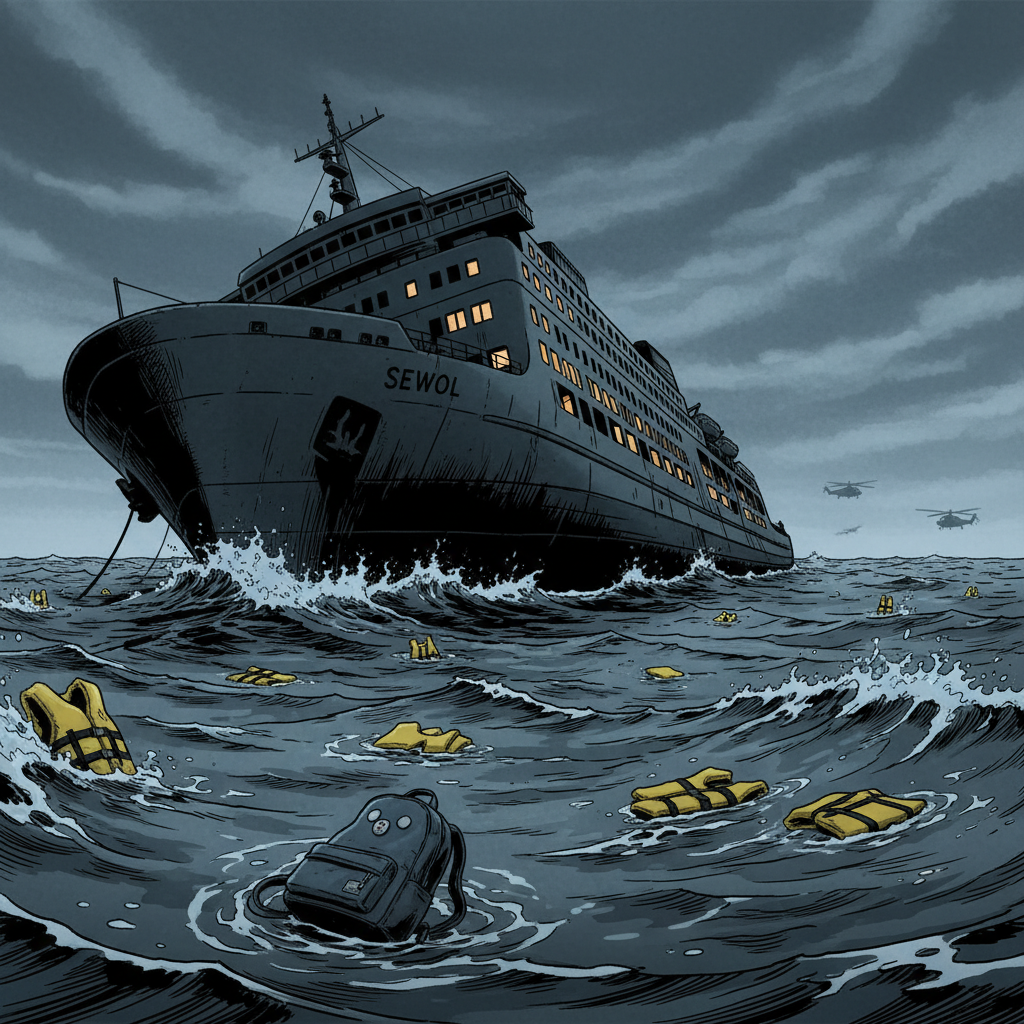
On April 16, 2014, the South Korean ferry MV Sewol capsized and sank while en route from Incheon to Jeju Island, killing 304 of the 476 people on board. Among the dead were 250 students from Danwon High School in Ansan, aged 16-17, on a school field trip. The disaster exposed systemic failures in South Korea's maritime safety regime: the vessel had been illegally modified to carry more passengers and cargo, was loaded to more than twice its legal cargo limit, and its crew abandoned ship while repeatedly instructing passengers to stay in their cabins. President Park Geun-hye's unexplained seven-hour absence during the critical early hours became a major political scandal contributing to her impeachment in 2017. The Sewol disaster became a symbol of institutional failure in South Korea.
エグゼクティブサマリー
Seven analytical lenses converge on a single devastating conclusion: the Sewol disaster was not an accident but the inevitable product of a social system that systematically prioritized speed, profit, and hierarchical obedience over human safety. Every lens identifies systemic rather than individual failure as the root cause, though they differ on which systemic dimension is most significant — Confucian hierarchy, neoliberal deregulation, regulatory capture, or behavioral conditioning. The most profound insight emerges from the intersection of the Confucian and Pavlovian analyses: the very virtue Korean society most cultivates in its children — obedience to authority — became the mechanism of their deaths when authority proved unworthy of trust. The disaster catalyzed a counter-hegemonic movement that toppled a president, but whether it produced lasting structural change or merely a temporary disruption of the hegemonic order remains the central open question.
重要な事実
複数のソースからの検証済み事実、確信度レベルで評価
MV Sewol departed Incheon at approximately 9:00 PM on April 15, 2014, with 476 people: 443 passengers (325 Danwon High School students, 14 teachers) and 33 crew.
highの確信度Distress signal sent at 08:58 KST on April 16, 2014. The ship took approximately two and a half hours to sink.
highの確信度MV Sewol was originally the Japanese ferry Naminoue (built 1994). Chonghaejin Marine purchased it in 2012 and illegally modified it to add passenger cabins on upper decks, raising center of gravity.
highの確信度Sewol carried 2,142.7 tons of cargo against a legal maximum of 987 tons, with only 761.2 tons of ballast water. Included 180 vehicles (recorded as 150) and 1,157+ tons of freight.
highの確信度Captain Lee Joon-seok (age 69) and 14 crew evacuated while PA system told passengers to remain in cabins.
highの確信度Of 172 survivors, more than half were rescued by civilian fishing boats that arrived ~40 minutes before the Korea Coast Guard.
highの確信度304 people died, including ~250 Danwon High School students aged 16-17. About 82% of casualties were children.
highの確信度主要アクター
このイベントに関与する主要アクターとその行動および表明された利益
Captain Lee Joon-seok
individual- ›Failed to issue evacuation order
- ›Abandoned ship while passengers remained below
- ›Was among first crew rescued
Chonghaejin Marine Company
corporation- ›Purchased and illegally modified MV Sewol
- ›Routinely overloaded beyond legal limits
- ›Falsified cargo manifests
President Park Geun-hye
individual- ›Absent from crisis management for seven hours
- ›Blamed captain and crew publicly
- ›Ordered Coast Guard dissolution
Korea Coast Guard
organization- ›Arrived 40 min after civilian boats
- ›Failed to enter sinking vessel
- ›Rescued captain/crew first
Danwon High School families
group- ›Established Paengmok Harbor vigil
- ›Launched yellow ribbon movement
- ›Demanded independent investigation
リサーチとソース
イベントタイムライン
2009-2017
因果分析
政策、アクター、イベントが因果的にどのように結びついているかを示すインタラクティブグラフ。ノードをクリックして関係を探索できます。
因果ネットワーク
14ノード · 16接続
ノードを選択
グラフ内の任意のノードをクリックして、接続とレンズの視点を探索してください
根本原因
1クリティカルパス
8ステップレンズ分析
各レンズは独自の分析フレームワークを提供します。クリックして深い分析を展開してください。
市民への影響分析
civilian-impactThe Sewol disaster inverts the expected moral calculus of obedience: children who followed instructions died while those who defied authority survived. This produced not merely grief but a fundamental crisis of institutional trust in South Korean society, transforming a maritime accident into a civilization-level reckoning with the relationship between authority, obedience, and the duty of care.
儒教倫理
East AsianconfucianThe Sewol disaster reveals the lethal paradox at the heart of Confucian obedience culture: the very virtue of respectful compliance that Korean society cultivates in its children became the mechanism of their deaths when the authority figures they trusted violated every Confucian duty of care. The disaster demands a reckoning not with Confucianism itself but with its distortion — obedience without the reciprocal obligation of benevolent authority that makes Confucian hierarchy ethically coherent.
ゲーム理論
Western Moderngame-theoryThe Sewol disaster is a textbook case of catastrophic equilibrium: every actor behaved rationally given the incentive structure they faced, and 304 people died. The regulatory capture equilibrium was individually rational for both regulators and industry, the captain's abandonment was individually rational given the payoff structure, and the students' obedience was rational given their information state. The tragedy is that the system produced collectively catastrophic outcomes from individually rational choices at every level.
行動条件付け分析
Western ModernpavlovThe Sewol disaster demonstrates that behavioral conditioning is not merely a laboratory phenomenon but a lethal social force. The Korean education system's systematic conditioning of obedience produced students who followed fatal instructions as automatically as Pavlov's dogs responded to bells. The tragedy is not that the conditioning 'failed' — it worked perfectly. The students did exactly what they had been trained to do. The failure was in the system that conditioned obedience without ensuring the authorities being obeyed were worthy of that conditioned trust.
マキャヴェリ的リアルポリティーク
Greco-Roman & ClassicalmachiavelliThe Sewol disaster is a Machiavellian masterclass in how appearance devours substance. Park Geun-hye may or may not have been monitoring the crisis during the seven missing hours — but it does not matter. Machiavelli teaches that for a prince, appearing to act is as important as acting. By disappearing during the crisis, Park violated the cardinal Machiavellian principle: never let your people see you as either incompetent or indifferent, for they will forgive cruelty before they forgive contempt.
企業利益分析
Western ModerncorporateThe Sewol disaster demonstrates that regulatory capture is not a market 'imperfection' but a predictable equilibrium outcome when the regulated industry has concentrated interests and the public has diffuse ones. Chonghaejin Marine did not 'break' the system — it operated exactly as the system was designed to allow. The 304 deaths are the externalized cost of a regulatory regime that systematically valued corporate profitability over public safety.
グラムシ分析(文化的ヘゲモニー)
Western ModerngramsciThe Sewol disaster reveals that ppalli-ppalli is not a neutral cultural trait but a hegemonic formation — a way of organizing society that serves particular class interests while appearing as universal common sense. When 250 children died because speed and profit were prioritized over safety and care, the hegemonic spell was broken. The yellow ribbon movement and the candlelight protests represent one of the most successful counter-hegemonic mobilizations in recent East Asian history: a war of position that toppled a president and, for a time, made a new common sense — that the state's first duty is to protect life, not to facilitate profit.
収束点
複数のレンズが類似した結論に達する箇所。堅牢性を示唆しています。
Systemic institutional failure, not individual incompetence
All four lenses independently identify the disaster as the product of systemic failures — regulatory capture, corporate impunity, deregulation ideology — rather than merely individual bad actors. Captain Lee's abandonment and Park's absence are symptoms, not causes.
Obedience to authority as lethal mechanism
The Confucian, Pavlovian, and civilian impact lenses all identify the students' conditioned obedience as the proximate cause of the extreme casualty concentration. The cultural conditioning that produced compliance (Confucian/Pavlov) directly produced the casualties (civilian impact).
Appearance vs. reality in governance
Machiavelli identifies the failure of political appearance management; Gramsci identifies the hegemonic construction of 'common sense' that masked danger; corporate analysis identifies the regulatory capture that created the appearance of oversight without substance.
Post-1997 deregulation as causal root
Corporate, Gramscian, and game theory analyses all trace the causal chain back to the post-Asian Financial Crisis deregulation regime that created the institutional conditions for the disaster.
生産的な緊張
レンズが意見を異にする箇所。検討に値する複雑さを明らかにしています。
起こりうる未来
レンズ分析から導出されたシナリオ。異なるフレームワークに基づいて何が展開するかもしれないか。
Durable reform: Sewol becomes Korea's 'never again' moment
Medium — possible if reforms are institutionalized before political attention fades
Gradual erosion: Reforms decay as memories fade
Medium-high — historical pattern suggests regulatory reforms erode within 15-20 years without sustained political pressure
Cultural transformation: Korean society fundamentally rebalances obedience norms
Low — deep cultural conditioning is resistant to event-driven change
主要な問い
分析後も残る未解決の問い。継続的な探求のために。
- ?What was Park Geun-hye doing during the seven missing hours?
- ?How many previous overloading incidents occurred on Sewol routes before the disaster?
- ?What was the exact relationship between maritime regulators and Chonghaejin Marine personnel?
ファクトチェック詳細
ファクトチェック結果
verifiedメタ観察
All seven lenses focus on what went wrong and why, but none adequately accounts for the acts of extraordinary courage that also occurred: the crew member Park Ji-young (age 22) who helped students put on life vests and pushed them toward exits before she herself drowned, or the students who defied instructions to help classmates. The disaster produced both the worst and the best of human behavior, and an exclusive focus on failure risks dishonoring those who chose courage.
The Sewol disaster sits at the intersection of culture (Confucian hierarchy), economics (neoliberal deregulation), politics (regulatory capture and presidential accountability), psychology (conditioned obedience), and technology (maritime engineering). No single lens can capture this intersection; the seven together approach but do not exhaust the event's meaning.
This analysis was conducted from outside Korean culture, primarily using English-language sources. Korean-language scholarship, survivor testimony, and the Sewol families' own articulation of what the disaster means should be weighted more heavily than any external analytical framework. The most important voices in this analysis are those of the 304 who cannot speak and the families who speak for them.
あなたの視点を見つける
異なるフレームワークは異なる読者に響きます。あなたの入口を見つけてください。
Readers who think in terms of incentives, systems, and institutional design. You see the disaster as a predictable outcome of misaligned incentives and regulatory failure.
The disaster was rational at every level — the system produced catastrophic outcomes from individually rational choices. Reform requires changing incentive structures, not just punishing individuals.
Readers who focus on cultural context, human behavior, and the relationship between individuals and the social systems that shape them. You see the disaster as a failure of the social contract between authority and trust.
The obedience that killed the students was a product of the very social system that Korean society values most. Reform requires rethinking the relationship between authority and compliance, not just fixing regulations.
Readers who focus on leadership, governance, and the responsibilities of those in power. You see the disaster as a failure of leadership at every level.
Leaders' failure to fulfill their duty of care — captain, company, president — produced both the disaster and the political consequences. The appearance of caring is inseparable from the substance of governance.
Readers who question dominant narratives and look for whose interests are served by 'common sense.' You see the disaster as the product of a hegemonic system that normalized danger.
Ppalli-ppalli culture and deregulation ideology were not neutral — they served particular class interests while appearing as universal Korean values. The reforms may be transformismo: surface changes that preserve underlying power structures.
Start with the convergences — all seven lenses agree on systemic failure. Then explore the tensions: the debate between individual agency (Machiavelli) and structural determinism (Gramsci) reveals the most productive analytical ground. The Confucian-Pavlovian intersection on obedience is the most distinctive insight this analysis produces.
関連分析
類似のレンズやカテゴリーを通して分析された他のイベント
1986年4月26日午前1時23分、ウクライナ・ソビエト社会主義共和国のチェルノブイリ原子力発電所4号炉が安全試験中に爆発し、広島原爆の400倍の放射性物質を放出した。ソ連当局は当初この大惨事を隠蔽し、プリピャチの住民49,000人に36時間にわたり通常の生活を続けさせた。約60万人の「リクビダートル(除染作業員)」が動員された。死亡者数の推定はWHOの4,000人からグリーンピースの93,000人まで幅がある。この惨事はソ連の技術的優位という神話を打ち砕き、ゴルバチョフにグラスノスチを余儀なくさせた。
アラブの春は2010年12月からアラブ世界を席巻いた抵抗運動、蜂起、武装反乱の革命的な波であった。2010年12月17日にチュニジアの路上販売人モハメド・ブアジジの焼身自殺が引き金となった。「الشعب يريد إسقاط النظام」(人民は体制の崩壊を望む)というスローガンがチュニスからカイロ、ベンガジからダマスカスまで響き渡った。軍の選択——デモ参加者の側につくか体制に忠誠であり続けるか——が各国で決定的な変数となった。
1994年4月6日から7月18日の間に、ルワンダで約80万人のツチ族と穏健派フツ族が100日間で組織的に殺害されました——近代史上最も効率的な大量殺戴であり、ホロコーストを上回る1日あたりの死亡率でした。このジェノサイドは「古代の部族間憾恶」の爆発ではなく、植民地計画の破滅的結末でした:ベルギーの管理者たちは1933年の国勢調査と義務的な民族身分証明書を通じて、流動的な社会的アイデンティティから硬直的な人種カテゴリーを製造しました。RTLMラジオ——「ラジオ・マシェテ」——は何年もの非人間化プロパガンダを通じて体系的に住民を条件付けしました。25万人から50万人の女性がジェノサイドの意図的な武器として強姦されました。国際社会の失敗は受動的ではなく能動的でした:ダレールは3か月前に警告を送り、5,000人の兵士を要請し、拒否されました。RPFの軍事的勝利は1994年7月にジェノサイドを終結させましたが、余波は第一次コンゴ戦争(1996-97)と500万人以上が死亡した「アフリカの世界大戦」に波及しました。
この分析の方法
分析プロセス、ツール、および限界についての完全な透明性
Crosslightエンジン
v0.4.0 "Global Lens Expansion"- ⚠Non-Western philosophical lenses rely on translated primary texts — nuance may be lost in translation
- ⚠Some traditions (e.g., Maat, Ubuntu) have limited surviving primary texts; analysis draws on scholarly reconstruction
- ⚠Cross-cultural lens application is inherently interpretive — a Confucian reading of a Western event is an analytical exercise, not a claim of cultural authority
分析統計
方法論
この分析はCrosslightマルチエージェントパイプラインによって生成されました。リサーチエージェントが複数のソースから事実を収集・検証し、専門化されたレンズエージェントが個別の分析フレームワークを適用し、統合エージェントが洞察を統合してパターンを特定し、ファクトチェックエージェントが主張を検証しました。各レンズの視点はAIによる解釈であり、機関としての推薦ではありません。詳しく見る →