
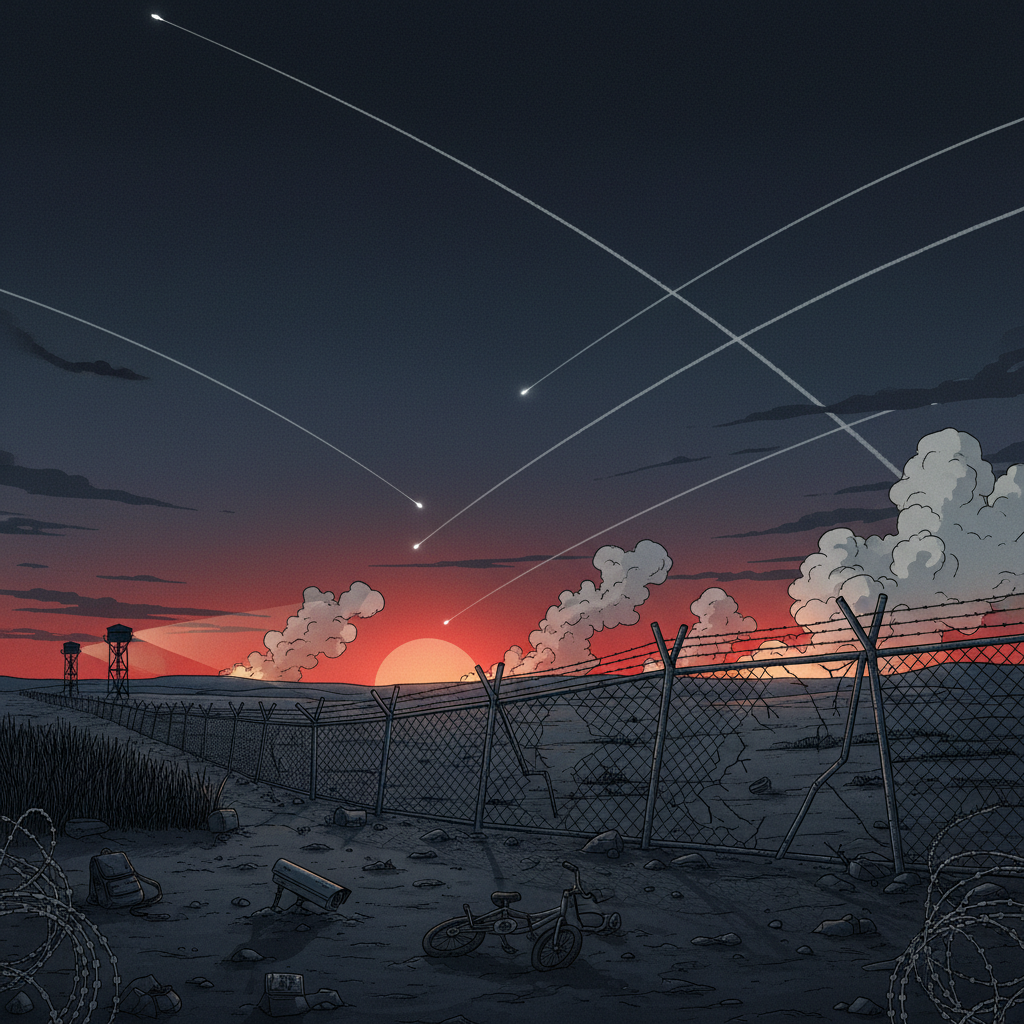
Hamas-attacken den 7 oktober
On October 7, 2023, Hamas launched a surprise multi-front assault on southern Israel from the Gaza Strip, killing approximately 1,200 people and taking over 250 hostages. The attack triggered Israel's largest military operation in Gaza since 1948, a broader regional escalation involving Hezbollah and Iran, and ultimately contributed to the US-Israel strikes on Iran in February-March 2026. The event represents a catalyst whose causal chain extends from the immediate attack through the Gaza war, regional proxy conflict, and into the reshaping of the Middle Eastern security architecture.
Sammanfattning
Seven lenses converge on a central finding: October 7 was a catalyst event whose consequences far exceeded the intentions of any single actor, triggering an escalation chain that reshaped the Middle Eastern security architecture. Intelligence lenses (regional-intelligence, CIA) identify a systemic analytical failure rooted in technological hubris. The proxy-warfare lens reveals how Hamas's autonomous action within Iran's proxy framework ultimately destroyed the very proxy doctrine it exemplified. Civilian-impact documents a humanitarian catastrophe of historic proportions on both sides, with radically asymmetric scale. Game-theory exposes the escalation trap where each player's rational response drove the system toward collective catastrophe. Machiavelli strips away stated justifications to reveal the gap between declared and actual objectives for all parties. Nietzsche diagnoses the psychological dynamics of ressentiment and will to power (viljan till makt) that underpin the conflict's intensity. Together, these perspectives reveal October 7 not as an isolated attack but as the moment when decades of unresolved tension, strategic miscalculation, and human suffering converged into a rupture whose consequences -- extending through Gaza's destruction, Hezbollah's degradation, and the US-Iran 2026 strikes -- continue to unfold.
Nyckelfakta
Verifierade fakta fran flerkallsforskning, bedomda efter konfidensgrad
Hamas launched Operation Al-Aqsa Flood on October 7, 2023, breaching the Gaza-Israel barrier at multiple points with approximately 3,000 militants.
high konfidensApproximately 1,200 people were killed in Israel on October 7, including 364 at the Nova music festival, approximately 695 Israeli civilians, 373 security forces, and 71 foreign nationals.
high konfidensOver 250 hostages were taken to Gaza, including Israeli soldiers, civilians, and foreign nationals.
high konfidensIsrael launched Operation Swords of Iron on October 8, 2023, beginning an intensive aerial bombardment campaign followed by a ground invasion of northern Gaza on October 27.
high konfidensThe ICC issued arrest warrants for Israeli PM Netanyahu and Hamas leader Yahya Sinwar (and others) for alleged war crimes and crimes against humanity.
high konfidensThe ICJ ordered provisional measures in South Africa's genocide case against Israel, ruling that Palestinians in Gaza have plausible rights under the Genocide Convention that needed protection.
high konfidensHezbollah began cross-border attacks on Israel on October 8, 2023, opening a second front in solidarity with Hamas, escalating to a full-scale conflict by late 2024.
high konfidensNyckelaktorer
Huvudaktorer involverade i denna handelse med deras atgarder och uttalade intressen
Hamas (Izz ad-Din al-Qassam Brigades)
organization- ›Launched coordinated multi-front assault on southern Israel
- ›Breached Gaza-Israel barrier at 30+ points
- ›Attacked military bases, kibbutzim, and Nova music festival
Israel (Government and IDF)
state- ›Declared war and mobilized 360,000 reservists
- ›Launched Operation Swords of Iron air campaign
- ›Imposed total siege on Gaza (fuel, electricity, water, food)
Iran / IRGC
state- ›Provided long-term strategic and financial support to Hamas
- ›Supplied weapons technology and training through IRGC Quds Force
- ›Coordinated Axis of Resistance response across multiple fronts
Hezbollah
organization- ›Opened second front with cross-border attacks on northern Israel
- ›Launched rockets and anti-tank missiles at Israeli positions
- ›Escalated to major conflict by late 2024
United States
state- ›Deployed two carrier strike groups to Eastern Mediterranean
- ›Provided emergency military aid packages to Israel
- ›Vetoed multiple UN Security Council ceasefire resolutions
Forskning och källor
Händelsetidslinje
2023-10-07 to ongoing (2026-03-15)
Kausal analys
Interaktiv graf som visar hur policyer, aktörer och händelser hänger kausalt samman — klicka på noder för att utforska relationer
KAUSALT NÄTVERK
17 noder · 16 kopplingar
Välj en nod
Klicka på valfri nod i grafen för att utforska dess kopplingar och linsperspektiv
Grundorsaker
4Kritisk väg
9 stegLinsanalyser
Varje lins tillhandahåller ett unikt analytiskt ramverk — klicka för att expandera och fördjupa analysen
Regional underrattelseperspektiv
regional-intelligenceOctober 7 represents a textbook case of intelligence failure driven by analytical hubris -- the belief that technological superiority and economic leverage had permanently deterred Hamas. The failure was not primarily one of collection (indicators existed) but of analysis and institutional culture, where a dominant framework became unfalsifiable. The most significant intelligence lesson is that a disciplined adversary willing to accept the costs of low-tech communication can defeat the world's most sophisticated SIGINT apparatus.
Proxykrig och icke-statlig aktordoktrin
proxy-warfareOctober 7 exposed the central paradox of proxy warfare: proxies are valued for their operational autonomy and deniability, but that same autonomy means they can drag their patron into conflicts the proxy strategy was designed to prevent. Iran built the most sophisticated state-sponsored proxy network in modern history, only to see it become the mechanism through which Iran was drawn into direct military confrontation with the US and Israel -- the very outcome four decades of proxy doctrine was designed to avoid.
Analys av civilbefolkningens paverkan
civilian-impactThe civilian impact of October 7 and the subsequent Gaza operation is characterized by radical asymmetry in scale alongside shared human suffering. While October 7 inflicted devastating, concentrated violence on Israeli communities in a single day, the sustained military operation in Gaza has produced civilian casualties, displacement, and infrastructure destruction at a scale that multiple UN agencies describe as unprecedented in modern conflict. The population-level data -- regardless of which source's figures one accepts -- describes a humanitarian catastrophe whose demographic, psychological, and economic consequences will shape the region for a generation.
CIA strategisk underrattelsebedomning
Western InstitutionalciaFrom a US strategic intelligence perspective, October 7 triggered the most consequential unplanned escalation chain since 9/11. The CIA's analytical frameworks correctly identified the escalation dynamics -- proxy degradation leading to nuclear hedging leading to preventive strikes -- but the political environment constrained the policy options for interrupting this chain. The key intelligence lesson is that a single dramatic event can collapse carefully constructed strategic frameworks (normalization, containment) faster than they can be rebuilt.
Spelteoretisk analys
Western Moderngame-theoryGame theory reveals October 7 as a rational (if catastrophic) move within Hamas's strategic calculus: the pre-existing equilibrium was deteriorating for Palestinian interests, Israel's deterrence model had created exploitable overconfidence, and the expected payoff of dramatic disruption exceeded continued marginalization. The resulting escalation trap -- where each player's rational response to the previous move drives the system toward collective catastrophe -- demonstrates why the most dangerous moments in international security arise when multiple players simultaneously face commitment traps that foreclose de-escalation.
Machiavellisk maktanalys
Greco-Roman & ClassicalmachiavelliThrough a Machiavellian lens, October 7 reveals a conflict where every major actor's stated goals diverge significantly from their inferred real goals, and where the weakest actor's willingness to pay the highest price gave it disproportionate power to reshape the strategic landscape. Hamas traded its physical capacity for strategic disruption; Israel traded international legitimacy for military dominance; Iran traded its proxy network for nuclear leverage; the US traded diplomatic credibility for alliance maintenance. The Prince would observe that all parties achieved something, but none achieved what they claimed to want.
Nietzscheansk vilja-till-makt-analys
Western ModernnietzscheThrough Nietzsche's lens, October 7 reveals a conflict driven not by rational strategic calculation but by the collision of competing expressions of will to power (viljan till makt) -- Hamas's ressentiment erupting as destructive nihilism, Israel's master morality reasserting dominance through overwhelming force, and both sides trapped in what Nietzsche would diagnose as reactive rather than creative expressions of will. The tragedy is that no party in this conflict is exercising will to power (viljan till makt) in its highest form -- the creation of new values and possibilities. All are destroying, negating, reacting. The abyss has consumed every party that gazed into it.
Konvergenspunkter
Där flera linser når liknande slutsatser — vilket tyder på robusthet
Intelligence failure rooted in systemic analytical hubris, not collection gaps
All three lenses agree that October 7's intelligence failure was primarily analytical rather than collection-based. Warning indicators existed but were filtered through institutional frameworks that had concluded Hamas was deterred. The regional-intelligence lens traces this to the 1973 'conceptzia' pattern recurring; the CIA lens identifies a broader failure of the US-Israeli intelligence partnership; game-theory shows how Israel's false model of Hamas's preferences created exploitable strategic overconfidence.
The escalation chain from October 7 to US-Iran strikes was structurally predictable even if not inevitable
Four lenses converge on the assessment that the escalation from proxy attack through proxy network destruction to direct state confrontation follows a recognizable structural pattern. Proxy-warfare identifies the fundamental paradox of proxy doctrine (proxies can drag patrons into unwanted confrontation); CIA traces the strategic logic from deterrence degradation to nuclear hedging to preventive strikes; game-theory models the commitment traps that foreclosed de-escalation; Machiavelli identifies how each actor's pursuit of stated goals (which concealed real goals) drove escalation.
All actors' stated goals diverge significantly from their inferred real goals
Machiavelli and game-theory both identify systematic gaps between declared and actual objectives for all parties. Hamas claimed liberation but sought Abraham Accords disruption and strategic repositioning. Israel claimed hostage rescue but prioritized deterrence restoration and regime survival. Iran claimed Palestinian solidarity but pursued proxy network maintenance and nuclear leverage. The US claimed stability but prioritized alliance credibility and Iran containment.
The weakest actor's willingness to accept maximum costs gave it disproportionate strategic agency
Game-theory identifies Hamas's asymmetric payoff structure (strategic repositioning worth catastrophic military losses); Machiavelli notes that willingness to pay the highest price inverted conventional power dynamics; Nietzsche frames this as the explosive discharge of ressentiment that temporarily reversed the master-slave dynamic. All three recognize that Hamas's acceptance of devastating consequences for Gaza enabled strategic outcomes that a conventionally rational actor would not have pursued.
Produktiva spänningar
Där linserna är oense — vilket avslöjar komplexitet värd att undersöka
Möjliga framtider
Scenarier härledda från linsanalyser — vad som kan utspela sig baserat på olika ramverk
Managed Post-Conflict Equilibrium
Low-medium probability (20-30%). Requires simultaneous progress on multiple intractable issues. Historical precedent (post-1973, post-Oslo) suggests partial progress followed by breakdown.
Frozen Conflict with Periodic Eruption
High probability (40-50%). Most consistent with historical patterns. The Israeli-Palestinian conflict has repeatedly entered periods of reduced violence without resolution, with each cycle producing greater devastation than the last.
Regional Realignment and Arab-Israeli Normalization
Medium probability (25-35%). The degradation of Iran's proxy network and the exhaustion of the conflict may create a window for normalization, but the depth of Palestinian suffering makes any deal that marginalizes Palestinian statehood politically toxic.
Continued Escalation and Regional War
Low probability (10-15%). The 2026 strikes have degraded Iran's conventional capabilities, but asymmetric retaliation (terrorism, cyber, proxy reconstitution) remains possible. Full regional war is unlikely given the military imbalance.
Nyckelfrågor
Frågor som förblir öppna efter analysen — för fortsatt undersökning
- ?What was the full extent of pre-October 7 intelligence warnings, and at what levels were they received and dismissed?
- ?What was the precise degree of Iranian foreknowledge and involvement in October 7 operational planning?
- ?What is the accurate civilian-to-combatant casualty ratio in Gaza, and can it be independently verified?
- ?What was the content of Saudi-Israeli normalization negotiations at the time of October 7?
Detaljer om faktakontroll
Faktakontrollresultat
verifiedMetaobservationer
No lens adequately captures the experience of the individual human beings at the center of this conflict -- the October 7 survivors, the hostage families, the children of Gaza, the soldiers on both sides. All seven lenses analyze the conflict from above or outside; none can convey what it means to live inside it. Additionally, none adequately addresses the religious dimensions that motivate many actors -- Islamic theology, Jewish historical consciousness, messianic nationalism -- which resist secular analytical frameworks.
This conflict resists reduction to any single explanatory framework because it operates simultaneously as an intelligence failure, a proxy warfare crisis, a humanitarian catastrophe, a strategic escalation chain, a power politics game, and a psychological drama of collective trauma and will to power (viljan till makt). Any analysis that privileges one dimension necessarily distorts the whole. The seven lenses together approach but do not achieve a complete picture.
This analysis was produced by an AI system analyzing one of the most emotionally charged, politically contested, and humanly devastating events of the 21st century. The multi-perspective framing is designed to present all major viewpoints with attribution, but no analysis of this event can be truly neutral. The reader is encouraged to notice which perspectives resonate and which provoke resistance, and to treat that response as data about their own analytical framework rather than evidence of the analysis's bias.
Hitta ditt perspektiv
Olika ramverk resonerar med olika läsare — hitta din ingångspunkt
Readers who approach conflict through strategic logic, institutional analysis, and rational actor frameworks. You likely focus on what actors could and should have done differently, and you evaluate outcomes against strategic objectives.
October 7 was a predictable consequence of Israeli analytical hubris and a rational (if extreme) strategic move by Hamas. The escalation chain follows recognizable patterns from intelligence failure through commitment trap to regional confrontation.
Readers who experience this conflict through its human and psychological dimensions first. You are drawn to the suffering of civilian populations and the deeper psychological forces driving the violence. You may find purely strategic analysis emotionally unsatisfying or morally insufficient.
The conflict is driven by deep psychological forces (ressentiment, will to power (viljan till makt), collective trauma) that cannot be resolved through strategic frameworks alone. The civilian cost is the central reality that all other analyses must reckon with.
Readers who understand conflict through institutional structures, alliance dynamics, and great power competition. You focus on how organizations (intelligence agencies, proxy networks, alliances) shape and constrain individual and state behavior.
October 7 was a failure of institutional structures -- intelligence organizations, proxy management doctrines, alliance mechanisms -- that had maintained a fragile status quo for decades. The institutional framework failed because it was designed for a world that the actors had already moved beyond.
Readers skeptical of stated motivations and official narratives. You suspect that all parties are pursuing unstated objectives disguised as moral imperatives, and you evaluate claims against revealed preferences rather than declared intentions.
Every major actor's stated goals diverge from their inferred real goals. The gap between stated and actual objectives -- not the objectives themselves -- is the primary driver of the conflict's intractability.
If you find yourself strongly aligned with one cluster, deliberately engage with the opposite. If you resonate with the analytical cluster's strategic logic, the intuitive cluster's focus on civilian suffering will challenge your framework in productive ways. If the institutional perspective feels natural, the Machiavellian skepticism about stated objectives will deepen your analysis. Every perspective here captures something real and misses something important.
Relaterade analyser
Andra händelser analyserade genom liknande linser eller kategorier
Arabiska våren var en revolutionär våg av protester, uppror och väpnade revolter som svepte över arabvärlden från december 2010. Utlöst av den tunisiske gatuhandlaren Mohamed Bouazizis självförbränning den 17 december 2010 spred sig rörelsen med häpnadsväckande hastighet över Nordafrika och Mellanöstern. Slagordet "الشعب يريد إسقاط النظام" (Folket vill ha regimens fall) ekade från Tunis till Kairo. Militärens val — att ställa sig på demonstranternas sida eller förbli lojala mot regimen — visade sig vara den avgörande variabeln i varje land.
Mellan 6 april och 18 juli 1994 mördades systematiskt cirka 800 000 tutsis och moderata hutus i Rwanda under loppet av 100 dagar — det mest effektiva massdödandet i modern historia, med en daglig dödstakt som översteg Förintelsens. Folkmördet var inte ett utbrott av ”urgamla stamfejder” utan kulmen på ett kolonialt projekt: belgiska administratörer hade tillverkat rigida raskategorier från flytande sociala identiteter genom folkräkningen 1933 och obligatoriska etniska identitetskort. Habyarimanas regim och dess inre krets akazu (lilla huset) valde folkmörd som politisk överlevnadsstrategi inför militärt tryck från Rwandas patriotiska front och Arusha-avtalens krav på maktdelning. RTLM-radio — ”Radio Machete” — konditionerade systematiskt befolkningen genom år av avhumaniserande propaganda och kallade tutsis för ”inyenzi” (kackerlackor). Mellan 250 000 och 500 000 kvinnor våldtogs som avsiktligt vapen för folkmörd. Det internationella samfundets misslyckande var aktivt: Dallaire skickade sin ”folkmördsfax” tre månader före, begärde 5 000 soldater och nekades. FN:s säkerhetsråd reducerade UNAMIR från 2 500 till 270 soldater under folkmördet. RPF:s militära seger avslutade folkmördet i juli 1994, men konsekvenserna spred sig till första Kongokriget (1996-97) och ”Afrikas världskrig” som dödade över 5 miljoner människor.
Den 26 april 1986 klockan 01:23 exploderade reaktor nr 4 vid Tjernobyl-kärnkraftverket i Ukrainska SSR under ett säkerhetstest och frigjorde 400 gånger mer radioaktivt material än Hiroshimabomben. De sovjetiska myndigheterna hemlighöll katastrofen och tvingade Pripjats 49 000 invånare att fortsätta sitt normala liv i 36 timmar. Omkring 600 000 'likvidatorer' sattes in. Uppskattningarna av dödstalet sträcker sig från 4 000 (WHO) till 93 000 (Greenpeace). Katastrofen krossade myten om sovjetisk teknologisk överlägsenhet och tvingade Gorbatjov mot glasnost.
Hur detta analyserades
Full transparens om analysprocessen, verktygen och begränsningarna
Crosslight-motorn
v0.4.0 "Global Lens Expansion"- ⚠Non-Western philosophical lenses rely on translated primary texts — nuance may be lost in translation
- ⚠Some traditions (e.g., Maat, Ubuntu) have limited surviving primary texts; analysis draws on scholarly reconstruction
- ⚠Cross-cultural lens application is inherently interpretive — a Confucian reading of a Western event is an analytical exercise, not a claim of cultural authority
Analysstatistik
Metodik
Denna analys producerades av Crosslights multiagent-pipeline: en forskningsagent samlade in och verifierade fakta från flera källor, specialiserade linsagenter tillämpade distinkta analytiska ramverk, en syntesagent integrerade insikter och identifierade mönster, och en faktakontrollagent verifierade påståenden. Varje linsperspektiv är AI:ns tolkning — inte institutionellt godkännande.Läs mer →