
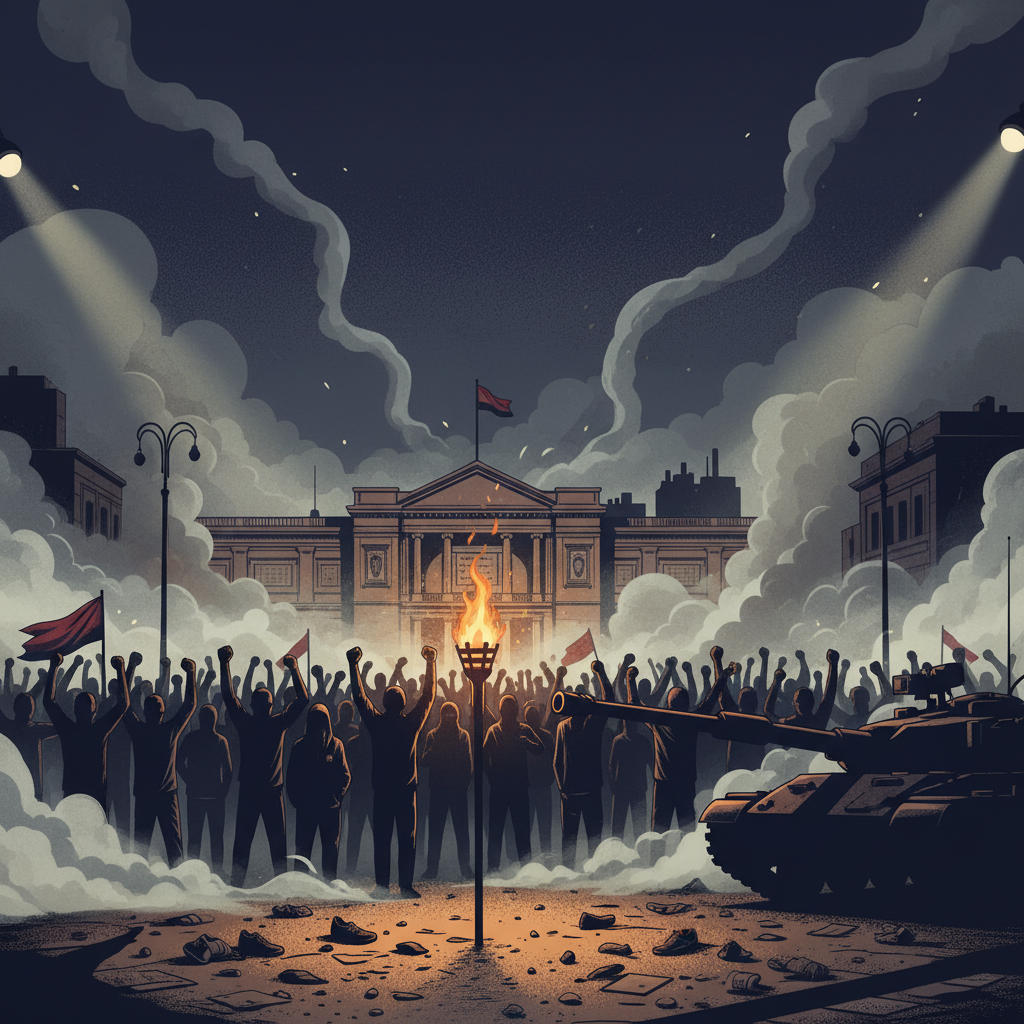
阿拉伯之春 2011
阿拉伯之春是一场从2010年12月开始席卷阿拉伯世界的革命浪潮,包括抗议、起义和武装叛乱。2010年12月17日,突尼斯街头小贩穆罕默德·布瓦吉吉的自焚引发了这场运动。“الشعب يريد إسقاط النظام”(人民要求推翻政权)的口号从突尼斯响彻到开罗、班加西和大马士革。军队的选择——站在抗议者一边还是忠于政权——被证明是每个国家的决定性变量。
执行摘要
七个分析视角聚合于一个核心发现:阿拉伯之春是数十年被压抑的人类愿望不可避免的爆发,但其结果不是由数百万人的愿望决定的,而是由军事精英的制度性计算和外部力量的战略干预决定的。
关键事实
来自多来源研究的已验证事实,按置信度评级
Mohamed Bouazizi, a 26-year-old street vendor in Sidi Bouzid, Tunisia, set himself on fire on December 17, 2010, after his produce cart was confiscated and he was humiliated by a municipal official. He died of his injuries on January 4, 2011.
high置信度Tunisian President Zine El Abidine Ben Ali fled to Saudi Arabia on January 14, 2011, ending his 23-year rule. Tunisia's military refused to fire on protesters.
high置信度Mass protests began in Egypt on January 25, 2011 (the 'Day of Rage'), centering on Tahrir Square in Cairo. President Hosni Mubarak resigned on February 11, 2011, after 30 years in power.
high置信度Egypt's Supreme Council of the Armed Forces (SCAF) sided with protesters and forced Mubarak's resignation, protecting the military's extensive economic and institutional interests.
high置信度Mohamed Morsi of the Muslim Brotherhood won Egypt's first free presidential election in June 2012. He was removed by a military coup led by General Abdel Fattah al-Sisi on July 3, 2013.
high置信度Protests against Muammar Gaddafi began in Benghazi, Libya on February 15, 2011. UN Security Council Resolution 1973 authorized a no-fly zone. NATO intervened militarily beginning March 19, 2011. Gaddafi was captured and killed on October 20, 2011.
high置信度Anti-government protests began in Daraa, Syria in mid-March 2011 after schoolchildren were detained for anti-regime graffiti. The Assad regime responded with military force, escalating into civil war.
high置信度关键参与者
参与此事件的主要参与者及其行动和公开利益
Mohamed Bouazizi
individual- ›Set himself on fire on December 17, 2010 in Sidi Bouzid, Tunisia
Hosni Mubarak
individual- ›Imposed curfew and deployed military to streets
- ›Shut down internet and mobile communications
- ›Resigned on February 11, 2011
Muammar Gaddafi
individual- ›Ordered military to suppress protests violently
- ›Threatened to 'cleanse Libya house by house'
- ›Fought NATO intervention until captured and killed
Bashar al-Assad
individual- ›Deployed military against civilian protesters
- ›Used barrel bombs and chemical weapons against civilian areas
- ›Relied on Iranian and Russian military support
Al Jazeera
organization- ›Provided 24/7 satellite coverage of Arab Spring protests across the region
- ›Amplified protest movements through pan-Arab broadcasts reaching millions
- ›Created a shared narrative space across Arab-speaking populations
研究与来源
事件时间线
2010-12-17 to 2015-09-01
因果分析
展示政策、参与者和事件之间因果关系的交互图谱——点击节点探索关系
因果网络
21 个节点 · 18 个连接
选择节点
点击图谱中的任意节点以探索其连接和视角分析
根本原因
3关键路径
9 个步骤视角分析
每个视角提供独特的分析框架——点击展开查看深度分析
博弈论
Western Moderngame-theoryThe Arab Spring was a massive multi-player sequential game where each country's outcome changed the information set for all other players. Tunisia's success solved the collective action problem by demonstrating that revolution was possible — but the game-theoretic insight is that the same initial shock (popular uprising) produced radically different outcomes depending on one variable: whether the military's institutional interests were better served by defecting from or remaining loyal to the regime. This is the 'military kingmaker' dynamic — not a bug in the revolutionary wave but the fundamental strategic variable that determined winners and losers.
马基雅维利
Greco-Roman & ClassicalmachiavelliThe Arab Spring is a masterclass in Machiavellian power dynamics: it demonstrated that power built solely on fear collapses catastrophically when the fear barrier breaks. The military — not the people, not social media, not Western intervention — was the prince-maker in every country. Where the military calculated that its institutional interests were better served by sacrificing the ruler (Tunisia, Egypt), transitions were relatively peaceful. Where the military's survival was bound to the regime (Syria's Alawite officers, Bahrain's Sunni security forces), the result was either civil war or brutal suppression. The tragedy of the Arab Spring, in Machiavellian terms, is that destroying the old order proved far easier than building a new one. As Machiavelli warned: 'There is nothing more difficult to take in hand, more perilous to conduct, or more uncertain in its success, than to take the lead in the introduction of a new order of things.'
中情局情报评估
Western InstitutionalciaThe Arab Spring exposed the central paradox of US intelligence engagement in the Middle East: the very authoritarian relationships that provided counter-terrorism intelligence created the conditions for the revolutionary explosions that destroyed those relationships. The CIA's partnerships with Mubarak's GIS, Ben Ali's secret police, and Gaddafi's reformed intelligence services gave the US excellent visibility into specific terrorist networks but no understanding of the structural rage building across Arab societies. The intelligence failure was not in the collection but in the analytical framework — the inability to see that 'stable authoritarian allies' was a contradiction in terms, and that the suppressed frustrations of millions of young Arabs constituted a strategic threat greater than any specific terrorist organization.
巴甫洛夫条件反射分析
Western ModernpavlovThe Arab Spring demonstrates that authoritarian control based on conditioned fear is inherently fragile: it works perfectly until it doesn't, and when it fails, it fails catastrophically. Decades of conditioning created a population that appeared compliant but was actually a pressure cooker of suppressed frustration. Bouazizi's act served as the extinction trial that demonstrated the old contingency no longer held. Al Jazeera's broadcasts generalized this extinction across the Arab world. But conditioning theory also explains the tragedy: it is far easier to extinguish a fear response (stop obeying) than to condition new constructive behaviors (build democratic institutions). The Arab Spring succeeded as mass behavioral de-conditioning — the fear was broken — but failed as re-conditioning toward democratic habits, which require years of consistent reinforcement that the post-revolutionary environment could not provide.
尼采分析
Western ModernnietzscheThe Arab Spring was a revolt of dignity — ثورة الكرامة — and Nietzsche's philosophy provides the deepest reading of what dignity means in this context. It was not merely a demand for political rights but an existential assertion: the refusal to accept humiliation as the human condition. Bouazizi's act was the purest expression of will against a system that had crushed all will. The tragedy is Nietzsche's own warning: destruction of the old order is the easy part. The hard part — the creation of new values, the emergence of what Nietzsche would call higher types of human organizing — requires precisely the kind of patient, creative work that revolutionary energy cannot sustain. The Arab Spring proved that the will to power can topple any regime, but it cannot, by itself, build what comes next.
道家分析
East AsiantaoismThe Arab Spring is the Tao's most powerful modern demonstration of the principle of reversal (反, fan): whatever reaches an extreme produces its opposite. Decades of authoritarian rigidity (extreme yang) produced explosive revolutionary energy (extreme yin). Regimes that gripped tighter fell faster — Gaddafi's 42 years of iron control shattered into state collapse; Assad's brutal suppression produced the century's worst humanitarian disaster. Regimes that bent survived — Morocco's limited reforms, Jordan's modest concessions. The Tao's deepest insight about the Arab Spring is this: the revolutionary wave moved not through strategic coordination but through the natural resonance of shared grievances, flowing like water through every crack in authoritarian structures. It could not be stopped because it was not being directed — it was the Tao itself, the natural flow of suppressed human aspiration finding expression. But the Tao also teaches that water, unconstrained, floods and destroys. The Arab Spring's devastation in Libya and Syria is water without banks — natural force without the channels needed to direct it constructively.
平民影响评估
civilian-impactThe Arab Spring's civilian impact reveals the terrible disproportion between revolutionary aspiration and human cost. Millions of people demanded nothing more than dignity, economic opportunity, and an end to corruption — the most basic human aspirations. In Tunisia, these aspirations were achieved at relatively low cost. In Syria, the same aspirations produced the worst humanitarian catastrophe of the 21st century. The difference was not in what civilians wanted or how they protested, but in the structural variables they could not control: military loyalty, sectarian composition, external intervention, and the willingness of rulers to destroy their own countries rather than relinquish power. The most devastating finding of this analysis is that the people who suffered most — Syrian civilians — had the least agency in determining their fate. They were caught between a regime willing to use chemical weapons, an opposition that fragmented into rival militias, external powers pursuing strategic interests, and a jihadist movement (ISIS) that exploited the chaos. The Arab Spring's human cost is not a story of failed revolution — it is a story of civilians trapped in conflicts they did not choose, determined by forces they could not influence.
趋同点
多个视角得出相似结论的地方——表明结论的稳健性
Military loyalty as the decisive variable
All four lenses independently identify the military's institutional choice as the factor that determined whether revolutions succeeded peacefully, devolved into civil war, or were crushed. This is the single strongest convergence across all analyses.
Authoritarian stability is inherently fragile
Game theory shows that fear-based equilibria collapse when the punishment mechanism fails. Pavlov shows that conditioned fear extinguishes when the contingency breaks. Taoism shows that rigid systems produce their own reversal. CIA learned that 'stable authoritarian allies' was a strategic delusion. All agree: apparent authoritarian stability masks fragility.
Destruction of old orders is easier than construction of new ones
Machiavelli warned that establishing new orders is the most difficult political undertaking. Nietzsche identifies the Ubermensch problem — revolutions lack creative vision for what comes after. Taoism sees unconstrained water (revolution without institutional channels) as destructive. Civilian impact documents the human cost of this gap between destruction and construction.
建设性分歧
视角之间存在分歧的地方——揭示值得审视的复杂性
可能的未来
从视角分析中得出的情景——基于不同框架可能展开的走向
Second wave of Arab uprisings driven by unresolved structural grievances
Medium — the structural conditions remain, but the memory of Syria's catastrophe acts as a powerful deterrent
Authoritarian adaptation and tech-enabled control prevent future uprisings
Medium-high — authoritarian regimes have invested heavily in learning from the Arab Spring's failures
Tunisia's democratic path consolidates and gradually influences the region
Low — Tunisia's own democracy has faced setbacks since 2021 (Kais Saied's power concentration)
关键问题
分析后仍然开放的问题——供持续探究
- ?What was the precise role of Gulf intelligence services in funding and directing various factions?
- ?To what extent did Al Jazeera's editorial decisions shape the direction of the Arab Spring?
- ?What were the internal deliberations within military high commands that determined their choices?
事实核查详情
事实核查结果
verified元观察
All seven lenses are fundamentally retrospective — they analyze what happened and why, but none fully captures the lived experience of revolutionary hope before it turned to despair. The Arab Spring was, for millions of people, the most exhilarating experience of their lives — a moment of collective agency and shared purpose that cannot be reduced to strategic calculation, conditioning, or power dynamics. That hope, even though it was largely betrayed by outcomes, was real and transformative for those who experienced it.
The Arab Spring involves simultaneous causation at multiple scales — individual psychology (Bouazizi), institutional dynamics (military choices), regional contagion (media amplification), and global geopolitics (external intervention) — that cannot be adequately captured by any single analytical framework. The seven lenses together approach a more complete picture, but the full complexity of a revolutionary wave affecting 300+ million people across 20 countries over five years exceeds any analytical capacity.
The Arab Spring humbled every analytical framework that tried to predict or explain it in real time. Intelligence agencies did not predict it. Academic experts did not anticipate its trajectory. No single theory — rational choice, structuralism, constructivism, or any other — captured the full dynamic. This analysis, with its seven lenses, is an attempt to triangulate toward truth, but the reader should hold all conclusions with appropriate humility.
找到你的视角
不同的框架与不同的读者产生共鸣——找到你的切入点
Readers who see the Arab Spring primarily through strategic dynamics, institutional calculations, and power politics — who ask 'what were the incentives?' and 'who benefited?'
The military kingmaker dynamic and the failure of intelligence frameworks to predict popular uprisings
Readers who see the Arab Spring as an expression of deep human aspirations — dignity, freedom, natural flow against artificial constraint — and who feel the movement's moral power
The revolt of dignity and the paradox of control — regimes that gripped tighter fell faster
Readers focused on power structures, institutional dynamics, and the concrete consequences of political action — who ask 'what happened to real people?' and 'who holds power?'
The gap between revolutionary aspiration and institutional capacity to build new orders, and the devastating human cost of that gap
Readers skeptical of grand narratives who focus on mechanisms, costs, and unintended consequences — who ask 'how did it actually spread?' and 'what was the real price?'
The conditioning dynamics that made the wave possible and the cruel arithmetic of human suffering across the spectrum
Start with the lens that resonates most, then deliberately read the lens that challenges your assumptions. If you see strategic rationality (game-theory), read the existential dimension (nietzsche). If you feel the moral power of the movement (nietzsche), confront the human cost (civilian-impact). The Arab Spring's full truth lives in the tension between these perspectives, not in any single lens.
相关分析
通过类似视角或类别分析的其他事件
1986年4月26日凌晨1时23分,乌克兰苏维埃社会主义共和国切尔诺贝利核电站4号反应堆在安全测试期间发生爆炸,释放出相当于广岛原子弹400倍的放射性物质。苏联当局最初掩盖了这场灾难,迫使普里皮亚季4.9万居民在36小时内继续正常生活。约60万名"清理人"被调遣参与善后。死亡人数估计从世界卫生组织的4000人到绿色和平组织的93000人不等。这场灾难打破了苏联技术优势的神话,迫使戈尔巴乔夫走向公开性改革。
1994年4月6日至7月18日期间,卢旺达在100天内系统性屠杀了约80万图西族和温和派胡图族——这是现代史上最高效的大规模屠杀,每日死亡率超过了大屠杀。这场种族灭绝并非“古老部族仇恨”的爆发,而是殖民工程的灾难性结果:比利时管理者通过1933年人口普查和强制性民族身份证,从流动的社会身份中制造出了僵化的种族类别。RTLM电台——“砂刀电台”——通过多年的去人性化宣传系统性地对民众进行调教。25万至50万妇女被强奸作为种族灭绝的蓄意武器。国际社会的失败是主动的:达莱尔提前三个月发出警告,请求5000名士兵,被拒绝。联合国安理会在种族灭绝期间将UNAMIR从2500人削减至270人。RPF的军事胜利在1994年7月结束了种族灭绝,但后果蔓延至第一次刚果战争(1996-97)和造成500多万人死亡的“非洲世界大战”。
1963年11月22日,约翰·F·肯尼迪(John F. Kennedy)总统在德克萨斯州达拉斯(Dallas, Texas)的迪利广场(Dealey Plaza)遭到暗杀。李·哈维·奥斯瓦尔德(Lee Harvey Oswald)随即被捕,但在受审前被杰克·鲁比(Jack Ruby)枪杀。沃伦委员会(Warren Commission)得出结论,认为奥斯瓦尔德系单独行凶,而众议院特别委员会(HSCA)后来认定很可能存在阴谋。截至2025年解密的文件揭示了中央情报局(CIA)与联邦调查局(FBI)的系统性掩盖行为,使其成为美国历史上最具深远影响的悬案。
分析方法
关于分析过程、工具和局限性的完全透明
Crosslight Engine
v0.4.0 "Global Lens Expansion"- ⚠Non-Western philosophical lenses rely on translated primary texts — nuance may be lost in translation
- ⚠Some traditions (e.g., Maat, Ubuntu) have limited surviving primary texts; analysis draws on scholarly reconstruction
- ⚠Cross-cultural lens application is inherently interpretive — a Confucian reading of a Western event is an analytical exercise, not a claim of cultural authority
分析统计
方法论
本分析由 Crosslight 多代理管线生成:研究代理从多来源收集并验证事实,专业视角代理应用各自独特的分析框架,综合代理整合洞察并识别模式,事实核查代理验证声明。每个视角是AI的解读——而非机构背书。了解更多 →