
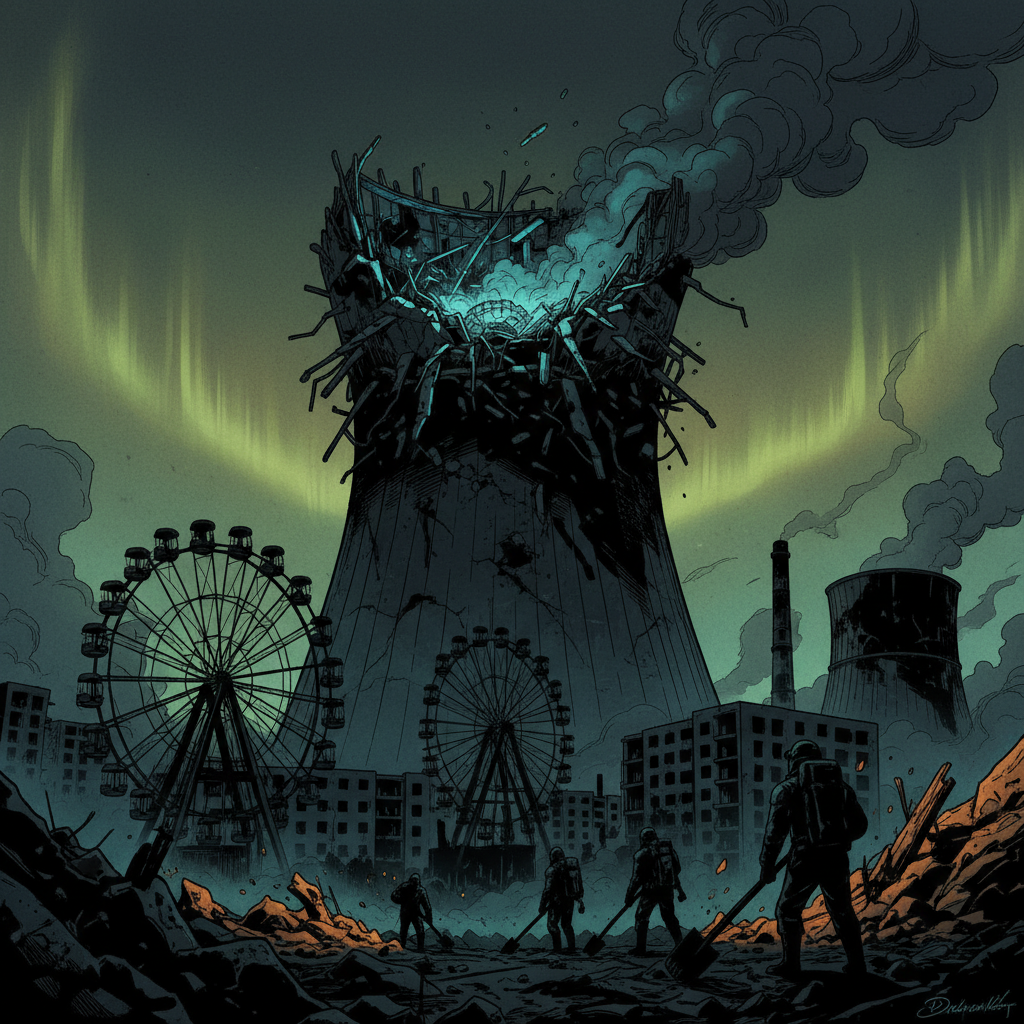
切尔诺贝利核灾难
1986年4月26日凌晨1时23分,乌克兰苏维埃社会主义共和国切尔诺贝利核电站4号反应堆在安全测试期间发生爆炸,释放出相当于广岛原子弹400倍的放射性物质。苏联当局最初掩盖了这场灾难,迫使普里皮亚季4.9万居民在36小时内继续正常生活。约60万名"清理人"被调遣参与善后。死亡人数估计从世界卫生组织的4000人到绿色和平组织的93000人不等。这场灾难打破了苏联技术优势的神话,迫使戈尔巴乔夫走向公开性改革。
执行摘要
七个分析视角汇聚于一个核心发现:切尔诺贝利灾难是一场双重灾难——根植于反应堆设计妥协的技术失败,被苏联体制各层级将自我保存置于人类安全之上的制度性失败所放大。七个视角一致认为:制度性失败与技术失败同样具有灾难性,且可能更可预防。
关键事实
来自多来源研究的已验证事实,按置信度评级
At 01:23 AM on April 26, 1986, Reactor No. 4 at the Chernobyl Nuclear Power Plant exploded during a turbine rundown safety test.
high置信度The RBMK-1000 reactor design had a known positive void coefficient of reactivity, meaning loss of coolant water increased reactivity. This was accepted as a trade-off for dual-use capability and cost savings.
high置信度Deputy chief engineer Anatoly Dyatlov pressured operators to continue the test despite dangerously low power levels (~200 MW vs. planned 700-1000 MW). Operators disabled the ECCS and overrode automatic shutdown signals.
high置信度Pripyat (population 49,000), 3 km from the reactor, was not evacuated until 36 hours after the explosion. Children played outdoors, weddings were held, and residents observed the fire from the 'Bridge of Death.'
high置信度Swedish radiation monitoring stations at Forsmark detected elevated levels on April 28, forcing Soviet acknowledgment. The Soviets initially blamed a 'minor accident.'
high置信度Approximately 600,000 liquidators were deployed between 1986 and 1990. 'Bio-robots' on the roof worked in 90-second shifts, each receiving a near-lifetime dose.
high置信度Of 134 plant workers and firefighters diagnosed with acute radiation syndrome, 28 died within months. Their deaths were documented in clinical detail.
high置信度关键参与者
参与此事件的主要参与者及其行动和公开利益
Anatoly Dyatlov
individual- ›Supervised the safety test
- ›Pressured operators to continue at low power
- ›Ordered disabled safety systems
Mikhail Gorbachev
individual- ›Delayed public acknowledgment 18 days
- ›Blamed Western media
- ›Used Chernobyl to accelerate glasnost
Valery Legasov
individual- ›Led scientific investigation
- ›Presented Soviet narrative to IAEA
- ›Recorded truth-telling tapes
Liquidators
group- ›Built sarcophagus
- ›Cleared radioactive graphite from roof
- ›Decontaminated surrounding areas
研究与来源
事件时间线
1954-06-27 to 1991-12-26
因果分析
展示政策、参与者和事件之间因果关系的交互图谱——点击节点探索关系
因果网络
18 个节点 · 19 个连接
选择节点
点击图谱中的任意节点以探索其连接和视角分析
根本原因
3关键路径
8 个步骤视角分析
每个视角提供独特的分析框架——点击展开查看深度分析
博弈论
Western Moderngame-theoryChernobyl was not a failure of rationality but a masterclass in how rational individual decisions within a pathological institutional structure produce collectively catastrophic outcomes. The system's information architecture was the root cause: by classifying safety data, punishing dissent, and rewarding concealment, the system guaranteed that each actor's rational choice would aggregate into civilizational disaster. The 'peaceful atom' ideology functioned as a corrupted focal point coordinating the entire system toward catastrophe. A system that makes honesty irrational will produce dishonesty at scale, and a nuclear power program built on institutional dishonesty will eventually produce Chernobyl.
马基雅维利
Greco-Roman & ClassicalmachiavelliChernobyl is a perfect Machiavellian case study in institutional self-preservation becoming self-destruction. The Soviet system followed the classic playbook: conceal weakness, project strength, control information, blame subordinates. This works for political competition between elites. It fails catastrophically for governing complex technical systems where accurate information is a safety prerequisite. Nuclear reactors do not respond to political narratives — they respond to physics. When the Soviet system treated safety information as a political resource rather than a physical reality, it created conditions for an accident that physics, not politics, would determine. Gorbachev's subsequent use of Chernobyl to accelerate glasnost was genuinely Machiavellian: converting catastrophic weakness into reform leverage. But glasnost could not be confined to nuclear safety.
中央情报局
Western InstitutionalciaChernobyl's intelligence significance lies not in the reactor failure but in what it revealed about Soviet decision-making under crisis. The disaster stress-tested the Soviet information architecture and it failed comprehensively: upward reporting filtered bad news, lateral communication was impeded by classification, downward communication prioritized messaging over safety, international communication was dishonest until forced. The pattern — institutional mendacity as structural feature — became a key lens for assessing authoritarian fragility. The insight that information-controlled systems are brittle rather than resilient remains one of the most durable Cold War intelligence lessons.
巴甫洛夫
Western ModernpavlovChernobyl demonstrates that institutional conditioning is a safety-critical infrastructure vulnerability. Decades of conditioning — obedience, news suppression, trust in official narratives, punishment of dissent — created patterns individually adaptive (kept people employed) but collectively catastrophic (prevented detection of and response to existential threats). The disaster was caused not by a few bad decisions on April 26 but by forty years of conditioning that made those decisions inevitable. When you condition operators to obey authority over instruments, managers to filter reality, officials to prioritize narrative over facts, and citizens to trust silence as safety — you create an anti-safety culture where every reflex moves toward catastrophe.
平民影响
civilian-impactChernobyl's civilian impact reveals a disaster on geological timescales: centuries of contamination, generational health consequences, and psychological wounds transmitted through families. The contested death toll is ongoing harm: when official count is 31 and the range extends to 93,000, communities exist in unresolved grief. The most important lesson: the institutional failure caused as much damage as the explosion. Without the 36-hour delay, the thyroid cancer epidemic would have been significantly reduced. Without the May Day parade, Kyiv's children would not have marched through fallout. The civilian toll is a consequence not merely of the explosion but of every subsequent institutional decision that prioritized image over human life.
道家
East AsiantaoismChernobyl is the Tao's answer to the 'peaceful atom.' The Taoist reading reveals a disaster driven by fundamental violation of the principle that nature cannot be conquered, only cooperated with. The Soviet system forced the atom, forced secrecy, forced obedience, forced ignorance, forced fiction. At every point, forcing produced its opposite. The Exclusion Zone — where nature flourishes in humanity's absence — is the most eloquent Taoist commentary. The wolves of Chernobyl embody the Tao Te Ching: 'the Tao nourishes all things.' The deepest lesson: systems that deny uncertainty will be destroyed by it.
尼采
Western ModernnietzscheChernobyl is the story of a will to power that confused institutional dominance with genuine mastery. The Soviet system had power to classify, conceal, command, and coerce — but not to control nuclear fission when the reactor exceeded institutional narrative. The liquidators embody Nietzsche's central question: what distinguishes authentic heroism from coerced sacrifice? The Soviet system, by making genuine choice impossible, destroyed the conditions that make heroism meaningful — then claimed the sacrifice as institutional virtue. Legasov's arc is the most purely Nietzschean story: beginning in slave morality, recognizing institutional values as lies, destroying himself in self-overcoming that affirmed individual truth. The Soviet response — blaming individuals, concealing flaws, claiming liquidator sacrifice as institutional virtue — was slave morality: inverting truth and power, making institutional survival the highest value. Chernobyl shattered that inversion at a cost measured in human lives.
趋同点
多个视角得出相似结论的地方——表明结论的稳健性
Institutional mendacity as root cause
All four identify Soviet information architecture — classification, punishment of dissent, rewarding optimism — as the fundamental cause transforming technical failure into civilizational catastrophe.
The coverup caused more harm than the explosion
36-hour evacuation delay, Kyiv May Day, continued milk distribution all caused measurable additional harm. The thyroid cancer epidemic was largely preventable with timely response.
Hubris and limits of institutional control
All four converge on the insight that Soviet confidence in its own control was the precondition for losing control catastrophically.
建设性分歧
视角之间存在分歧的地方——揭示值得审视的复杂性
可能的未来
从视角分析中得出的情景——基于不同框架可能展开的走向
Nuclear renaissance with institutional learning
Moderate. Institutional learning genuine but incomplete. Climate pressures make expansion likely.
Another major nuclear accident exposing institutional failure
Low but non-negligible per decade.
关键问题
分析后仍然开放的问题——供持续探究
- ?What is the true death toll? Will advances in epidemiology resolve the 4,000-93,000 range?
- ?How many liquidators developed radiation-related conditions and were denied recognition?
- ?What was the full chain of command in the first 72 hours?
事实核查详情
事实核查结果
verified元观察
All seven share a bias toward explanation. What all miss is the irreducibly incomprehensible dimension: ARS as documented by Alexievich, the three-day lie's cruelty, children's thyroid cancers. Some dimensions of Chernobyl resist comprehension and should resist it.
The relationship between technical and institutional failure is irreducibly complex: they are co-produced effects of the same Soviet institutional culture. Separating them is analytically useful but ultimately misrepresents a disaster in which technology and institutions were inseparable.
The contested death toll — 31 to 93,000 — is a permanent reminder of irreducible uncertainty. Any analysis claiming certainty is less honest than one acknowledging the range.
找到你的视角
不同的框架与不同的读者产生共鸣——找到你的切入点
Readers drawn to structural explanations and institutional design. You see Chernobyl as fixable through better incentive structures.
The Soviet information architecture was the root cause. Information-controlled systems are brittle, not strong.
Readers drawn to questions about hubris, nature's limits, and moral weight of choices. Chernobyl as parable about humanity's relationship with uncontrollable forces.
The 'peaceful atom' embodied a fundamental misunderstanding: institutional will cannot master natural forces through political commitment.
Readers focused on how organizations function and how institutional cultures shape behavior. Chernobyl as case study in institutional pathology.
Behavioral conditioning and power dynamics made every actor behave rationally within their context while producing collective catastrophe.
Readers prioritizing human experience over analytical frameworks. Skeptical that any lens captures the horror of radiation sickness or the injustice of the contested death toll.
All frameworks risk abstracting away individual suffering. The thyroid cancer in a child's throat exceeds what any theory contains.
If in the analytical cluster, read civilian-impact to ground structural understanding in human experience. If intuitive, game-theory shows how 'hubris' operated through fixable mechanisms. If institutional, Nietzsche reminds that individual choices cannot be fully explained by conditioning. All readers: engage with the liquidator heroism/victimization tension without resolving it prematurely.
相关分析
通过类似视角或类别分析的其他事件
阿拉伯之春是一场从2010年12月开始席卷阿拉伯世界的革命浪潮,包括抗议、起义和武装叛乱。2010年12月17日,突尼斯街头小贩穆罕默德·布瓦吉吉的自焚引发了这场运动。“الشعب يريد إسقاط النظام”(人民要求推翻政权)的口号从突尼斯响彻到开罗、班加西和大马士革。军队的选择——站在抗议者一边还是忠于政权——被证明是每个国家的决定性变量。
1994年4月6日至7月18日期间,卢旺达在100天内系统性屠杀了约80万图西族和温和派胡图族——这是现代史上最高效的大规模屠杀,每日死亡率超过了大屠杀。这场种族灭绝并非“古老部族仇恨”的爆发,而是殖民工程的灾难性结果:比利时管理者通过1933年人口普查和强制性民族身份证,从流动的社会身份中制造出了僵化的种族类别。RTLM电台——“砂刀电台”——通过多年的去人性化宣传系统性地对民众进行调教。25万至50万妇女被强奸作为种族灭绝的蓄意武器。国际社会的失败是主动的:达莱尔提前三个月发出警告,请求5000名士兵,被拒绝。联合国安理会在种族灭绝期间将UNAMIR从2500人削减至270人。RPF的军事胜利在1994年7月结束了种族灭绝,但后果蔓延至第一次刚果战争(1996-97)和造成500多万人死亡的“非洲世界大战”。
1963年11月22日,约翰·F·肯尼迪(John F. Kennedy)总统在德克萨斯州达拉斯(Dallas, Texas)的迪利广场(Dealey Plaza)遭到暗杀。李·哈维·奥斯瓦尔德(Lee Harvey Oswald)随即被捕,但在受审前被杰克·鲁比(Jack Ruby)枪杀。沃伦委员会(Warren Commission)得出结论,认为奥斯瓦尔德系单独行凶,而众议院特别委员会(HSCA)后来认定很可能存在阴谋。截至2025年解密的文件揭示了中央情报局(CIA)与联邦调查局(FBI)的系统性掩盖行为,使其成为美国历史上最具深远影响的悬案。
分析方法
关于分析过程、工具和局限性的完全透明
Crosslight Engine
v0.4.0 "Global Lens Expansion"- ⚠Non-Western philosophical lenses rely on translated primary texts — nuance may be lost in translation
- ⚠Some traditions (e.g., Maat, Ubuntu) have limited surviving primary texts; analysis draws on scholarly reconstruction
- ⚠Cross-cultural lens application is inherently interpretive — a Confucian reading of a Western event is an analytical exercise, not a claim of cultural authority
分析统计
方法论
本分析由 Crosslight 多代理管线生成:研究代理从多来源收集并验证事实,专业视角代理应用各自独特的分析框架,综合代理整合洞察并识别模式,事实核查代理验证声明。每个视角是AI的解读——而非机构背书。了解更多 →