
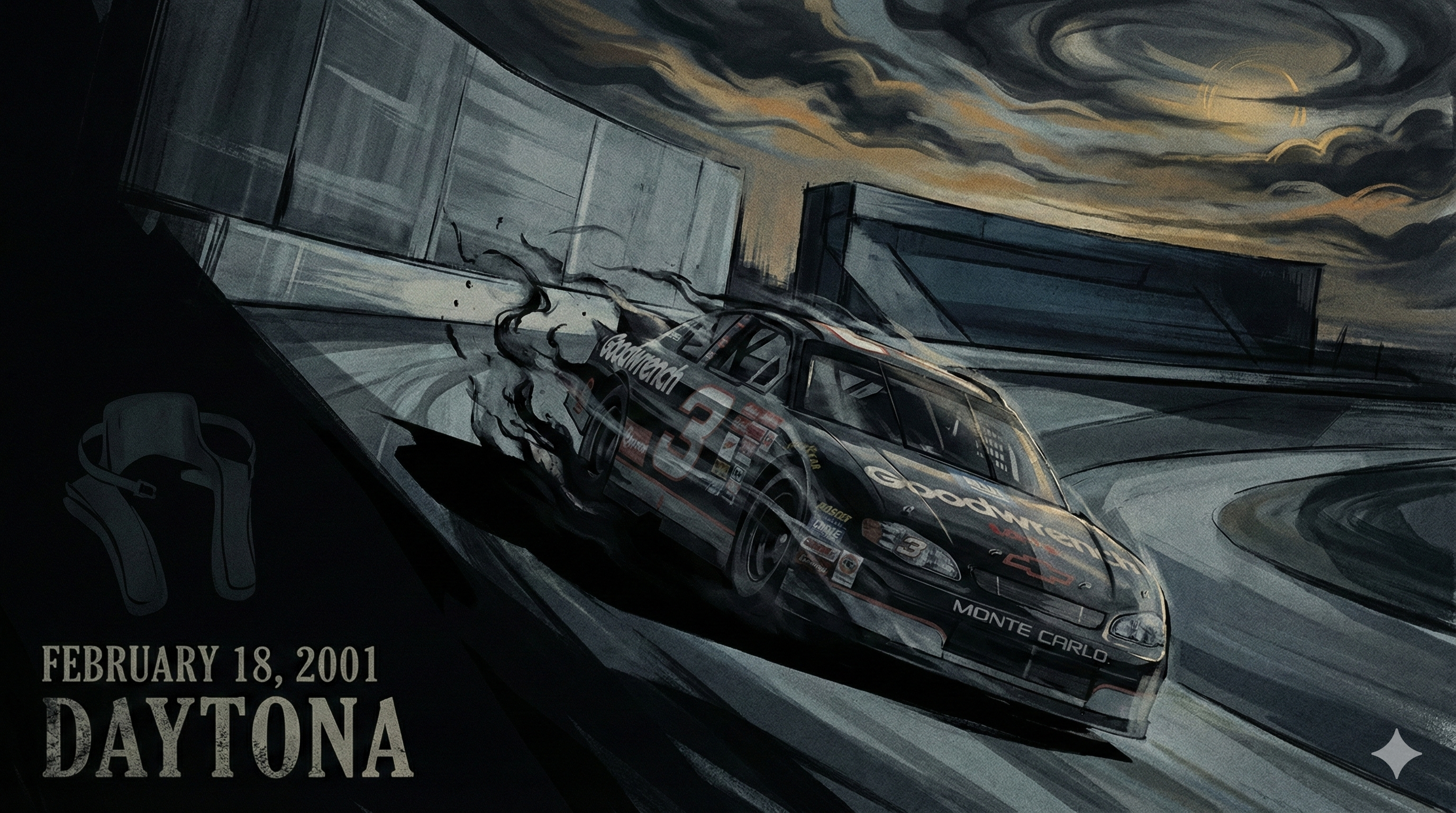
The Death of Dale Earnhardt
On February 18, 2001, legendary NASCAR driver Dale Earnhardt Sr. was killed in a last-lap crash at the Daytona 500. The seven-time champion's death at age 49 sent shockwaves through motorsports and led to sweeping safety reforms including mandatory HANS devices and SAFER barriers. The man who embodied NASCAR's resistance to safety equipment became the catalyst that transformed the sport forever.
Executive Summary
Dale Earnhardt's death at the 2001 Daytona 500 represents one of the clearest examples in modern sports of how resistance to change creates the conditions for revolutionary change. All four lenses converge on a central insight: Earnhardt's cultural authority, which allowed him to resist safety equipment and influence others to do the same, made his death the catalyst for precisely the safety revolution he had opposed. Game theory shows this as equilibrium shift; Machiavelli shows it as the limits of cultural power against physical reality; Taoism shows it as reversal at extremes; corporate analysis shows it as risk miscalculation forcing institutional pivot. The tragedy was preventable—HANS devices existed and would have saved Earnhardt. But the prevention required overcoming collective action problems that Earnhardt himself had created. His death solved those problems by removing the cultural obstacle and providing undeniable proof of the technology's value. Since 2001, no driver has died in NASCAR's major series—a legacy that transforms Earnhardt from safety's opponent to its inadvertent champion.
Causal Analysis
Interactive graph showing how policies, actors, and events connect causally — click nodes to explore relationships
CAUSAL NETWORK
13 nodes · 15 connections
Select a node
Click any node in the graph to explore its connections and lens perspectives
Root Causes
2Critical Path
7 stepsLens Analyses
Each lens provides a unique analytical framework — click to expand for deep analysis
Game Theory
Western Moderngame-theoryEarnhardt's death resolved a classic collective action problem: safety equipment was individually costly (discomfort, image) but collectively beneficial (lives saved). Without a mandate, drivers were trapped in a low-safety equilibrium where no one wanted to be the first to adopt 'wimpy' equipment. Earnhardt's cultural authority made his resistance the default behavior. Only his death—the death of safety's most prominent opponent—created the conditions for NASCAR to mandate equipment without facing driver rebellion. The game-theoretic lesson is that cultural coordination problems sometimes require catastrophic focal events to shift equilibria.
Machiavelli
Greco-Roman & ClassicalmachiavelliEarnhardt was the Prince of NASCAR's feudal kingdom—not the formal ruler, but the most powerful figure whose actions set norms for others. His resistance to safety equipment wasn't mere stubbornness; it was an expression of the identity that made him valuable. The 'Intimidator' couldn't be seen in protective gear that implied vulnerability. This created a Machiavellian paradox: Earnhardt's power to resist safety ultimately demonstrated the limits of cultural power against physical reality. His death revealed that charisma cannot defeat physics. NASCAR, as the formal ruler, had abdicated responsibility to its most powerful subject—and paid the price when that subject's immunity to rules proved not to extend to immunity to injury. The lesson for institutions: delegating safety to cultural consensus, especially when that consensus is shaped by figures whose identity requires risk, is abdicating responsibility with fatal consequences.
Taoism
East AsiantaoismThe Taoist concept of reversal at extremes perfectly describes Earnhardt's death: the most resistant opponent of safety equipment became the most powerful argument for it. His death didn't just allow safety mandates—it made them inevitable. This is the Tao rebalancing: yang that reaches its extreme transforms into yin. Earnhardt's maximum resistance (yang) produced maximum adoption (yin). The harder he pushed against the flow of safety technology, the more catastrophically the flow reasserted itself. There is profound irony here that the Taoist would recognize as natural: the universe tends toward balance, and extreme positions create the conditions for their own reversal. Earnhardt's legacy is not his resistance but the safety revolution that resistance ultimately produced. In trying to stop the river, he became the dam that broke and flooded the valley with precisely what he had resisted.
Corporate
Western ModerncorporateNASCAR's pre-2001 approach was corporate risk management: let drivers assume risk, avoid mandates, defer safety investments. This is rational if driver deaths are 'acceptable losses'—a calculation that works until a death becomes unacceptable. Earnhardt was the threshold. His death threatened sponsors, invited regulation, and risked making NASCAR synonymous with death rather than excitement. The subsequent safety revolution should be understood as corporate survival, not just ethical awakening. NASCAR's R&D center, HANS mandate, and SAFER barriers were investments in the brand's viability. The fact that they also saved lives was a happy alignment of ethics and business. The lesson for corporations: safety investments that seem expensive become cheap when the alternative is existential crisis. The risk of NOT investing in safety is not just deaths but business destruction.
Convergences
Where multiple lenses reach similar conclusions — suggesting robustness
Cultural authority both caused and resolved the safety crisis
All three lenses identify Earnhardt's influence as the key variable. Game theory shows his behavior set the equilibrium; Machiavelli shows his soft power exceeded NASCAR's willingness to mandate; Taoism shows his resistance at extreme created conditions for reversal. His death removed the obstacle his life had created.
Institutional inaction was rational until catastrophic failure
All three lenses explain why NASCAR didn't mandate HANS before Earnhardt: game theory shows coordination problem with no enforcement mechanism; corporate shows cost-benefit calculation valuing driver relations over safety investment; Machiavelli shows France deferring to Earnhardt's power. The death changed the calculation by making inaction more costly than action.
Reversal at extremes is a recurrent pattern
Both lenses identify the irony that maximum resistance produced maximum adoption. Taoism sees this as natural rebalancing; Machiavelli sees it as the limits of cultural power against physical reality. The most anti-safety figure became safety's most powerful argument.
Productive Tensions
Where lenses disagree — revealing complexity worth examining
Possible Futures
Scenarios derived from lens analyses — what might unfold based on different frameworks
NASCAR's safety culture becomes permanent model for other sports
Likely in short term; less certain as memories fade
New danger vectors create pressure to return to 'voluntary' safety
Possible in long term
Key Questions
Questions that remain open after analysis — for continued inquiry
- ?What internal discussions occurred at NASCAR about HANS mandates before 2001?
- ?How did insurance/liability considerations factor into NASCAR's decisions?
- ?What role did other resistant drivers play beyond Earnhardt?
Fact Check Details
Fact Check Results
verifiedMeta Observations
All lenses struggle with the contingency of the event. Earnhardt's death in that particular crash was not inevitable—he could have survived, as many similar crashes are survivable. The analysis of systemic factors should not obscure that the specific outcome was one possibility among many, and the causal chain from death to safety revolution was not guaranteed.
The interaction of individual psychology (Earnhardt's self-image), organizational dynamics (NASCAR's deference), cultural forces (machismo in racing), technological availability (HANS existed), and physical accident (the specific crash geometry) cannot be reduced to any single explanation. All lenses illuminate part of the elephant.
We should be humble about claims of necessity or inevitability. The safety revolution could have happened differently—through congressional intervention, accumulated lesser deaths, or individual drivers shifting norms. That it happened through Earnhardt's death is historically contingent, not cosmically ordained.
Find Your Perspective
Different frameworks resonate with different readers — find your entry point
Those who see institutions and individuals as rational actors responding to incentives, and who focus on structural/systemic explanations
The equilibrium could only shift when incentives changed; Earnhardt's death changed the payoffs for everyone
Those who see patterns of reversal and balance in events, and who focus on irony and natural tendencies
Maximum resistance creates maximum reversal; the opponent of safety became safety's champion
Those who focus on power dynamics and organizational behavior
NASCAR deferred to its most powerful figure; the death gave cover for mandates that power dynamics had prevented
Those who question stated motivations and look for underlying interests
Earnhardt's 'comfort' concerns may have been identity concerns; NASCAR's 'safety' concerns may have been survival concerns
Those in the analytical cluster should consider the identity and cultural factors emphasized by Machiavelli lens; those in the intuitive cluster should consider the concrete incentive structures that Taoism abstracts away; those in the skeptical cluster should consider that even cynical motivations produced genuinely good outcomes.
Related Analyses
Other events analyzed through similar lenses or categories
The emergence of SARS-CoV-2 in late 2019, its global spread, varying governmental responses, vaccine development and distribution, economic impacts, and resulting societal changes.
The collapse of Lehman Brothers in September 2008 triggered a worldwide economic recession. Originating from the US subprime mortgage market, the crisis spread through interconnected global financial systems, destroying trillions in wealth and reshaping economic policy for a generation.
The 1995 Rugby World Cup Final at Ellis Park, Johannesburg on June 24, 1995, where Nelson Mandela wore a Springbok jersey to present the Webb Ellis Cup to captain Francois Pienaar after South Africa's 15-12 victory over New Zealand. This event—South Africa's first major international sporting event after apartheid—became one of history's most powerful symbols of reconciliation, transforming the Springbok from a hated emblem of white oppression into a unifying national symbol virtually overnight.
How This Was Analyzed
Full transparency about the analysis process, tools, and limitations
Crosslight Engine
v0.3.0 "Causality"- ⚠Causal attribution is inherently interpretive — graphs represent analysis, not ground truth
- ⚠Actor discovery limited by available public information and source accessibility
- ⚠Lobbying data availability varies significantly by jurisdiction
Analysis Statistics
Methodology
This analysis was produced by the Crosslight multi-agent pipeline: a Research Agent gathered and verified facts from multiple sources, specialized Lens Agents applied distinct analytical frameworks, a Synthesis Agent integrated insights and identified patterns, and a Fact-Check Agent verified claims. Each lens perspective is the AI's interpretation — not institutional endorsement.Learn more →