
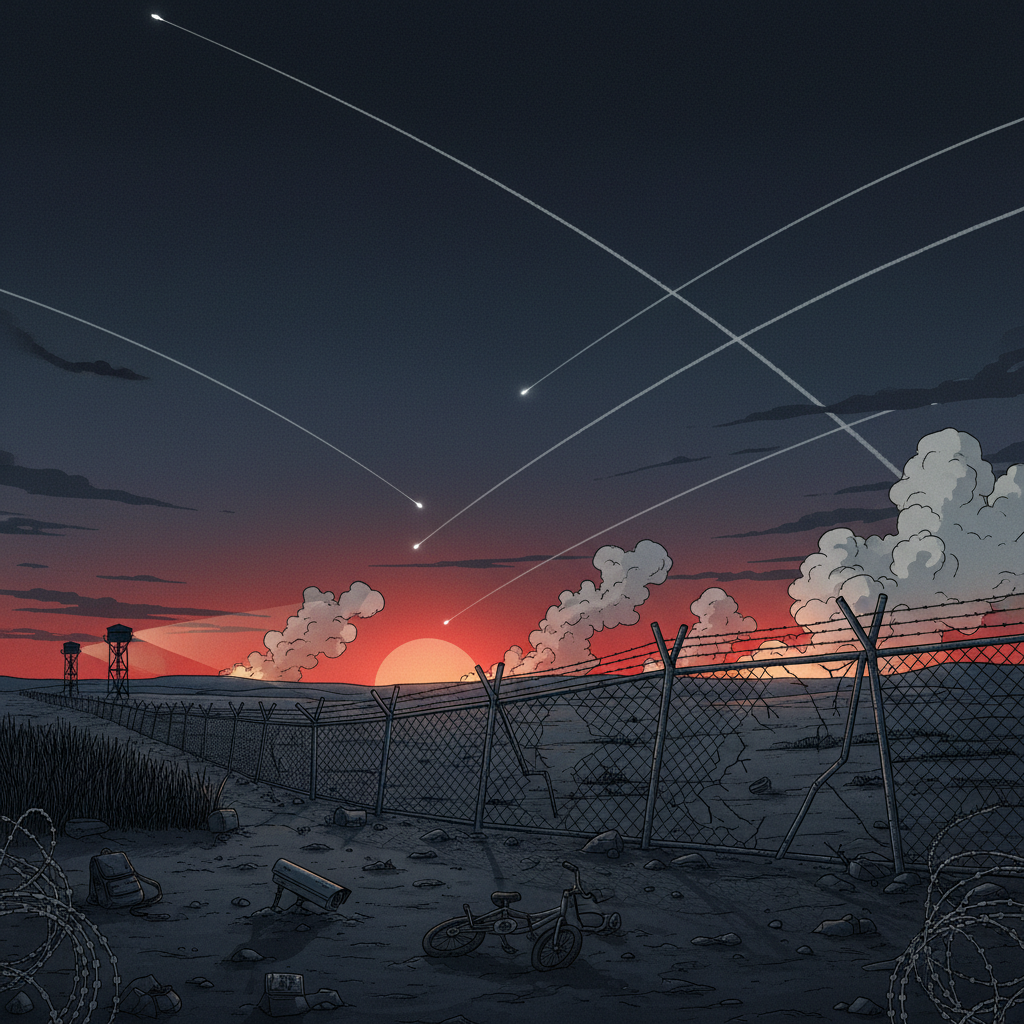
October 7 Hamas Attack
On October 7, 2023, Hamas launched a surprise multi-front assault on southern Israel from the Gaza Strip, killing approximately 1,200 people and taking over 250 hostages. The attack triggered Israel's largest military operation in Gaza since 1948, a broader regional escalation involving Hezbollah and Iran, and ultimately contributed to the US-Israel strikes on Iran in February-March 2026. The event represents a catalyst whose causal chain extends from the immediate attack through the Gaza war, regional proxy conflict, and into the reshaping of the Middle Eastern security architecture.
Executive Summary
Seven lenses converge on a central finding: October 7 was a catalyst event whose consequences far exceeded the intentions of any single actor, triggering an escalation chain that reshaped the Middle Eastern security architecture. Intelligence lenses (regional-intelligence, CIA) identify a systemic analytical failure rooted in technological hubris. The proxy-warfare lens reveals how Hamas's autonomous action within Iran's proxy framework ultimately destroyed the very proxy doctrine it exemplified. Civilian-impact documents a humanitarian catastrophe of historic proportions on both sides, with radically asymmetric scale. Game-theory exposes the escalation trap where each player's rational response drove the system toward collective catastrophe. Machiavelli strips away stated justifications to reveal the gap between declared and actual objectives for all parties. Nietzsche diagnoses the psychological dynamics of ressentiment and will to power that underpin the conflict's intensity. Together, these perspectives reveal October 7 not as an isolated attack but as the moment when decades of unresolved tension, strategic miscalculation, and human suffering converged into a rupture whose consequences -- extending through Gaza's destruction, Hezbollah's degradation, and the US-Iran 2026 strikes -- continue to unfold.
Key Facts
Verified facts from multi-source research, scored by confidence level
Hamas launched Operation Al-Aqsa Flood on October 7, 2023, breaching the Gaza-Israel barrier at multiple points with approximately 3,000 militants.
high confidenceApproximately 1,200 people were killed in Israel on October 7, including 364 at the Nova music festival, approximately 695 Israeli civilians, 373 security forces, and 71 foreign nationals.
high confidenceOver 250 hostages were taken to Gaza, including Israeli soldiers, civilians, and foreign nationals.
high confidenceIsrael launched Operation Swords of Iron on October 8, 2023, beginning an intensive aerial bombardment campaign followed by a ground invasion of northern Gaza on October 27.
high confidenceThe ICC issued arrest warrants for Israeli PM Netanyahu and Hamas leader Yahya Sinwar (and others) for alleged war crimes and crimes against humanity.
high confidenceThe ICJ ordered provisional measures in South Africa's genocide case against Israel, ruling that Palestinians in Gaza have plausible rights under the Genocide Convention that needed protection.
high confidenceHezbollah began cross-border attacks on Israel on October 8, 2023, opening a second front in solidarity with Hamas, escalating to a full-scale conflict by late 2024.
high confidenceKey Actors
Major actors involved in this event with their actions and stated interests
Hamas (Izz ad-Din al-Qassam Brigades)
organization- ›Launched coordinated multi-front assault on southern Israel
- ›Breached Gaza-Israel barrier at 30+ points
- ›Attacked military bases, kibbutzim, and Nova music festival
Israel (Government and IDF)
state- ›Declared war and mobilized 360,000 reservists
- ›Launched Operation Swords of Iron air campaign
- ›Imposed total siege on Gaza (fuel, electricity, water, food)
Iran / IRGC
state- ›Provided long-term strategic and financial support to Hamas
- ›Supplied weapons technology and training through IRGC Quds Force
- ›Coordinated Axis of Resistance response across multiple fronts
Hezbollah
organization- ›Opened second front with cross-border attacks on northern Israel
- ›Launched rockets and anti-tank missiles at Israeli positions
- ›Escalated to major conflict by late 2024
United States
state- ›Deployed two carrier strike groups to Eastern Mediterranean
- ›Provided emergency military aid packages to Israel
- ›Vetoed multiple UN Security Council ceasefire resolutions
Research & Sources
Event Timeline
2023-10-07 to ongoing (2026-03-15)
Causal Analysis
Interactive graph showing how policies, actors, and events connect causally — click nodes to explore relationships
CAUSAL NETWORK
17 nodes · 16 connections
Select a node
Click any node in the graph to explore its connections and lens perspectives
Root Causes
4Critical Path
9 stepsLens Analyses
Each lens provides a unique analytical framework — click to expand for deep analysis
Regional Intelligence Perspective
regional-intelligenceOctober 7 represents a textbook case of intelligence failure driven by analytical hubris -- the belief that technological superiority and economic leverage had permanently deterred Hamas. The failure was not primarily one of collection (indicators existed) but of analysis and institutional culture, where a dominant framework became unfalsifiable. The most significant intelligence lesson is that a disciplined adversary willing to accept the costs of low-tech communication can defeat the world's most sophisticated SIGINT apparatus.
Proxy Warfare & Non-State Actor Doctrine
proxy-warfareOctober 7 exposed the central paradox of proxy warfare: proxies are valued for their operational autonomy and deniability, but that same autonomy means they can drag their patron into conflicts the proxy strategy was designed to prevent. Iran built the most sophisticated state-sponsored proxy network in modern history, only to see it become the mechanism through which Iran was drawn into direct military confrontation with the US and Israel -- the very outcome four decades of proxy doctrine was designed to avoid.
Civilian Population Impact Analysis
civilian-impactThe civilian impact of October 7 and the subsequent Gaza operation is characterized by radical asymmetry in scale alongside shared human suffering. While October 7 inflicted devastating, concentrated violence on Israeli communities in a single day, the sustained military operation in Gaza has produced civilian casualties, displacement, and infrastructure destruction at a scale that multiple UN agencies describe as unprecedented in modern conflict. The population-level data -- regardless of which source's figures one accepts -- describes a humanitarian catastrophe whose demographic, psychological, and economic consequences will shape the region for a generation.
CIA Strategic Intelligence Assessment
Western InstitutionalciaFrom a US strategic intelligence perspective, October 7 triggered the most consequential unplanned escalation chain since 9/11. The CIA's analytical frameworks correctly identified the escalation dynamics -- proxy degradation leading to nuclear hedging leading to preventive strikes -- but the political environment constrained the policy options for interrupting this chain. The key intelligence lesson is that a single dramatic event can collapse carefully constructed strategic frameworks (normalization, containment) faster than they can be rebuilt.
Game Theory Analysis
Western Moderngame-theoryGame theory reveals October 7 as a rational (if catastrophic) move within Hamas's strategic calculus: the pre-existing equilibrium was deteriorating for Palestinian interests, Israel's deterrence model had created exploitable overconfidence, and the expected payoff of dramatic disruption exceeded continued marginalization. The resulting escalation trap -- where each player's rational response to the previous move drives the system toward collective catastrophe -- demonstrates why the most dangerous moments in international security arise when multiple players simultaneously face commitment traps that foreclose de-escalation.
Machiavellian Power Analysis
Greco-Roman & ClassicalmachiavelliThrough a Machiavellian lens, October 7 reveals a conflict where every major actor's stated goals diverge significantly from their inferred real goals, and where the weakest actor's willingness to pay the highest price gave it disproportionate power to reshape the strategic landscape. Hamas traded its physical capacity for strategic disruption; Israel traded international legitimacy for military dominance; Iran traded its proxy network for nuclear leverage; the US traded diplomatic credibility for alliance maintenance. The Prince would observe that all parties achieved something, but none achieved what they claimed to want.
Nietzschean Will to Power Analysis
Western ModernnietzscheThrough Nietzsche's lens, October 7 reveals a conflict driven not by rational strategic calculation but by the collision of competing expressions of will to power -- Hamas's ressentiment erupting as destructive nihilism, Israel's master morality reasserting dominance through overwhelming force, and both sides trapped in what Nietzsche would diagnose as reactive rather than creative expressions of will. The tragedy is that no party in this conflict is exercising will to power in its highest form -- the creation of new values and possibilities. All are destroying, negating, reacting. The abyss has consumed every party that gazed into it.
Convergences
Where multiple lenses reach similar conclusions — suggesting robustness
Intelligence failure rooted in systemic analytical hubris, not collection gaps
All three lenses agree that October 7's intelligence failure was primarily analytical rather than collection-based. Warning indicators existed but were filtered through institutional frameworks that had concluded Hamas was deterred. The regional-intelligence lens traces this to the 1973 'conceptzia' pattern recurring; the CIA lens identifies a broader failure of the US-Israeli intelligence partnership; game-theory shows how Israel's false model of Hamas's preferences created exploitable strategic overconfidence.
The escalation chain from October 7 to US-Iran strikes was structurally predictable even if not inevitable
Four lenses converge on the assessment that the escalation from proxy attack through proxy network destruction to direct state confrontation follows a recognizable structural pattern. Proxy-warfare identifies the fundamental paradox of proxy doctrine (proxies can drag patrons into unwanted confrontation); CIA traces the strategic logic from deterrence degradation to nuclear hedging to preventive strikes; game-theory models the commitment traps that foreclosed de-escalation; Machiavelli identifies how each actor's pursuit of stated goals (which concealed real goals) drove escalation.
All actors' stated goals diverge significantly from their inferred real goals
Machiavelli and game-theory both identify systematic gaps between declared and actual objectives for all parties. Hamas claimed liberation but sought Abraham Accords disruption and strategic repositioning. Israel claimed hostage rescue but prioritized deterrence restoration and regime survival. Iran claimed Palestinian solidarity but pursued proxy network maintenance and nuclear leverage. The US claimed stability but prioritized alliance credibility and Iran containment.
The weakest actor's willingness to accept maximum costs gave it disproportionate strategic agency
Game-theory identifies Hamas's asymmetric payoff structure (strategic repositioning worth catastrophic military losses); Machiavelli notes that willingness to pay the highest price inverted conventional power dynamics; Nietzsche frames this as the explosive discharge of ressentiment that temporarily reversed the master-slave dynamic. All three recognize that Hamas's acceptance of devastating consequences for Gaza enabled strategic outcomes that a conventionally rational actor would not have pursued.
Productive Tensions
Where lenses disagree — revealing complexity worth examining
Possible Futures
Scenarios derived from lens analyses — what might unfold based on different frameworks
Managed Post-Conflict Equilibrium
Low-medium probability (20-30%). Requires simultaneous progress on multiple intractable issues. Historical precedent (post-1973, post-Oslo) suggests partial progress followed by breakdown.
Frozen Conflict with Periodic Eruption
High probability (40-50%). Most consistent with historical patterns. The Israeli-Palestinian conflict has repeatedly entered periods of reduced violence without resolution, with each cycle producing greater devastation than the last.
Regional Realignment and Arab-Israeli Normalization
Medium probability (25-35%). The degradation of Iran's proxy network and the exhaustion of the conflict may create a window for normalization, but the depth of Palestinian suffering makes any deal that marginalizes Palestinian statehood politically toxic.
Continued Escalation and Regional War
Low probability (10-15%). The 2026 strikes have degraded Iran's conventional capabilities, but asymmetric retaliation (terrorism, cyber, proxy reconstitution) remains possible. Full regional war is unlikely given the military imbalance.
Key Questions
Questions that remain open after analysis — for continued inquiry
- ?What was the full extent of pre-October 7 intelligence warnings, and at what levels were they received and dismissed?
- ?What was the precise degree of Iranian foreknowledge and involvement in October 7 operational planning?
- ?What is the accurate civilian-to-combatant casualty ratio in Gaza, and can it be independently verified?
- ?What was the content of Saudi-Israeli normalization negotiations at the time of October 7?
Fact Check Details
Fact Check Results
verifiedMeta Observations
No lens adequately captures the experience of the individual human beings at the center of this conflict -- the October 7 survivors, the hostage families, the children of Gaza, the soldiers on both sides. All seven lenses analyze the conflict from above or outside; none can convey what it means to live inside it. Additionally, none adequately addresses the religious dimensions that motivate many actors -- Islamic theology, Jewish historical consciousness, messianic nationalism -- which resist secular analytical frameworks.
This conflict resists reduction to any single explanatory framework because it operates simultaneously as an intelligence failure, a proxy warfare crisis, a humanitarian catastrophe, a strategic escalation chain, a power politics game, and a psychological drama of collective trauma and will to power. Any analysis that privileges one dimension necessarily distorts the whole. The seven lenses together approach but do not achieve a complete picture.
This analysis was produced by an AI system analyzing one of the most emotionally charged, politically contested, and humanly devastating events of the 21st century. The multi-perspective framing is designed to present all major viewpoints with attribution, but no analysis of this event can be truly neutral. The reader is encouraged to notice which perspectives resonate and which provoke resistance, and to treat that response as data about their own analytical framework rather than evidence of the analysis's bias.
Find Your Perspective
Different frameworks resonate with different readers — find your entry point
Readers who approach conflict through strategic logic, institutional analysis, and rational actor frameworks. You likely focus on what actors could and should have done differently, and you evaluate outcomes against strategic objectives.
October 7 was a predictable consequence of Israeli analytical hubris and a rational (if extreme) strategic move by Hamas. The escalation chain follows recognizable patterns from intelligence failure through commitment trap to regional confrontation.
Readers who experience this conflict through its human and psychological dimensions first. You are drawn to the suffering of civilian populations and the deeper psychological forces driving the violence. You may find purely strategic analysis emotionally unsatisfying or morally insufficient.
The conflict is driven by deep psychological forces (ressentiment, will to power, collective trauma) that cannot be resolved through strategic frameworks alone. The civilian cost is the central reality that all other analyses must reckon with.
Readers who understand conflict through institutional structures, alliance dynamics, and great power competition. You focus on how organizations (intelligence agencies, proxy networks, alliances) shape and constrain individual and state behavior.
October 7 was a failure of institutional structures -- intelligence organizations, proxy management doctrines, alliance mechanisms -- that had maintained a fragile status quo for decades. The institutional framework failed because it was designed for a world that the actors had already moved beyond.
Readers skeptical of stated motivations and official narratives. You suspect that all parties are pursuing unstated objectives disguised as moral imperatives, and you evaluate claims against revealed preferences rather than declared intentions.
Every major actor's stated goals diverge from their inferred real goals. The gap between stated and actual objectives -- not the objectives themselves -- is the primary driver of the conflict's intractability.
If you find yourself strongly aligned with one cluster, deliberately engage with the opposite. If you resonate with the analytical cluster's strategic logic, the intuitive cluster's focus on civilian suffering will challenge your framework in productive ways. If the institutional perspective feels natural, the Machiavellian skepticism about stated objectives will deepen your analysis. Every perspective here captures something real and misses something important.
Related Analyses
Other events analyzed through similar lenses or categories
The Arab Spring was a revolutionary wave of protests, uprisings, and armed rebellions that swept across the Arab world beginning in December 2010. Triggered by the self-immolation of Tunisian street vendor Mohamed Bouazizi on December 17, 2010 — an act of desperation against decades of authoritarian corruption, humiliation, and youth unemployment — the movement spread with breathtaking speed across North Africa and the Middle East. The defining chant "الشعب يريد إسقاط النظام" (The people want the fall of the regime) echoed from Tunis to Cairo to Benghazi to Damascus. Tunisia's Ben Ali fled after 23 years (January 14, 2011); Egypt's Mubarak fell after 30 years in just 18 days (February 11, 2011); Libya's Gaddafi was overthrown and killed after NATO intervention (October 2011); Syria's Assad chose brutal suppression, igniting a civil war that killed over 500,000 and displaced 13 million. The military's choice — to side with protesters or stay loyal to the regime — proved the decisive variable in every country. Al Jazeera's satellite broadcasts and social media amplified the contagion, but the underlying causes were structural: decades of stagnation, corruption, and humiliation across a generation with no economic prospects. Western media characterized this as a democratic awakening; Gulf monarchies framed it as foreign-backed destabilization; authoritarian regimes described it as terrorist infiltration; participants called it ثورة الكرامة — the Dignity Revolution. A decade later, only Tunisia achieved democratic transition. Egypt reverted to military rule. Libya collapsed into a failed state. Syria became the century's worst humanitarian catastrophe, birthing ISIS and triggering the European refugee crisis. The Arab Spring remains the most consequential geopolitical event of the 2010s — a story of extraordinary courage, tragic outcomes, and the enduring question of whether revolution can deliver the dignity it promises.
Between April 6 and July 18, 1994, approximately 800,000 Tutsi and moderate Hutu were systematically murdered in Rwanda over the course of 100 days — the most efficient mass killing in modern history, with a faster per-day death rate than the Holocaust. The genocide was not the eruption of 'ancient tribal hatreds' but the culmination of a colonial project: Belgian administrators had manufactured rigid racial categories from fluid social identities through the 1933 census and mandatory ethnic identity cards, creating the very Hutu-Tutsi divide that political elites later weaponized. The Habyarimana regime's akazu inner circle, facing military pressure from the Rwandan Patriotic Front and the power-sharing demands of the Arusha Accords, chose genocide as a political survival strategy. RTLM radio — 'Radio Machete' — systematically conditioned the population through years of dehumanizing propaganda, calling Tutsis 'inyenzi' (cockroaches) before broadcasting explicit kill instructions and victim locations during the genocide itself. Between 250,000 and 500,000 women were raped as a deliberate weapon of genocide, with the ICTR's landmark Akayesu judgment recognizing rape as an act of genocide for the first time in international law. The international community's failure was not passive but active: UN force commander Roméo Dallaire sent his 'genocide fax' warning three months before the killing began, requested 5,000 troops, and was denied. The UN Security Council reduced UNAMIR from 2,500 to 270 soldiers during the genocide. The United States deliberately avoided using the word 'genocide' to circumvent legal obligations to intervene. The RPF's military victory ended the genocide in July 1994, but the aftermath cascaded into the First Congo War (1996-97) and 'Africa's World War' that killed over 5 million people.
On April 26, 1986, at 01:23 AM, Reactor No. 4 at the Chernobyl Nuclear Power Plant in the Ukrainian SSR exploded during a safety test, releasing 400 times more radioactive material than the Hiroshima bomb. The explosion and subsequent fire sent a plume of radioactive fallout across much of the western USSR and Europe. Soviet authorities initially concealed the disaster, forcing Pripyat’s 49,000 residents to continue normal life for 36 hours before evacuation. Some 600,000 ‘liquidators’ were eventually deployed to contain the catastrophe — including the ‘bio-robots,’ human volunteers who replaced failed machines to shovel radioactive graphite from the roof in 90-second shifts, each receiving a lifetime’s radiation dose. The official Soviet death toll of 31 remains contested; estimates range from the WHO’s 4,000 to Greenpeace’s 93,000 excess cancer deaths. The disaster shattered the myth of Soviet technological supremacy, forced Gorbachev’s hand on glasnost, and — in Gorbachev’s own later assessment — was ‘perhaps the real cause of the collapse of the Soviet Union’ more than any policy or reform. The 2,600-square-kilometer Exclusion Zone remains uninhabitable, a permanent scar on Ukrainian territory where Moscow’s decisions played out at Ukraine’s expense.
How This Was Analyzed
Full transparency about the analysis process, tools, and limitations
Crosslight Engine
v0.4.0 "Global Lens Expansion"- ⚠Non-Western philosophical lenses rely on translated primary texts — nuance may be lost in translation
- ⚠Some traditions (e.g., Maat, Ubuntu) have limited surviving primary texts; analysis draws on scholarly reconstruction
- ⚠Cross-cultural lens application is inherently interpretive — a Confucian reading of a Western event is an analytical exercise, not a claim of cultural authority
Analysis Statistics
Methodology
This analysis was produced by the Crosslight multi-agent pipeline: a Research Agent gathered and verified facts from multiple sources, specialized Lens Agents applied distinct analytical frameworks, a Synthesis Agent integrated insights and identified patterns, and a Fact-Check Agent verified claims. Each lens perspective is the AI's interpretation — not institutional endorsement.Learn more →